

Removals in the UK are priced by volume, distance and access rather than by the hour for anything larger than a studio.
Data from reallymoving published by the HomeOwners Alliance in January 2026 puts the average cost at £432 for a one bedroom property, £603 for two bedrooms, £867 for three bedrooms, £1,196 for four and £1,590 for five. A move of more than 100 miles costs considerably more: £800 to £1,200 for one or two bedrooms and around £2,000 for a four bedroom house, including VAT. Full packing for a three bedroom house adds roughly £400 to £500.
Three things separate a reliable removal company from an informal operator: written Goods in Transit insurance with a stated per item limit, registration as a waste carrier if anything is being taken away, and a fixed written quote produced after the firm has assessed volume, floors and parking at both addresses. Trade accreditation through the British Association of Removers adds an annual external audit, a Chartered Trading Standards Institute code of practice and protection for prepayments. This guide covers 2026 costs by property size, how to compare quotes fairly, the accreditations that mean something, and how to run completion day when the keys are late. It is written for a move anywhere in the UK, with the London specifics handled separately by EUROBR’s house and flat removals service.
How do removals services work in the UK?
A UK removal company sells one of three things: transport only, transport with packing, or a managed move that includes packing, dismantling, transport, reassembly and disposal. The quote structure follows the service level, and the price is normally fixed after a survey rather than charged by the hour.
The sequence on a standard residential job is consistent across the country. The firm surveys the property, either in person or by a detailed room by room list, and issues a fixed price. Materials are delivered ahead of the move if packing is included. On the day, the crew protects floors and doorways, dismantles what needs dismantling, loads in a planned order, drives the route, and unloads room by room against the inventory. A managed move adds reassembly and the removal of packing waste afterwards.
What separates the British market from many others is the completion day problem. In a purchase, the keys to the new property are released only when funds transfer, which can happen at any point during the working day. Removal firms in the UK price and plan around that uncertainty, which is why an experienced firm will ask about your solicitor’s likely completion window before quoting.
Man with a van or a full removal company: which does what
A man with a van moves a load that fits in one vehicle, with a crew of one or two, and does not usually include packing or dismantling. A full removal company sends a larger vehicle and a crew of three or more, and takes contractual responsibility for protecting, moving and reassembling your belongings.
The dividing line normally falls between a one and a two bedroom property. Below that, a single van finishes in a morning. Above it, one van means repeat journeys, and repeat journeys on a national move are rarely cheaper than sending the right vehicle once.
| Factor | Man with a van | Full removal company |
| Typical property size | Single item to 1 bedroom | 2 bedrooms upwards |
| Crew size | 1 to 2 | 3 or more |
| Pricing | Hourly, with a minimum charge | Fixed price after survey |
| Packing | Booked separately if at all | Full, part or materials only |
| Dismantling and reassembly | Ask first, often excluded | Standard |
| Long distance suitability | Poor above one bedroom | Designed for it |
| Insurance scope | Goods in Transit, limits vary | Goods in Transit plus CMR for international |
The hiring mechanics of the smaller service are set out in EUROBR’s guide to man with a van hire. If the move is a single room or a single item, that is the cheaper route and this guide is more than you need.
What a full service includes: packing, dismantling and transport
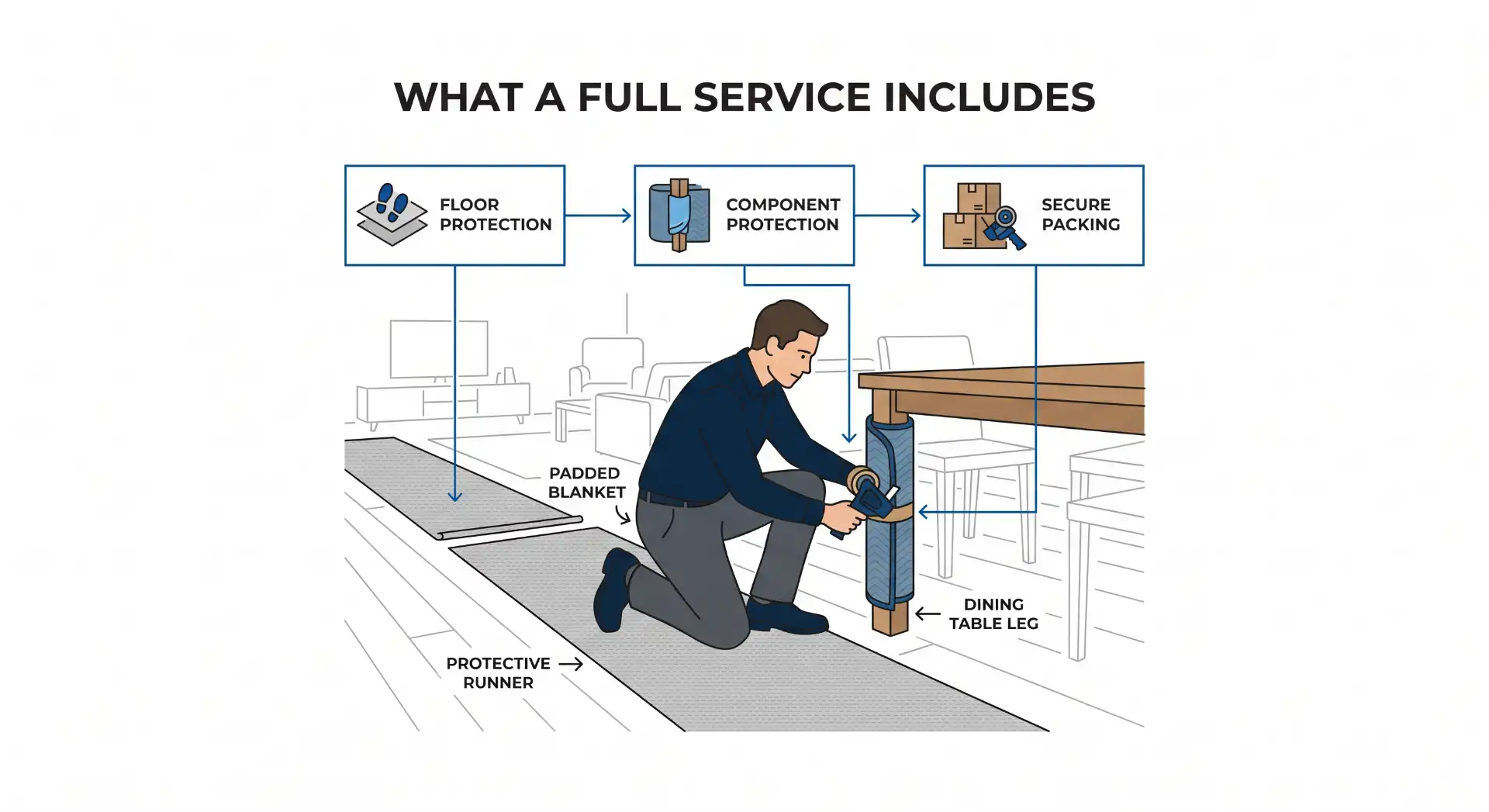
A full removals service covers materials, packing, protection, dismantling, loading, transport, unloading into named rooms, reassembly and the removal of packing waste. What is not included, unless stated, is disconnecting plumbing, gas or hardwired electrics, and moving specialist items such as pianos and safes.
The components are worth understanding separately, because they are the levers you can pull to change a quote.
- Materials. Cartons, wardrobe boxes, picture and mirror cartons, bubble wrap, paper, tape and protective covers. Standard box formats are explained in the guide to packing box sizes for moving house, which is the quickest way to estimate volume before you request quotes.
- Packing. Full packing means the crew packs everything. Part packing usually covers kitchens, fragile items and artwork only. Materials only means you pack and the firm supplies the boxes. The service itself, and what each level includes, is set out in EUROBR’s packing services and materials.
- Dismantling and reassembly. Beds, wardrobes, desks and flat pack units. EUROBR handles this through furniture assembly and delivery.
- Protection. Floor runners, door frame padding, blankets and straps inside the vehicle.
- Disposal. Old furniture and white goods taken away, which legally requires the carrier to be registered, covered further below.
How much do removal companies in the UK cost in 2026?
Budget £430 to £900 for a local move of one to three bedrooms and £800 to £2,500 for a move of more than 100 miles, before packing. Packing a three bedroom house adds roughly £400 to £500, and unpacking around £200.
Those figures come from reallymoving data published by the HomeOwners Alliance and last updated on 6 January 2026. They are national averages, so a move within central London or between two properties with difficult access will sit above them, and a move between two ground floor properties in a smaller town will sit below.
Average costs by property size
| Property size | Local move, 2026 average | Move over 100 miles, including VAT |
| 1 bedroom | £432 | £800 to £1,200 |
| 2 bedrooms | £603 | £800 to £1,200 |
| 3 bedrooms | £867 | £1,500 |
| 4 bedrooms | £1,196 | £2,000 |
| 5 bedrooms | £1,590 | £2,500 |
Source: reallymoving data from November 2025, published by the HomeOwners Alliance and updated January 2026. Packing for a three bedroom house adds £400 to £500; unpacking adds around £200.
For comparison at the smaller end, Checkatrade’s cost guide for man and van prices, updated in August 2026, gives a UK average of about £64 an hour for one operative with a van, £78 for two and £94 for three, and notes that prices are often higher in London and parts of the South East. That comparison is the useful one: two operatives at £78 an hour for six hours plus fuel is close to the fixed price of a three bedroom move that includes far more.
What changes the price: distance, volume, access and peak dates
Six factors account for almost all the variation between quotes on the same property.
- Volume. Measured in cubic metres or in carton equivalents. This is the primary driver and the one you can reduce, by decluttering before the survey rather than after.
- Distance. Over roughly 100 miles the vehicle and crew are committed for longer, and an overnight stay may be needed, which is why long distance figures jump so sharply.
- Access. Floor number, lift availability, stair width, driveway length and how far the vehicle can park from the door. Access is why two identical three bedroom houses can differ by hundreds of pounds.
- Timing. Fridays and the last working day of the month are the busiest dates in the UK because tenancies and completions cluster there. End of month Fridays in summer are the peak of the peak.
- Service level. Transport only against full packing and reassembly.
- Special items. Pianos, safes, artwork, antiques, garden machinery and anything needing a hoist. EUROBR treats piano removals as a distinct job with its own handling and cover conversation.
Housing type also shapes the job more than people expect. ONS Census 2021 data on housing in England and Wales records that 54.0 per cent of London households, 1.8 million of them, live in a flat or maisonette, against 21.7 per cent across England and Wales. A move out of a third floor flat with no lift is a different quote from a move out of a semi detached house with a driveway, and a national firm will price the two very differently.
How to request and compare removal quotes properly
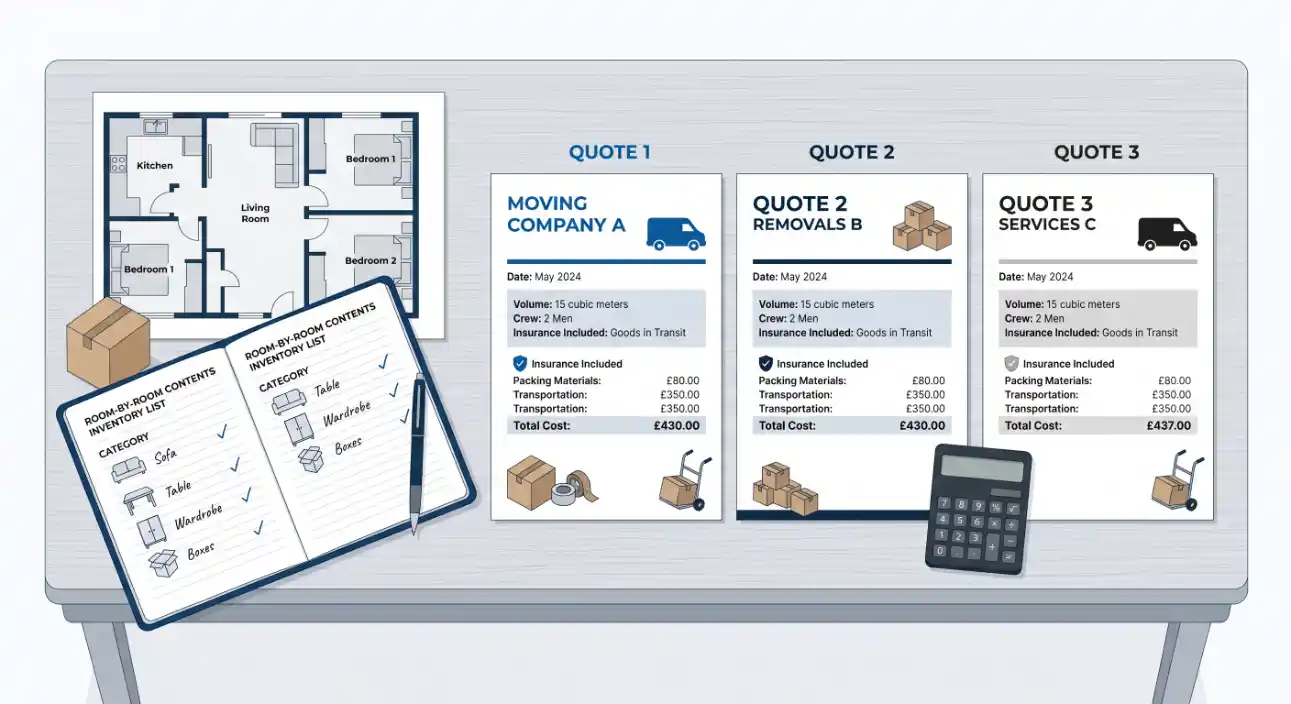
Get three written quotes, give all three firms exactly the same information, and compare them line by line rather than on the headline number. A quote that is £200 cheaper but excludes packing materials, dismantling and disposal is not cheaper.
Provide each firm with the same brief: full addresses and postcodes, floor numbers at both ends, lift availability, a room by room inventory including large furniture, whether parking can be reserved, your target date and your fallback date, and a list of anything unusual. Then compare on eight points.
| What to compare | Why it matters |
| Fixed price or estimate | An estimate can move on the day; a fixed price should not |
| Whether VAT is included | A 20 per cent difference hides in this line |
| Packing materials included | Cartons for a three bedroom house are a material cost |
| Dismantling and reassembly | Often the difference between two quotes |
| Goods in Transit limit, total and per item | Decides what a claim is worth |
| Public liability cover | Covers damage to the property itself |
| Waste carrier registration | Required if anything is taken away |
| Cancellation and date change terms | Completion dates move; find out what that costs |
EUROBR’s position on the first point is published: volume, access, floors and parking at both addresses are assessed, then a clear fixed price is given, which is why the price does not change on the day. Ask every firm you approach to commit to the same thing in writing.
How do long distance and nationwide moves differ from a local move?
A long distance UK move changes three things: the vehicle is committed for a day or more rather than hours, the crew may need an overnight stay, and the load is sometimes held in the vehicle or in storage between collection and delivery. That is why the published cost roughly doubles past 100 miles.
Practical consequences follow. Delivery may be the day after collection rather than the same afternoon, so an overnight bag and a plan for pets and children matter more. The inventory matters more too, because a longer journey with a possible overnight means more handling. Road charges apply if the route crosses a charging zone: Transport for London’s Ultra Low Emission Zone charges £12.50 a day for non compliant vehicles across all London boroughs, and the central London Congestion Charge rose to £18 a day on 2 January 2026 as reported by the RAC. Clean air zones in other English cities operate on their own schedules and should be confirmed for the specific route.
Storage between dates is the other common requirement on a long move, because completion dates at each end rarely align. EUROBR publishes storage overnight, short term and long term alongside its removals services, and short term storage between moving dates on the house and flat removals page. Confirm the duration, the security arrangements and whether insurance cover continues while goods are stored, because cover during storage is not automatic.
If the move is leaving the UK rather than crossing it, the paperwork changes entirely. Road freight into Europe runs under the CMR Convention, explained in EUROBR’s guide to CMR regulations, and the practical routes are covered by removals to Europe from the UK, including the fixed monthly road route to Portugal. Sea freight to Brazil is a separate process again, handled through removals to Brazil.
How to choose a reliable removal company and avoid scams
Check accreditation, insurance and waste carrier registration before you check reviews. Those three are verifiable from outside the company; reviews are not.
Industry accreditation: BAR and the National Guild of Removers and Storers
Accreditation matters in UK removals because the industry has no statutory licensing regime for household moves. Anyone can trade as a remover, so trade body membership is the closest thing to an external quality check.
The British Association of Removers is the principal body. Its published position is that membership is not easy to obtain and that movers must pass an extensive external audit each year to retain it. Members must follow a Chartered Trading Standards Institute Code of Practice. For UK moves and moves into or out of the UK, prepayments made to a BAR member are protected by a Payment Guarantee Scheme, and disputes that cannot be resolved directly can be referred to an independent and approved Consumer Ombudsman. Those are three separate protections and it is worth knowing which apply to your booking.
The National Guild of Removers and Storers is the other recognised body in the UK market, operating its own accreditation and complaints process. Membership of either is a positive signal. Absence of both is not proof of a problem, because many competent regional firms operate outside the trade bodies, but it does mean the burden of proof shifts to the insurance documents and the written terms.
The insurance to insist on: Goods in Transit, CMR and public liability
Goods in Transit insurance covers your belongings while they are in the mover’s care during a domestic journey. CMR insurance is the international equivalent for cross border road freight, governed by the CMR Convention. Public liability insurance is a third, separate cover: it pays for damage the crew causes to the building or injury to a third party.
“Fully insured” on its own tells you nothing. Ask four questions and get the answers in writing.
- Which covers are held, by name?
- What is the total sum insured for one load?
- What is the maximum payable for any single item?
- What is excluded?
The exclusions are where most disputes start. Standard policies commonly exclude items packed by the customer rather than the crew, along with fragile items, plants and pets. EUROBR publishes Goods in Transit and CMR cover on every move and states those exclusions openly, which is the correct industry practice. If you pack your own china and it breaks, most policies will not pay, and that is a reason to book part packing for fragile items even on a tight budget.
Warning signs when hiring a removals firm
- No written quote, or a quote with no company name, registered address or VAT position.
- A large deposit demanded by transfer to a personal account, or cash only pricing.
- A price quoted in under a minute with no questions about floors, lifts, access or parking.
- Refusal to state the Goods in Transit per item limit.
- No waste carrier registration where the job includes taking anything away. Carrying waste in England as a business without registering is an offence, and GOV.UK confirms you can get an unlimited fine if you do not register, with registration costing £191.02 and an upper tier renewal £130.25 every three years under the waste carrier registration rules. The duty of care sits with you as the waste producer as well as with the carrier, so an unregistered operator who fly tips your old sofa creates a problem for you.
- Terms that disclaim all liability for damage. That is a signal about how claims will be handled.
The most common errors customers make, and how to avoid them, are collected in the guide to mistakes when moving house.
Completion day: a practical checklist

Completion day in a UK purchase is unpredictable by design, because keys are released only when funds transfer, and that can happen at any point in the working day. Plan for a late release rather than an early one, and agree with the removal firm in advance what happens if the keys arrive after 15:00.
How far ahead should a removal company be booked?
Four to six weeks ahead for a standard move, and eight weeks for an end of month Friday in summer. Book provisionally as soon as you have an expected completion or tenancy end date, and confirm once the date is firm.
Two separate lead times run in parallel and people often manage only one. The removal firm needs notice to allocate a vehicle and crew. Parking at either address may need a council application, and in London that means about ten working days for a suspension, five for a dispensation and seven for a temporary permit, with charges from roughly £30 to £130 a day, as set out on EUROBR’s parking page. Booking the van six weeks out and the parking three days out defeats the purpose. Which? recommends using a vetted trade scheme when selecting a firm in its moving house checklist, which also covers the utility and redirection tasks that sit alongside the removals booking. EUROBR’s own moving checklist sets the sequence out week by week.
What to do if the keys are late
Agree the contingency before the day, not during it. Ask three questions when you book: how long will the crew wait at no extra charge, what is the hourly waiting rate after that, and can the load stay in the vehicle overnight or go into storage if the keys do not arrive at all.
The practical sequence on the day is:
- Load in the morning as planned, regardless of the key position.
- Keep your solicitor’s direct line and your estate agent’s mobile number to hand, not the switchboard.
- Tell the crew supervisor the moment a delay looks likely, so the route and any second drop can be replanned.
- Park the vehicle legally while waiting. The Highway Code’s rules on waiting and parking apply to a loaded removals vehicle exactly as they do to any other, and a penalty charge notice on a waiting van is an avoidable cost.
- If the keys will not arrive, move to the agreed overnight or storage plan rather than negotiating it under pressure.
A rented move is more predictable, because the tenancy end date is fixed, but the deposit is at stake instead. The timing and cleaning sequence for that situation is covered in the guide to end of tenancy removals.
What happens if something is damaged or lost?
Report it in writing as soon as you find it, keep the packaging and photograph the damage, and claim against the Goods in Transit policy within the notice period stated in the firm’s terms, which is often seven days.
Your position rests on three layers. The first is the removal firm’s own terms and insurance. The second is consumer law: Citizens Advice explains that under the Consumer Rights Act 2015 a service must be provided with reasonable care and skill, and where it is not you can ask for the service to be done again or for a price reduction, with up to six years to bring a claim in England, Wales and Northern Ireland and five in Scotland. Their guidance on how to complain about a service sets out the escalation steps. The third layer applies only to accredited firms: BAR members are subject to a Chartered Trading Standards Institute code and an independent Consumer Ombudsman where the dispute cannot be settled directly.
Prevention is more effective than any of the three. Photograph high value items before they are loaded, with the date visible. Ask for a written inventory and check it at both ends. Declare anything valuable before the move so it is priced and covered properly, rather than discovering the per item cap after a claim. And let the crew pack fragile items, because customer packed goods are the most commonly excluded category in the market.
There is also a safety dimension worth respecting. In 2024/25 the Health and Safety Executive recorded 59,219 non fatal injuries reported by employers under RIDDOR, with 17 per cent arising from handling, lifting or carrying, and its guidance on manual handling law requires employers to avoid, assess and reduce that risk. A crew that insists on two people for a wardrobe, or that refuses an unsafe stair carry, is protecting both its staff and your furniture.
Frequently asked questions about removals in the UK
How much does it cost to move house in the UK in 2026?
The average cost depends mainly on property size and distance. Data from reallymoving published by the HomeOwners Alliance and updated in January 2026 gives national averages of £432 for a one bedroom property, £603 for two bedrooms, £867 for three, £1,196 for four and £1,590 for five bedrooms on a local move. A move of more than 100 miles costs substantially more: £800 to £1,200 for one or two bedrooms, around £1,500 for three, £2,000 for four and £2,500 for five, including VAT. Full packing for a three bedroom house adds roughly £400 to £500, and unpacking around £200. Those are averages rather than quotes, and three factors push a specific job above or below them: access at both ends, the date, and how much of the work the firm does. A third floor flat with no lift on the last Friday of the month costs more than a ground floor house mid week. At the smaller end, an hourly booking may be cheaper, and the comparison is set out in the guide to man with a van hire.
Do removal companies provide boxes and packing materials?
Most UK removal companies supply materials, and there are normally three ways to buy them. Materials only means the firm delivers cartons, tape, paper and protective covers and you do the packing. Part packing means the crew packs the categories most likely to break, typically kitchens, glassware, artwork and mirrors, and you pack the rest. Full packing means the crew packs everything and, on a managed move, removes the packing waste afterwards. The cost difference is significant: full packing for a three bedroom house runs to roughly £400 to £500 on published 2026 averages. There is also an insurance reason to consider part packing at minimum, because standard Goods in Transit policies commonly exclude items the customer packed themselves, so a box of china you taped up is often outside cover while the same box packed by the crew is inside it. Standard carton formats and what fits in each are explained in the guide to packing box sizes for moving house, and the service options in packing services and materials.
Is a deposit needed to confirm a removals booking?
A deposit is common practice in UK removals, particularly for peak dates, and a request for one is not a warning sign in itself. What matters is the amount, the payment method and the terms attached. A modest deposit paid to a company account, with written cancellation and date change terms, is normal. A large deposit demanded by transfer to a personal account, or full payment in cash before the job, is not. Because completion dates in UK property transactions frequently move, the date change terms deserve as much attention as the cancellation terms: ask what happens if the date shifts by a week, and whether the deposit transfers. Accredited firms offer an extra layer here. The British Association of Removers operates a Payment Guarantee Scheme that protects prepayments made to member companies for moves within the UK and moves into or out of the UK, which means a deposit paid to a member is protected in a way that a deposit paid to an unaccredited operator is not. The wider checks to run before paying anything are set out in the guide to mistakes when moving house.
How far in advance should a removal company be booked in the UK?
Four to six weeks is the working answer for most moves, extending to eight weeks for an end of month Friday in summer, which is the busiest slot in the British calendar because tenancies and completions cluster there. Book provisionally as soon as an expected completion or tenancy end date exists, and confirm when the date firms up, since most firms will hold a provisional slot. A second lead time runs alongside the booking and is the one most often missed: parking. Where the property sits in a controlled parking zone, a council application is needed, and typical London notice periods are ten working days for a suspension, five for a dispensation and seven for a temporary permit, with daily charges ranging from about £30 to £130 depending on the borough. Applying three days before the move means arriving with nowhere legal for the vehicle to stop. Storage should be arranged on the same timeline if the two completion dates do not align. The full week by week sequence, including utilities and redirection, is in EUROBR’s moving checklist.
Do removal companies move pianos, safes and other special items?
Specialist items are usually moved, but they are quoted, staffed and insured separately, and they must be declared before the survey rather than mentioned on the day. An upright piano weighs roughly 180 to 300 kilograms and a grand piano 300 to 550 kilograms, which puts both outside what a standard two person crew can handle safely on stairs. Safes, large aquariums, garden machinery, marble tops, antiques and original artwork raise the same issues in different forms: weight, fragility, value, or all three. Two consequences follow. First, the crew needs the right equipment, which may include a piano board, a stair climber or occasionally a hoist through a window, and that has to be planned and sometimes permitted. Second, the insurance position changes, because high value single items frequently exceed the per item cap on a standard Goods in Transit policy and need to be declared and specifically covered. Undeclared valuables are the most common reason a claim pays less than the owner expected. The handling and cover considerations are set out in detail in the guide to piano removals.
What insurance should a UK removal company have?
Three covers are relevant and they do different jobs. Goods in Transit insurance covers belongings while they are in the mover’s care on a domestic journey. CMR insurance is the international equivalent for cross border road freight under the CMR Convention. Public liability insurance covers damage the crew causes to the building or injury to a third party, such as a cracked window or a scratched communal stairwell. Ask which covers are held by name, what the total sum insured is for one load, what the maximum payable is for any single item, and what is excluded. The per item limit is the figure that decides what a claim on a valuable piece is actually worth, and it is rarely volunteered. Common exclusions include items packed by the customer rather than the crew, fragile goods, plants and pets. EUROBR publishes Goods in Transit and CMR cover on every move and states those exclusions openly. The international dimension, including when CMR applies and what it does and does not cover, is explained in the guide to CMR regulations.
Can a removal company take away unwanted furniture and rubbish?
Only if it is registered as a waste carrier, and this is a legal requirement rather than a matter of service scope. Any business transporting waste in England must register with the Environment Agency. GOV.UK states that you can get an unlimited fine if you do not register, with registration costing £191.02 and an upper tier renewal £130.25 every three years. The duty of care is shared: as the person who produced the waste, you can be held responsible if an unregistered operator takes your old sofa and dumps it illegally, so the registration number should be requested and checked on the Environment Agency’s public register before anything is loaded. Registered carriers must take waste to a permitted site, and a written record of the transfer is good practice. Separate rules apply to upholstered furniture containing persistent organic pollutants and to electrical goods, both of which cannot simply go into a general skip. EUROBR is a licensed waste carrier and lists home clearance and waste removal among its services, with items going to a certified recycling centre. The costs and legal duties are covered in the guide to house clearance.
Planning your UK move: what to do next
Three actions in the right order will do more for the cost and the calm of your move than anything else. Estimate your volume honestly, using box counts and a list of large furniture rather than a room count. Get three written fixed price quotes on identical information, and compare them on the eight line items above rather than the headline figure. Confirm the insurance position in writing, including the per item limit, before you pay a deposit.
Then deal with access early. Parking applications, lift bookings and storage between completion dates all have lead times measured in working days, and they are the most common cause of a delay that costs money. In 12 years moving London and UK households, the EUROBR team finds that access arranged in advance, rather than a lower headline quote, is what separates a move that finishes on schedule from one that does not.
Planning a move anywhere in the UK? EUROBR has operated since 2013, is fully insured with Goods in Transit and CMR cover on every move, and is a licensed waste carrier registered with the Environment Agency. Get a free, no obligation quote from EUROBR’s insured team, message on WhatsApp at +44 7878 921856 or request a price online.