

End of tenancy removals in London are moves timed around a checkout inspection and a deposit return rather than around a completion date.
Two things changed in 2026: most fixed-term assured shorthold tenancies in England became periodic assured tenancies on 1 May 2026, and tenants now give two months’ written notice that can be served at any time (Shelter, 2026). Deposits must be returned within 10 days of both parties agreeing the amount, and cleaning remains the single biggest cause of deductions at 29.38% of claims in 2025 (The Deposit Protection Service, 2026). The practical consequence for a renter is that the property must be empty, clean and inspected on the same day the van leaves, which is why an end of tenancy move needs a different plan from an ordinary house move.
Introduction
End of tenancy removals in London are judged by a standard no other move faces: someone inspects the property after you have gone and decides how much of your money to give back. That changes the priorities. A homeowner moving out cares about the contents arriving safely. A renter cares about that too, but also about the flat being empty enough to clean, the carpets being clear by a fixed hour, and the inventory being signed off without an argument. This guide covers the notice rules as they stand in 2026, how to sequence the last fortnight, what removals actually cost in London, how the parking and access side works, and where deposits most often get eaten. EUROBR has been moving London renters since 2013 across Greater London and the M25.
What makes an end of tenancy move different
An end of tenancy move is a removal with a deadline set by a contract and an inspection, not by a chain. The van has to be gone early enough for cleaning and a checkout to happen the same day, and anything left behind becomes a deduction.
Three constraints define it. The first is the handover time, often midday or earlier, which compresses loading into a morning. The second is the condition standard, because an empty room still has to be clean. The third is disposal, since almost every tenancy ends with items that are not moving on and cannot simply be left on the kerb.
| Ordinary house move | End of tenancy move |
| Timed to completion and key release | Timed to a checkout appointment |
| Property condition is the buyer’s problem | Property condition determines the deposit |
| Unwanted items can leave later | Everything must go on the day |
| Flexible arrival window | Loading usually has to finish by midday |
| No third-party inspection | Inventory clerk or agent inspects after you leave |
Tenancy notice rules in London as of 2026
Most private tenancies in England now run as periodic assured tenancies, and tenants give two months’ written notice. The rules changed materially on 1 May 2026 and older guidance is no longer accurate.
Under the Renters’ Rights Act, fixed-term assured shorthold tenancies were replaced by periodic assured tenancies, existing fixed-term agreements converted automatically, and section 21 no-fault eviction notices were abolished (Shelter).
What a tenant now has to do
- Give two months’ notice in writing, unless the landlord agrees a shorter period in writing.
- Serve it at any time, because a periodic tenancy has no fixed end date to wait for.
- End the notice on the first or last day of a tenancy period, which is usually tied to the rent payment date.
- Pay rent to the end of the notice period, whether or not you have already moved out.
Citizens Advice sets out the mechanics in its guidance on ending a private tenancy, including the point that most fixed-term agreements became periodic on 1 May 2026 even where the paperwork still says fixed term.
Why this changes the moving timetable
Under the old fixed-term system, a tenant frequently knew the end date months ahead. Under a periodic tenancy the date is set by when notice is served, which means the two-month window is often the entire planning period. Booking a removals firm and applying for a parking suspension both sit inside that window, and the suspension is the tighter of the two, because councils count in working days.
How much do end of tenancy removals cost in London
A one or two-bedroom rented flat is the most common end of tenancy job in London, and it is usually priced either hourly through a man and van service or as a fixed quote for a full removal.
National moving data from November 2025 puts a one-bedroom move at £432 and a two-bedroom at £603 across the UK (HomeOwners Alliance). London quotes sit above those averages, mainly because of access, parking and higher labour costs.
The costs a renter should budget for
| Cost | What it covers | Typical timing |
| Removals | Crew, vehicle, loading, transport, unloading | Quoted 4 to 6 weeks ahead |
| Packing materials | Boxes, tape, wrap, mattress covers | 2 to 3 weeks ahead |
| Parking suspension or dispensation | Council permission for the van to stand legally | Applied for 1 to 3 weeks ahead |
| End of tenancy cleaning | Professional clean after the property is empty | Booked for the day the van leaves |
| Disposal of unwanted items | Licensed collection of furniture and waste | Same day or the day before |
| Overlap rent | Rent on both properties if dates do not align | Unavoidable in some cases |
The last row is the one renters forget. If the new tenancy starts before the old one ends, the overlap is usually cheaper than a same-day double move and it removes almost all the timing risk. If it does not, the sequencing has to be exact.
For hourly rate detail across London, the EUROBR man with a van cost guide sets out 2026 pricing, and the choice between an hourly service and a full removal is compared in the guide to choosing a man and van service in London.
Man and van or a full removal for a rented flat
For a studio or one-bedroom flat where the furniture belongs to the landlord, an hourly man and van service is usually the right answer, since the load is mostly boxes and personal items. For a two or three-bedroom rental with the tenant’s own furniture, a full removal with dismantling and reassembly included is generally faster and, once crew hours are counted, often no more expensive. Whole-property options sit under house and flat removals in London.
Protecting the deposit: where the money actually goes
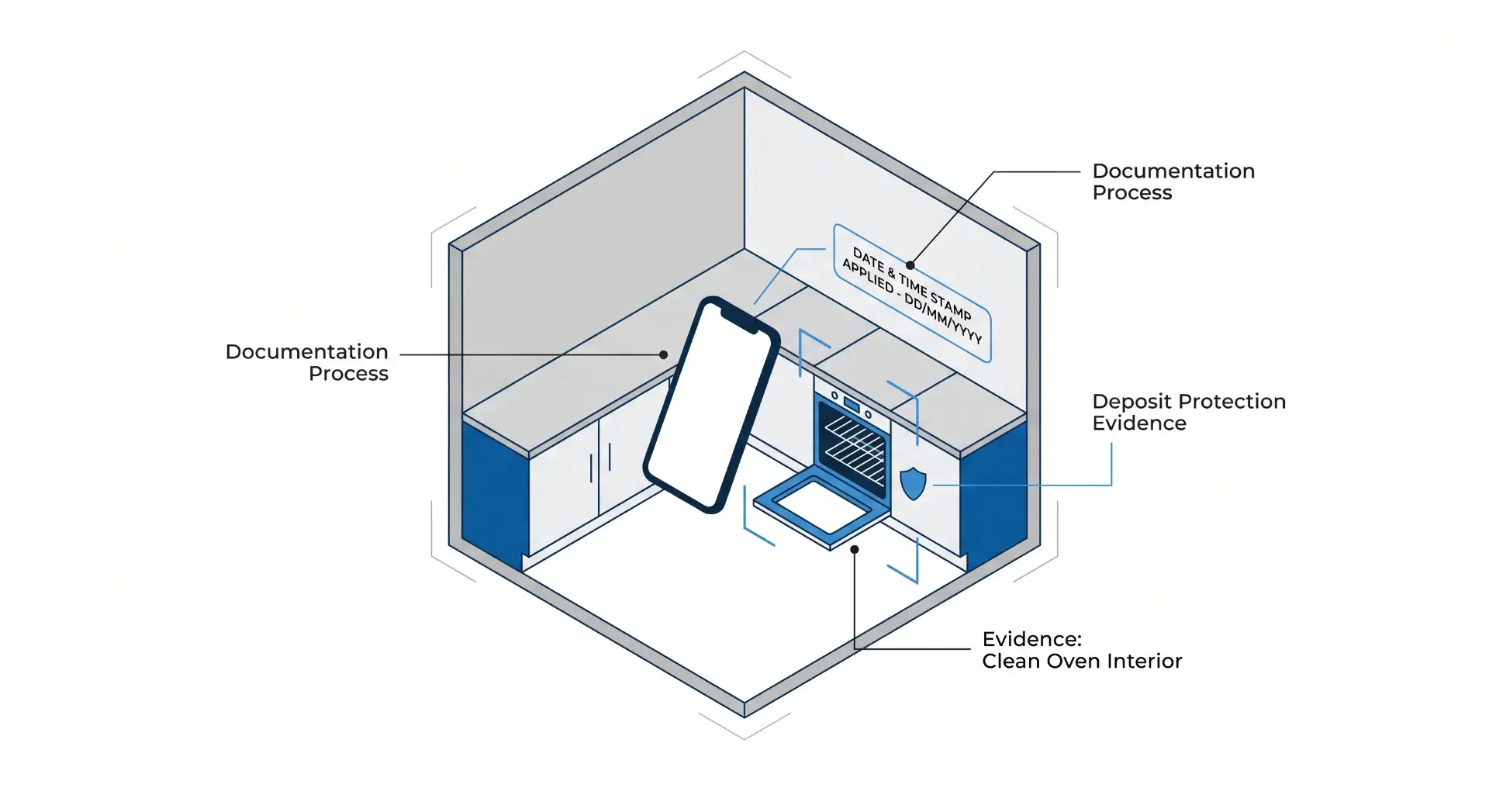
Deposit deductions are dominated by cleaning, not by dramatic damage. The most recent published breakdown of claims shows cleaning at 29.38%, damage at 18.42%, rent arrears at 16.45% and redecoration at 10.88% (The Deposit Protection Service, 2026 release covering 2025 claims).
That distribution has a clear implication for how you plan the day. Three of those four categories are affected by what happens after the van leaves, which is why booking the clean for the afternoon of the move, rather than the day before, is the single most useful scheduling decision available.
How deposit protection works
Deposits on assured tenancies must be protected in one of three government-approved schemes: the Deposit Protection Service, MyDeposits or the Tenancy Deposit Scheme. A landlord must protect the deposit within 30 days of receiving it, and must return it within 10 days of both parties agreeing how much is due (GOV.UK). Where the amount is disputed, the deposit stays protected in the scheme until the dispute is resolved.
Citizens Advice sets out the practical steps for getting your tenancy deposit back, including what to do if a landlord does not respond.
Practical steps that survive a dispute
- Photograph every room after it is empty and clean, with a timestamp, including inside cupboards, the oven and behind appliances.
- Compare against the check-in inventory rather than against your memory of how the flat looked.
- Keep receipts for professional cleaning, carpet cleaning and any repairs you arranged.
- Report damage caused during the move immediately to the removals firm, in writing, before the crew leaves.
- Note pre-existing wear in your photographs so that fair wear and tear is not recategorised as damage.
Damage caused during a removal is a separate matter from deposit deductions and is dealt with through the firm’s Goods in Transit insurance, which covers items in the crew’s care. Ask for the insurer and the cover limit in writing before booking.
Parking, access and the practical side of a London checkout
The van needs somewhere legal to stand for two to four hours on a morning when you cannot afford to lose an hour. In most of London that means applying to the council in advance.
A parking bay suspension is a temporary reservation of controlled parking bays outside an address, arranged through the local council, with notices installed on the street before the date. It matters because on most London residential streets there is nowhere legal for a removal vehicle to wait, and without one the crew either carries your belongings a long distance or the vehicle risks a penalty charge notice.
Notice periods and charges vary sharply by borough. Two examples verified on 10 August 2026:
| Borough | Permission | Minimum notice | Charge, 2026 |
| Bromley | Dispensation | 1 working day | £40 per vehicle per week |
| Bromley | Bay suspension | 3 working days | £40 per bay per day plus £30 administration fee |
| Richmond upon Thames | Dispensation | 7 working days | £30.50 administration fee plus £2.20 to £62.60 per vehicle per day by zone |
| Richmond upon Thames | Bay suspension | 7 working days | £160.80 administration fee plus £13.60 to £53.30 per bay per day by tier |
Sources: Bromley Council and Richmond Council.
Where no suspension is in place, the ordinary loading rules apply. Yellow kerb markings with upright signs restrict loading, and double yellow lines mean no waiting at any time (The Highway Code, rules 238 to 252). The EUROBR guide to parking suspension for moving in London explains the application process, and the parking page covers what EUROBR arranges on a customer’s behalf.
Vehicle charges that apply
The Ultra Low Emission Zone, or ULEZ, charges older, more polluting vehicles £12.50 a day to drive anywhere in London, 24 hours a day, every day except 25 December (Transport for London). The Congestion Charge is separate, applies in central London only, and rose to £18 a day from 2 January 2026 (Transport for London). Ask whether either is included in the quote.
Flats, lifts and communal areas
Purpose-built blocks and converted flats add their own layer. Managing agents often restrict moving hours, require lift booking, and expect communal carpets and lift interiors to be protected. Check the lease or the agent’s rules at least two weeks ahead, because a block that only permits moves between 9am and 5pm on weekdays can force a change of date. The specific challenges of flat moves are covered in the EUROBR guide to flat removals in Wimbledon, which applies broadly across London conversions.
Getting rid of what is not moving with you

Every tenancy ends with a pile that is not coming: a broken clothes airer, a mattress the new flat has no room for, half-used paint. Leaving it in the property is a deduction. Leaving it on the pavement is fly-tipping.
Any business that transports waste in England must be registered with the Environment Agency, and operating without registration carries an unlimited fine (GOV.UK). Upper tier registration costs £191.02 with a £130.25 renewal every three years as of 2026. If you pay someone to take items away and they fly-tip them, the waste can be traced back to you, which is why checking the Environment Agency public register before handing anything over is worth the minute it takes.
EUROBR holds licensed waste carrier registration with the Environment Agency, and details of its credentials sit on the about us page.
A workable disposal sequence
- Four weeks out: sort into keep, sell, donate and dispose. Selling takes the longest, so start there.
- Three weeks out: book council bulky waste collection or a licensed carrier for the dispose pile.
- Two weeks out: deliver donations to charity shops, which frequently cannot collect at short notice.
- One week out: clear the loft, the cupboard under the stairs and any communal storage, which are the three places renters forget.
- Moving day: nothing left to decide, only to load.
The last fortnight, in order
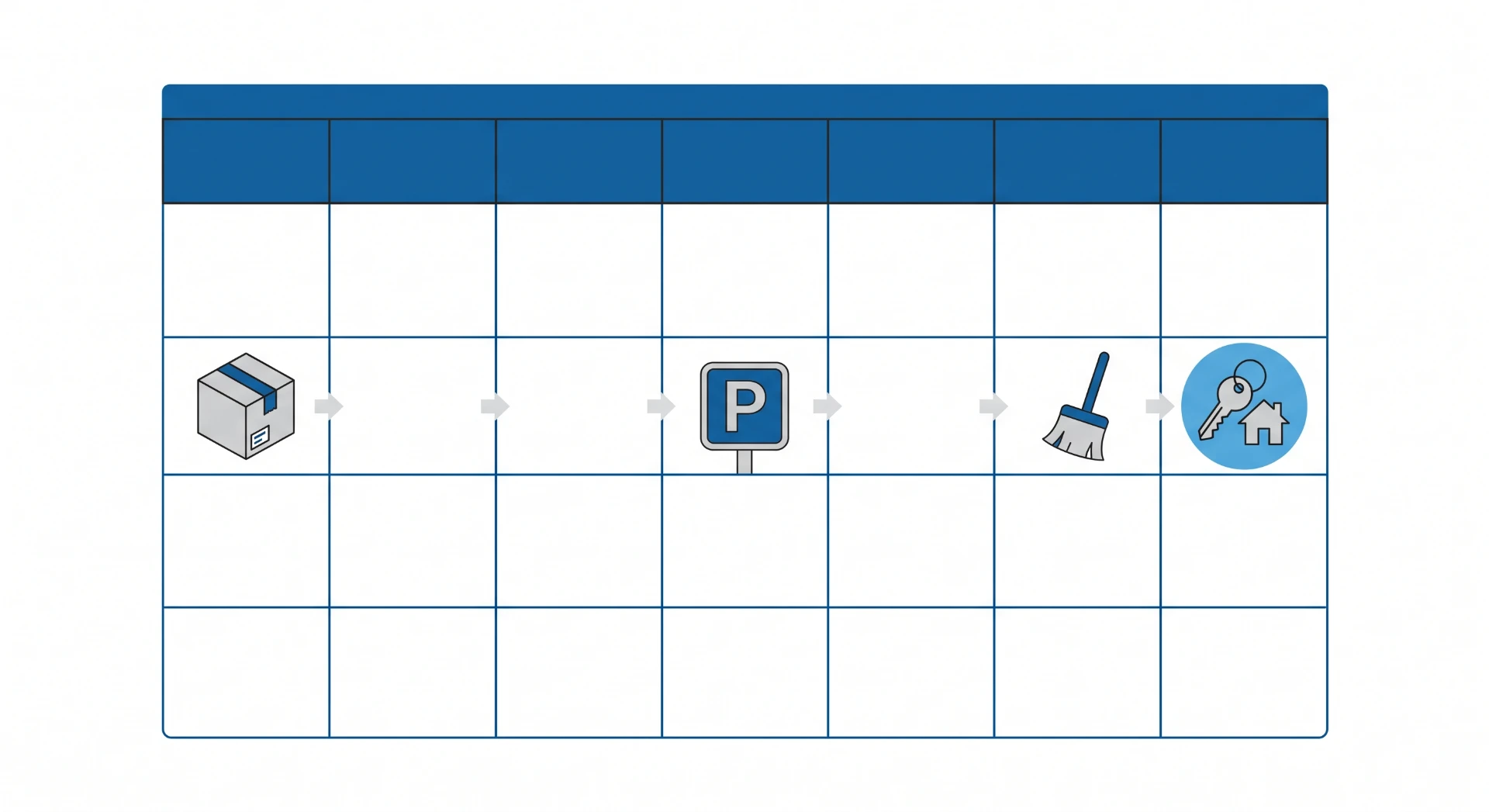
Sequencing is what separates a calm checkout from an expensive one.
| When | Action |
| 2 weeks before | Confirm the checkout appointment time in writing with the agent or landlord |
| 2 weeks before | Book the removals firm and the end of tenancy clean for the same day |
| 10 working days before | Apply for the parking suspension or dispensation at both addresses |
| 1 week before | Pack everything except essentials, label by room, photograph valuables |
| 1 week before | Arrange meter readings, redirect post, notify the council of the change of address |
| 3 days before | Confirm suspension signage, lift booking and the crew arrival window |
| Day before | Defrost the freezer, empty and clean the oven, run a final rubbish check |
| Moving day, morning | Load, then check every cupboard, the loft and behind every door |
| Moving day, afternoon | Clean, photograph the empty property, hand over keys |
The EUROBR moving checklist covers the same ground in more depth, the packing box sizes guide helps with quantities, and the guide to mistakes when moving house lists the errors that most reliably cost money. Materials are available through packing services and materials in London, and landlord-owned furniture that needs dismantling is covered by furniture assembly and delivery.
Renters leaving the UK altogether at the end of a tenancy have a different sequence again, with customs paperwork sitting alongside the checkout. Those routes are covered under removals to Europe from the UK, removals to Portugal and removals to Brazil, with a practical starting point in the guide to moving from the UK.
Frequently asked questions about end of tenancy removals in London
How much notice does a tenant have to give to end a tenancy in England?
Tenants on an assured tenancy in England give two months’ written notice, and since 1 May 2026 that notice can be served at any time rather than only towards the end of a fixed term. The change followed the Renters’ Rights Act, which converted most fixed-term assured shorthold tenancies into periodic assured tenancies automatically, including agreements whose paperwork still describes them as fixed term. Two technical requirements attach to the notice. It must be in writing, and it must expire on the first or last day of a tenancy period, which in most agreements is tied to the date rent falls due. Rent remains payable to the end of the notice period whether or not the property has been vacated, so moving out early does not shorten the liability. A shorter notice period is possible only where the landlord agrees in writing, which is worth requesting early if the moving date is fixed by a new tenancy. Because the two-month window is often the whole planning period, removals and parking permissions should be booked as soon as notice is served. A practical sequence is set out in the EUROBR moving checklist.
What are the most common reasons deposits are reduced?
Cleaning is the leading cause of deposit deductions and has been for five consecutive years, accounting for 29.38% of claims in 2025, followed by damage at 18.42%, rent arrears at 16.45% and redecoration at 10.88%, according to figures published by The Deposit Protection Service in June 2026. The pattern is consistent: most deductions come from condition rather than from serious incidents. Ovens, extractor filters, bathroom sealant, carpets, window tracks and the space behind appliances account for a large share of cleaning claims, because these are the areas a routine weekly clean does not reach. Damage claims frequently involve marks left by furniture, holes from wall fixings and scuffs on painted surfaces created during the move itself, which is one argument for loading before cleaning rather than the reverse. Fair wear and tear cannot lawfully be charged for, so the check-in inventory is the reference document in any dispute, and timestamped photographs of the empty property are the single most useful piece of evidence a tenant can hold. Independent guidance is available on getting your tenancy deposit back, and the preparation errors that most often lead to deductions are listed in the guide to mistakes when moving house.
How far in advance should end of tenancy removals be booked in London?
Four to six weeks is the practical minimum in London, and the binding constraint is usually the council rather than the removals firm. Parking permissions are counted in working days and vary widely by borough, from one working day for a dispensation in Bromley to at least seven working days for either permission in Richmond upon Thames as of 2026. Applications submitted late leave no margin for correction, and councils install suspension signage several days before the start date, which pushes the real deadline earlier than the stated notice period suggests. Demand is also uneven across the calendar. Fridays, the final working days of each month, and the July to September period are the busiest slots in the London market, so an end of tenancy date falling in any of those should be booked earlier. Where the checkout appointment time has not yet been confirmed by the agent, a provisional booking protects the date without committing to the parking application. Borough-specific notice periods and charges are explained in the guide to parking suspension for moving in London.
Should the property be cleaned before or after the removal?
Cleaning after the property is empty produces a better result and a lower risk of deduction, which is why professional end of tenancy cleans are normally booked for the afternoon of the moving day rather than the day before. The reason is mechanical: furniture and boxes conceal skirting boards, carpet edges, wall marks and floor damage, and a clean carried out around them leaves exactly the areas an inventory clerk checks first. Loading also generates its own marks, since carrying wardrobes and sofas through a hallway scuffs paintwork and drags dirt across floors that were cleaned hours earlier. The practical sequence is therefore to load in the morning, clean in the early afternoon, photograph the empty property with timestamps, and hand over keys last. This requires the removal to finish early, which in turn depends on packing being complete before the crew arrives and on a legal parking position being available. Where the checkout appointment is fixed for the morning, the alternative is to move the day before and hold overlap rent for 24 hours. Materials and packing options that shorten the loading window are described under packing services and materials in London.
Who is responsible for disposing of unwanted furniture at the end of a tenancy?
Responsibility sits with the tenant for anything they brought into the property, and leaving items behind is normally treated as a deduction covering removal and disposal costs. Options include council bulky waste collection, which typically requires booking in advance and charges per item, charity collection for furniture in good condition with a valid fire label, resale, or a licensed waste carrier. The legal point that catches people out concerns duty of care. Any business transporting waste in England must be registered with the Environment Agency, registration status is publicly searchable, and operating without it carries an unlimited fine. Where an unregistered operator fly-tips items they collected, the waste can be traced back to the household that handed it over, and enforcement action can follow. Checking registration before paying anyone to take items away takes under a minute and eliminates that exposure entirely. Items in landlord ownership, such as fitted appliances or furniture listed on the inventory, must remain in the property regardless of their condition. Registration can be verified on the Environment Agency public register, and a week-by-week sorting sequence is set out in the EUROBR moving checklist.
Are belongings insured during an end of tenancy move?
Belongings carried by a professional removals firm should be covered by Goods in Transit insurance, which applies while items are on the vehicle and during loading and unloading. Cover is not universal across the London market and limits vary, so the details worth obtaining in writing are the insurer, the cover limit per load, the excess, and whether high-value single items require separate declaration. Two exclusions recur. Damage to contents inside boxes packed by the customer rather than the crew is frequently outside cover, and cash, jewellery and important documents are commonly excluded altogether, which is why they are better transported personally. A distinct question arises at the end of a tenancy: damage caused to the property itself during a move, such as a scuffed hallway or a chipped door frame, sits between the removals firm’s liability and the tenant’s deposit, so it should be reported to the crew in writing before they leave rather than raised after the checkout. For moves that cross a national border by road, the applicable cover is CMR rather than domestic Goods in Transit, as explained on the CMR regulations page.
Planning your checkout? Here is the next step
Work backwards from the checkout appointment, not forwards from today. Fix the inspection time in writing, book the removal and the clean for that same day, apply for the parking permission as soon as the date is set, and give yourself a fortnight to deal with everything that is not coming with you.
Get a free, no-obligation quote from EUROBR’s insured team for your end of tenancy move. Message on WhatsApp at +44 7878 921856, call the same number, or request a price online. Same-day and next-day slots are available across Greater London and the M25 subject to crew availability, and the full range of options sits on the services page and the man and van services page. More guides are published on the EUROBR blog.