

Piano removals in London are a specialist job because an upright piano weighs roughly 180kg to 300kg and a grand between 300kg and 550kg, concentrated on three legs or castors that will punch through a floorboard if the instrument is tipped.
Market guides in 2026 put a local London upright move at roughly £80 to £150 and a grand at £150 to £500 or more, with stairs, spiral staircases and narrow hallways capable of doubling the figure. Before booking, check three things: Goods in Transit cover with a per item limit high enough for your instrument, public liability cover for damage to the building, and a written access plan covering stairs, doorway widths and where the vehicle will legally park.
Piano removals in London go wrong for reasons that have nothing to do with the piano itself. The instrument survives the lift and the stairs, then the crew discovers the van cannot stop outside because the bay was never suspended, or the insurance certificate turns out to cap a single item at a figure well below what a baby grand is worth. Both problems are avoidable, and both are settled before moving day rather than on it. This guide sets out what a piano actually weighs, what the job costs in London as of 2026, how Victorian staircases and lift-free flats change the plan, what the equipment and the process should look like, and which insurance questions separate a genuine specialist from an optimistic van driver.
What specialist piano removals in London involve
Specialist piano removals are a controlled lift, not a carry. The instrument is never picked up by its legs or lid; it is wrapped, secured to a skid board or piano trolley, and taken along a route that has been measured in advance.
That distinction matters because of how the weight is distributed. A piano is not simply heavy, it is heavy in an unhelpful shape. Most of the mass sits in the cast iron frame and the strings, high and towards the back on an upright, and off centre on a grand once the legs come off. Tilt it the wrong way and the load transfers to a single point on the floor or on a person’s spine. The Health and Safety Executive reports that handling, lifting or carrying accounted for 17% of the 59,219 non-fatal employee injuries reported by employers under RIDDOR in 2024/25, the single largest category. Piano work sits at the extreme end of that risk.
Why a standard man and van is the wrong choice for a piano
A general man and van service is built around boxes and flat pack furniture, not a 300kg instrument on a staircase. The van, the straps, the trolley and the crew size are all specified for a different job.
There are three practical gaps. First, equipment: a piano needs a skid board, piano shoes, heavy duty webbing straps and a trolley rated well above domestic furniture weights, none of which come as standard on an hourly booking. Second, crew: two people can move a sofa, but a baby grand down a flight of stairs usually needs three or four, with one person controlling the descent rather than carrying. Third, cover: many hourly removal contracts carry a per item liability limit that is fine for a wardrobe and inadequate for an instrument worth five figures. If you are comparing a general local move with a specialist booking, the pricing logic is explained in the EUROBR guide to how much a man with a van costs in London.
Uprights, baby grands and concert grands: what changes with each
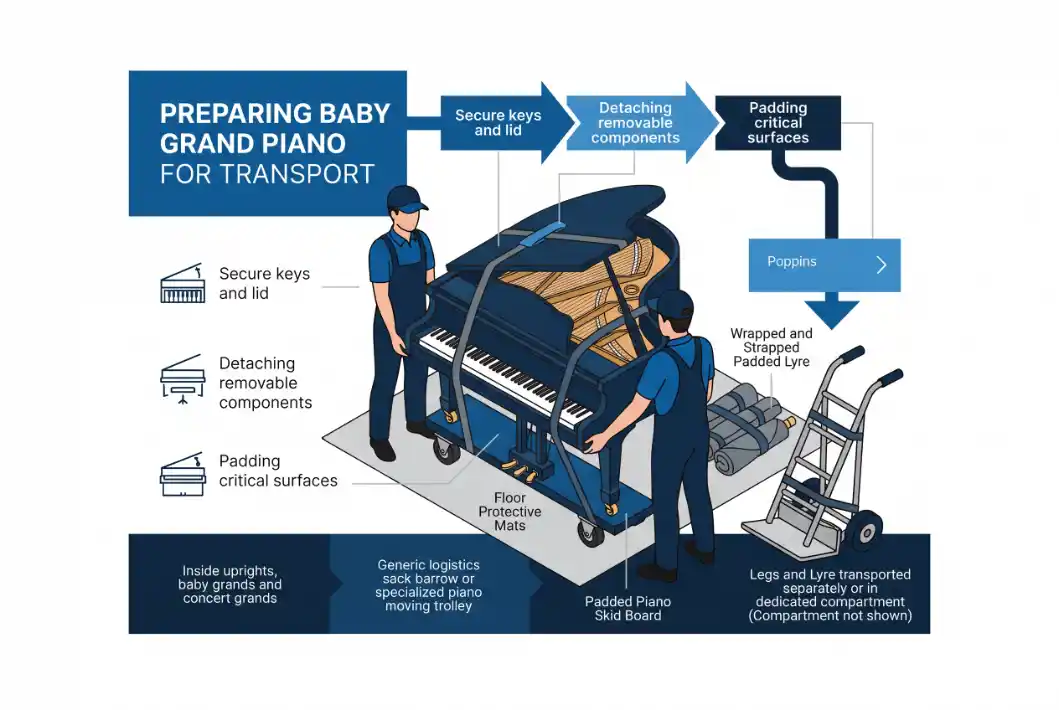
The type of piano changes the crew size, the equipment and the dismantling, not just the price. Weight ranges published by UK removal comparison guides in 2026 are set out below.
| Piano type | Typical weight | What the move usually involves |
| Small upright or spinet | Around 180kg to 220kg | Wrapped whole, moved on a piano trolley, two to three people |
| Full size upright | Around 250kg to 300kg | Wrapped whole, skid board on stairs, three people on any flight |
| Baby grand | Around 300kg to 400kg | Legs and lyre removed, body on a padded skid board, three to four people |
| Concert grand | Up to around 550kg | Full dismantling of legs and lyre, four or more people, often a specialist vehicle |
Source: Moving Compared piano removal cost guide, figures current in 2026.
A grand piano is the more involved job even when it weighs the same as a large upright, because it has to be turned onto its straight side, supported on a skid board and moved with the legs detached. An upright travels upright. That single difference explains most of the price gap between the two.
How much do piano removals in London cost?
A local London upright move typically starts around £80 to £150 and a grand around £150 to £500 or more, based on UK market guides published for 2026. Long distance moves within the UK generally run £200 to £600, and international piano shipping usually reaches four figures once crating, freight and customs are added.
Those are market benchmarks, not a quote. Every piano job in London is priced on access rather than distance, which is why two moves of identical length can differ by several hundred pounds. The table below sets out the ranges and what pushes a job to the top of each band.
| Move type | 2026 market range | What pushes it to the top of the band |
| Local upright, ground floor to ground floor | £80 to £150 | Long carry from the kerb, no parking bay suspended |
| Local grand or baby grand | £150 to £500 or more | Legs removed, tight turns, more than two crew |
| Any piano with stairs | Rises sharply, can double or more | Spiral staircase, narrow half landing, no lift |
| Long distance within the UK | £200 to £600 | Piano type, access at both ends |
| International | Usually four figures | Crating, sea or road freight, customs paperwork |
Source: Moving Compared piano removal cost guide, 2026. Figures exclude parking, permit and vehicle charges, which are covered below.
What drives the price: distance, stairs and piano type
Three variables set the price, and stairs are the most expensive of them. Distance matters least inside Greater London, because the driving time is small next to the time spent getting the instrument out of one building and into another.
- Piano type and weight, which sets the crew size and whether dismantling is needed
- Access at both ends, meaning stairs, doorway width, turning space and lift availability
- Distance and drive time, including any restricted zone the route crosses
- Timing, since evening, weekend and short notice bookings cost more
- Parking, permits and vehicle charges, which are separate from the labour
Get a quote that itemises those lines rather than a single figure. A written breakdown is what allows you to compare two firms honestly, and it is what stops a surprise appearing on the invoice.
Why transparent pricing matters: parking, ULEZ and access charges
Vehicle and parking charges are the most common source of an unexpected line on a London piano invoice, because they are paid to the council and Transport for London rather than to the mover.
As of 2026 the Ultra Low Emission Zone, a daily charge for vehicles that do not meet the emissions standard, costs £12.50 a day and covers all London boroughs, 24 hours a day, every day except 25 December. If the route crosses the central zone, the Congestion Charge adds £18 a day paid in advance or on the day, rising to £21 if paid by midnight on the third day after travel, and it applies 07:00 to 18:00 Monday to Friday and 12:00 to 18:00 at weekends and on bank holidays. Parking is charged separately by the borough. EUROBR’s own parking suspension guide puts borough fees in a range of roughly £30 to £130 per day and lists the notice periods that apply.
Overcoming London’s access challenges
London access problems are structural rather than occasional. Census 2021 recorded that 54.0% of London households, around 1.8 million, live in a flat or maisonette, against 21.7% across England and Wales. A large share of the city’s pianos therefore sit above ground level in buildings that were never designed to move them.
Narrow Victorian staircases, tight corners and flats without a lift
A Victorian staircase is the single hardest obstacle in London piano work, because the problem is usually the turn rather than the width. Two measurements decide whether the job is possible: the clear width at the narrowest point, and the diagonal space available on the half landing where the staircase turns back on itself.
Measure both before you book, and photograph them. A piano that fits through a doorway can still be defeated by a 90 degree turn with a handrail on the inside. Where a staircase genuinely cannot take the instrument, the alternatives are a hoist through a window or a balcony, or a crane, both of which need their own survey, their own insurance and in some cases a highway licence from the council. Hoisting is not something to arrange on the day, and any firm that offers it casually over the phone without seeing the building should be treated with caution. The EUROBR guides to house removals in Wandsworth and flat removals in Wimbledon cover the same access questions for terraced and converted stock in south west London.
ULEZ, the Congestion Charge and parking suspensions
A parking suspension is a temporary reservation of controlled parking bays outside the address, arranged through the local council. It matters for a piano more than for any other item, because a long carry from the nearest legal parking space multiplies both the time and the risk.
Councils set their own fees and notice periods. Wandsworth, for example, charges a booking fee of £82.50 with 10 working days’ notice or £93.20 with 7, then £43.20 for the first day per 5 metre bay and £35.20 for each consecutive day, with a yellow line waiver at £59.40 per 5 metre space per day, on figures published in 2026. Other boroughs price differently and some need up to fifteen working days. In 12 years moving London households, the EUROBR team finds parking access arranged too late is the most common cause of a delayed start, which is why the detailed parking suspension guide exists as a standalone resource.
The specialist piano moving process, step by step
A specialist piano move runs in four stages: assessment, protection, controlled movement, and placement. Nothing in that sequence should be improvised on the day.
The pre-move assessment and access survey
The assessment establishes whether the move is possible and what it needs, before anyone quotes a number. It is the stage most often skipped, and skipping it is what produces the phone call that starts with the crew already outside.
A useful survey records the piano make, model and type, its approximate weight, the floor it sits on at both addresses, the clear width of every doorway and the narrowest point of every staircase, the turning space on landings, lift dimensions and weight limit where a lift exists, the distance from the kerb to the front door, and the parking situation at both ends. Photographs of the staircase, the front door and the street are worth more than a description. Where a piano is old, valuable or unusual, note that explicitly; the EUROBR house and flat removals page asks for particularly complex or antique pieces to be flagged at survey stage for exactly this reason.
Wrapping, covers and equipment: piano shoes, skid boards and dollies
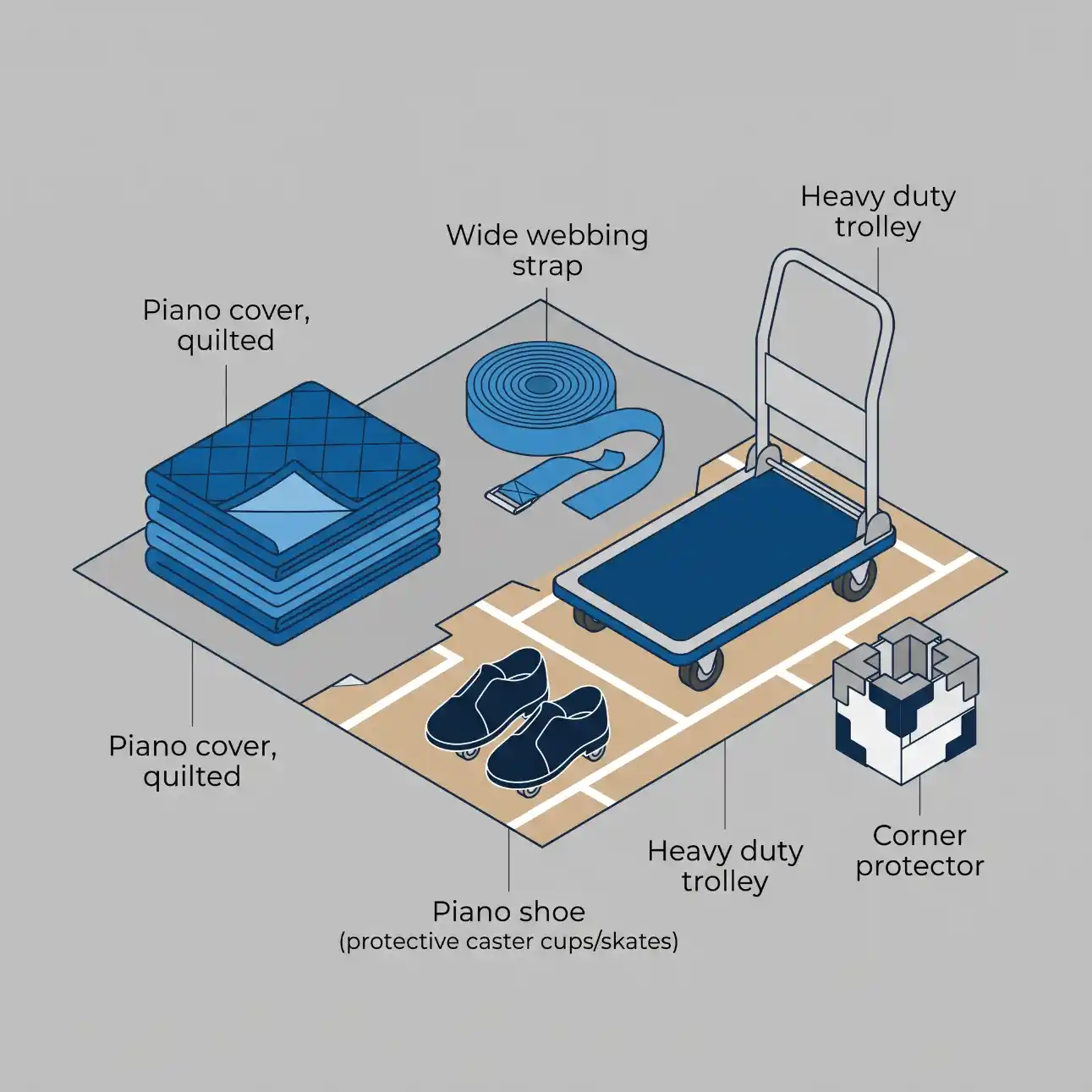
Protection is applied before the piano moves an inch, and the equipment list is short but non negotiable. Wrapping guards the finish; the frame and the trolley carry the weight.
- Heavy quilted covers or blankets over the case, secured so nothing can shift in transit
- A padded skid board for grands, onto which the body is lowered once the legs are removed
- Piano shoes or dollies rated well above the instrument’s weight
- Wide webbing straps and a spotter controlling the descent on any staircase
- Corner and edge protection for the property, not only for the piano
The keyboard lid is closed and secured, the music desk removed where it lifts out, and the castors checked, because a seized castor will gouge a floor rather than roll. If your move also involves flat pack items or furniture that needs taking apart, the furniture assembly and delivery service covers dismantling and reassembly as a separate line.
Vehicle conditions and what they mean for tuning and timber
A piano is a timber instrument under roughly twenty tonnes of accumulated string tension, so it responds to changes in temperature and humidity rather than to the journey alone. The realistic goal in transit is a stable, dry, well secured load, not a laboratory.
In practice that means the instrument is strapped so it cannot slide or rock, kept clear of the vehicle wall, and not left standing in a cold van overnight or in direct sun. Some specialist operators market climate controlled vehicles; if that matters to you, ask what is actually controlled and over what range, because the term is used loosely. What every owner should expect regardless is that the piano is allowed to settle in the new room for a period before it is tuned, since the timber and the strings need to reach the new environment first.
Insurance for piano removals in London: what to check before you book
Insurance is the single most important thing to check, because a piano is often the most valuable individual object in the house and standard cover is written around average items. Two different policies are involved, and they do different jobs.
Goods in Transit, per item limits and declaring value
Goods in Transit insurance covers your belongings while they are being carried. The catch is the per item limit, not the overall total.
Removal comparison guidance is direct about this: some contracts set a fixed maximum amount per item under limited liability terms, which may be far below what the item is actually worth, and valuable items such as antiques and fine art may need to be declared separately. A policy with a generous overall limit can still pay out a fraction of a grand piano’s value if the per item cap is low. Ask for the per item figure in writing, declare the instrument’s value before the move, and keep a recent valuation or purchase invoice. EUROBR carries Goods in Transit and CMR cover on every move, CMR being the international road haulage convention that governs liability for goods carried by road across borders, explained on the CMR regulations page.
Public liability and damage to the property
Public liability is separate cover, and it is the one that applies when the building is damaged rather than the piano. A dropped instrument can take out a banister, a floor or a doorframe, and repairing a period staircase costs real money.
Goods in Transit and CMR cover goods in transport. Damage to the fabric of a property during the lift is a different category, so ask specifically whether public liability cover is held and what the limit is. Ask the same question of a leaseholder’s building management, because some blocks require proof of contractor insurance before a heavy item is moved through a communal stairwell. If a service is not carried out with reasonable care and skill, Citizens Advice explains the remedies available under the Consumer Rights Act 2015, including asking for the work to be done again or for a price reduction.
How to prepare your piano before moving day
Preparation takes about an hour and removes most of the delay risk. The crew handles the instrument; you handle the route and the loose parts.
Clearing the route and securing lids, music desks and castors
Clear everything from the path the piano will take, at both addresses, before the van arrives. That includes the obvious obstacles and the ones people forget.
- Remove rugs, runners and door mats along the route, and prop or remove doors that swing inwards
- Take down pictures and mirrors on the staircase wall, since a piano on a skid board needs the full width
- Empty the piano stool and remove sheet music, metronomes and anything resting on the lid
- Secure or remove the music desk if it lifts out, and check the lid closes and locks
- Confirm the destination room is empty and decide exactly where the piano will stand
- Photograph the instrument from several angles, including any existing marks, before it is wrapped
Decide the final position in advance, away from a radiator, an external wall with damp, or direct sunlight. Moving a piano twice inside a room because the position was not agreed is a common and entirely avoidable extra. A wider moving preparation sequence is set out in the EUROBR moving checklist.
Tuning and settling in after the move
Expect the piano to need tuning after a move, and expect to wait before booking it. Even a careful relocation can knock an instrument slightly out of tune, because the timber and the strings respond to a change in temperature and humidity as much as to the journey.
The practical approach is to let the piano acclimatise in its new room, then arrange tuning once it has settled. The Pianoforte Tuners’ Association maintains a searchable directory of members by area, which is the sensible way to find a tuner in a new borough. The association states that it cannot advise on fees, so treat any figure quoted online as a market estimate rather than a standard, and get the price confirmed before the visit. If the instrument has travelled a long distance or been in storage, ask the tuner whether it needs one tuning or a pitch raise followed by a second appointment, since a piano that has drifted a long way from concert pitch rarely holds after a single visit.
How to check a piano mover is genuine
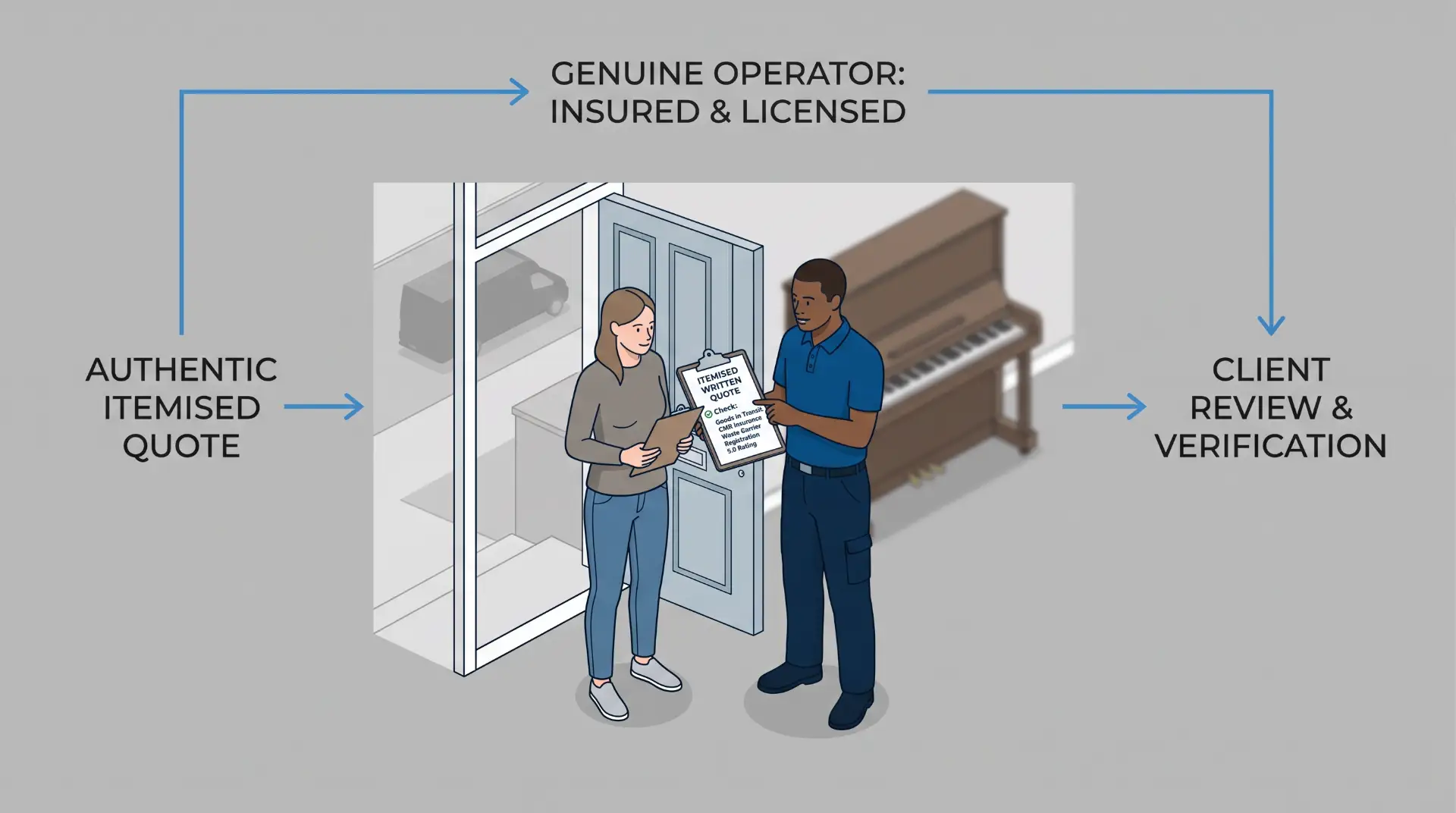
Check credentials before price, because the cheapest quote in this category is usually the one carrying the least cover. Four checks take ten minutes and rule out most of the risk.
| Check | What to ask for | Why it matters |
| Insurance | Goods in Transit certificate with the per item limit, and public liability limit | Decides what you actually recover if the instrument or the building is damaged |
| Experience with your piano type | Recent examples of the same type and similar access | A firm that moves uprights daily may never have taken a grand down stairs |
| Written access plan | Crew size, equipment, parking arrangement, contingency if the staircase fails | Stops the decision being made on the doorstep |
| Trade standards | Membership of a recognised body such as the British Association of Removers | BAR members follow a Chartered Trading Standards Institute code and are subject to an annual external audit |
Get the quote in writing, with the parking and vehicle charges shown as separate lines. If a firm will not put the per item insurance limit in writing, that is your answer.
Frequently asked questions
How much does it cost to move a piano in London?
Market guides published for 2026 put a local London upright move at roughly £80 to £150 and a grand or baby grand at roughly £150 to £500 or more, with long distance moves inside the UK generally running £200 to £600 and international shipping usually reaching four figures once crating, freight and customs are included. Those ranges cover labour and equipment only. Stairs are the variable that moves a quote furthest, and guidance notes that costs can double or more where a spiral staircase, a narrow hallway or several flights are involved. London adds charges that are paid to third parties rather than to the mover: the ULEZ daily charge, the Congestion Charge in the central zone, and a council parking bay suspension, which together can add a meaningful sum to a short move. The reliable way to compare firms is to ask for an itemised written quote separating labour, equipment, parking and vehicle charges. A similar breakdown for general local jobs appears in the guide to man and van costs in London.
Can a normal removal company move a piano?
A general removal company can sometimes move an upright piano on level ground, but a piano is not simply a heavy item of furniture and the difference shows on stairs. The equipment list is specific: a padded skid board, piano shoes or a trolley rated well above domestic furniture weights, wide webbing straps, and enough crew for one person to control the descent rather than carry. Grand pianos need the legs and lyre removed and the body lowered onto a skid board, which is a dismantling job rather than a lift. There is also an insurance dimension. Many general contracts carry a per item liability limit that suits a wardrobe and falls well short of an instrument worth several thousand pounds, so the cover you assume you have may not apply at the value you need. Ask any firm for the per item figure in writing and for recent experience of your specific piano type and access. General local removal capability is described on the house and flat removals page.
How many people are needed to move a piano?
Crew size is set by the weight, the piano type and the access rather than by a fixed rule. On level ground, a small upright of roughly 180kg to 220kg is usually handled by two to three people with a trolley. A full size upright of 250kg to 300kg generally needs three once any staircase is involved, because one person has to control the descent from below while the others take the weight above. A baby grand of 300kg to 400kg typically needs three to four, since the legs and lyre come off and the body travels on a skid board that must be kept level. A concert grand approaching 550kg usually needs four or more and often a specialist vehicle. Access changes the number as much as weight does: a tight half landing or a spiral staircase can add a person purely for spotting and route control. The Health and Safety Executive requires employers to avoid, assess and reduce manual handling risk, and sets no legal maximum weight, which is why the assessment matters. Access questions are covered further in the moving checklist.
Do I need a parking suspension to move a piano in London?
On most controlled London streets, yes, and it is worth arranging even where it is not strictly required. A parking suspension is a temporary reservation of controlled parking bays outside the address, granted by the local council, and it guarantees the vehicle a legal space at the kerb rather than a gamble on the day. For a piano this matters more than for boxes, because every additional metre between the van and the front door adds time, handling and risk to a 300kg object. Fees and notice periods vary by borough. Wandsworth charged a booking fee of £82.50 with 10 working days’ notice or £93.20 with 7 in 2026, then £43.20 for the first day per 5 metre bay and £35.20 for each consecutive day. Other boroughs price differently and some require up to fifteen working days, so this is booked well before moving day rather than in the final week. Borough by borough application links and notice periods are listed on the EUROBR parking page, and the process is explained in the parking suspension guide.
Will my piano need tuning after it is moved?
Almost always, and the reason is environmental rather than mechanical. A piano holds its tuning through the tension of its strings against a timber soundboard and frame, and both respond to changes in temperature and humidity. Moving the instrument from one building to another changes that environment, so even a carefully handled relocation usually leaves the piano slightly out of tune. The vibration of the journey contributes, but the change of room is generally the larger factor. The practical approach is to let the piano settle in its new position first, then arrange tuning once the timber has adjusted to the new conditions. Position matters here too: keep the instrument away from radiators, external walls prone to damp and direct sunlight, since a stable spot holds tuning longer. The Pianoforte Tuners’ Association maintains a searchable directory of members by area and states that it cannot advise on fees, so confirm the price directly with the tuner. If the piano has travelled a long distance, ask whether a pitch raise and a second appointment will be needed. General settling in advice sits in the moving checklist.
What insurance should a piano mover have?
Two separate policies matter, and they cover different failures. Goods in Transit insurance covers the belongings being carried, but the figure to check is the per item limit rather than the overall total, because a policy with a large aggregate limit can still cap a single object well below what a grand piano is worth. Removal comparison guidance notes that some contracts set a fixed maximum per item under limited liability terms, and that valuable items may need to be declared separately before the move. Public liability is the second policy, and it applies when the building is damaged rather than the instrument, which is a real risk on a period staircase or a communal stairwell. Ask for both limits in writing, declare the piano’s value in advance, and keep a recent valuation. Some managed blocks require proof of contractor insurance before heavy items pass through communal areas, so check the lease as well. EUROBR carries Goods in Transit and CMR cover on every move; CMR governs liability for goods carried by road internationally and is explained on the CMR regulations page.
Can a piano be hoisted through a window in a London flat?
Hoisting is possible and is sometimes the only option in a converted London property, but it is a separate operation with its own survey, equipment and permissions rather than a fallback arranged on the day. It is used where the staircase physically cannot take the instrument, which is common in Victorian conversions with narrow half landings and a handrail on the inside of the turn. A hoist or crane lift needs the window or balcony opening measured, the structure and the anchor points assessed, a clear and safe area at street level, and in many cases a licence or road closure from the council, which takes notice. Insurance is checked separately, because lifting an object over a public highway is not covered by a standard removal policy. The realistic sequence is a site survey first, then a written plan and a quote, then the permissions, then the lift. Any firm that agrees to hoist a piano over the phone without seeing the building has not done the assessment. Access considerations for converted flats are covered in the flat removals Wimbledon guide.
Planning a piano move in London: your next step
Start with the survey, not the price. A written access plan covering stairs, doorway widths, lift dimensions, parking and crew size is what turns a piano move from a gamble into a scheduled job, and it is the document that lets you compare two quotes on equal terms.
EUROBR has moved London households since 2013, carries Goods in Transit and CMR cover on every move, is a licensed waste carrier registered with the Environment Agency and holds a 5.0 Google rating. Piano moving is not published as a standalone EUROBR service, so if your move includes an instrument, say so at the enquiry stage: the team will confirm what can be handled directly and what needs a specialist arranged alongside the main move, rather than promising it on the doorstep. For everything else in the move, the house and flat removals service covers packing, dismantling, parking suspensions and short term storage between moving dates.
Get a free, no obligation quote from EUROBR’s insured team. Message on WhatsApp at +44 7878 921856, or request a price online with photographs of your staircase and street.