

A man with a van is a small removals service: one driver, one van and usually one or two crew members, booked by the hour or as a fixed price for a single job.
It suits studio and one-bedroom moves, single-item collections, marketplace and flat pack pick-ups, student moves and light clearance work. Checkatrade’s cost guide, updated in August 2026, puts the average at around £64 per hour for one operative with a van and around £78 per hour for two. The service is cheaper and more flexible than a full removals crew, but it is also the part of the market where uninsured operators are easiest to find. Two checks separate a reliable firm from a risky one: valid Goods in Transit insurance, and a waste carrier registration if anything is being taken away for disposal.
Introduction
Man with a van hire is the most commonly booked removals service in the UK, and also the least regulated. Anyone with a van and a phone can advertise one. That is why the same job can be quoted at £45 an hour by one operator and £95 by another, and why the cheaper quote sometimes arrives two hours late in a vehicle too small for the load. This guide explains what the service actually covers, when it is the right tool and when it is not, what it costs in 2026, and the specific checks that tell you whether the person turning up is insured, registered and accountable. EUROBR has run small van jobs and full household moves across Greater London since 2013, and the patterns below come from that work.
What is a man with a van service and when should you use one?
A man with a van service is a single-vehicle removals booking, priced by time or by job rather than by the room count. It is the right choice when the load fits one van, when the job is straightforward enough that a survey would be overkill, and when you value flexibility on timing more than a large crew.
The service sits between DIY van hire and a full removals contract. With DIY hire you drive, load and carry everything yourself. With a full removals firm you get a surveyed fixed price, a multi-person crew, materials and a structured plan. A man with a van gives you a driver who also loads, at a fraction of the cost of the full contract, with the trade-off that you are buying labour by the hour rather than a managed project.
Small flat removals and student moves
For a studio or a one-bedroom flat, a man with a van is normally the most cost-effective option available. The volume rarely exceeds what a Luton van holds in one trip, and the work is usually complete inside three to five hours including travel. EUROBR publishes starting prices for exactly this bracket: from £50 plus VAT for a single item, £125 for a studio and £165 for a one-bedroom move, with the final figure confirmed once volume, access and parking are known.
Student moves fit the same profile. A term’s belongings, a mattress topper, a desk lamp and eight boxes do not justify a four-person crew. What they do need is someone who will carry to and from the door rather than leaving everything at the kerb, which is a question worth asking before booking. There is a fuller breakdown in the guide to student removals in London.
Single item transport: furniture delivery, marketplace and flat pack runs
Single-item transport is the fastest-growing use of the service. A sofa bought on a marketplace listing, a wardrobe from a warehouse store, a piano stool, a fridge freezer from a private seller: all of these need a vehicle, a tail lift or ramp, and two people who know how to get an awkward shape through a narrow doorway.
The thing to confirm before booking is whether the price includes carrying the item into the room you want it in, or only to the front door. Delivery-only pricing is common and legitimate, but it is not what most buyers assume they are paying for. If the item also needs building once it is inside, that is a separate skill and a separate quote, covered on the furniture assembly and delivery page and in the guide to flat pack furniture assembly.
Tip runs and waste clearance: check the waste carrier registration first
If your booking involves taking anything away for disposal, the legal position changes completely. Under the householder duty of care set out by GOV.UK on disposing of household waste, you must check that whoever removes your waste is legally allowed to take it. If they fly-tip it and it is traced back to you, you can be penalised even though you did not dump it yourself.
The check takes under a minute. Ask for the carrier registration number and look it up on the Environment Agency public register of waste carriers. Upper tier registration costs £191.02 in 2026, with a £130.25 renewal every three years, according to GOV.UK guidance on registering as a waste carrier, and operating without one carries an unlimited fine. An operator who cannot produce a number is not cheap. They are uninsured risk with a van. EUROBR is a registered waste carrier and everything collected for disposal goes to a licensed recycling facility, which is the standard set out on the house clearance guide.
Man with a van or a traditional removal company: what is the difference?
The difference is scope and pricing model, not quality. A man with a van sells you a vehicle and labour by the hour. A removals company sells you a surveyed, fixed-price project that includes materials, crew, protection and a plan for the day.
| Factor | Man with a van | Full removals company |
| Typical load | Studio to 2 bedrooms | 2 bedrooms and above |
| Pricing basis | Hourly rate or fixed price per job | Fixed price after a volume and access assessment |
| Crew | 1 to 2 people | 2 to 5 people |
| Materials | Usually charged separately | Normally included |
| Packing service | Sometimes, on request | Standard option |
| Dismantling and reassembly | Sometimes, on request | Normally included |
| Notice needed | Often same day or next day | Usually several days to weeks |
| Best for | Speed, flexibility, small volumes | Volume, fragile contents, fixed deadlines |
The practical test is deadline risk. If you have a key handover at a fixed hour, a tenancy that ends at noon, or a lift booking slot in a managed block, you are buying certainty rather than the lowest hourly rate. That is a removals contract. If your timing is flexible and the load is small, hourly is almost always cheaper.
Price and flexibility on small loads
On small loads the hourly model wins because you are not paying for capacity you do not use. Reallymoving data published in November 2025 and carried by the HomeOwners Alliance guide to removal costs puts an average one-bedroom removal at £432 and a two-bedroom at £603. A two-person van team at around £78 an hour, on Checkatrade’s August 2026 average, completes many one-bedroom jobs inside four hours. The arithmetic favours the van until the load grows past what one vehicle can shift in a single run.
The moment a second trip enters the picture, that advantage disappears. Two return journeys across London can add two hours of driving to a bill that is charged by the hour, which is why an honest operator will tell you when your load has outgrown the service. Getting the vehicle right first time matters more than the headline rate.
Loading and unloading: do you have to help the driver?
No, and you should not assume you will be allowed to. A professional service loads and unloads as part of the booking, and most operators carry employer’s liability cover that does not extend to customers handling items alongside the crew.
The confusion comes from the cheapest end of the market, where some listings quote a driver-only rate and expect the customer to carry. Ask the question directly when you book: does the quoted rate include carrying, or only driving? Manual handling is also the single largest category of reportable workplace injury in the UK. HSE statistics for 2024/25 record 59,219 non-fatal injuries reported by employers under RIDDOR, of which 17 per cent came from handling, lifting or carrying. The HSE guidance on manual handling law places the duty to assess and reduce that risk on the employer, not on you.
Van sizes: choosing between a medium wheelbase, long wheelbase and Luton
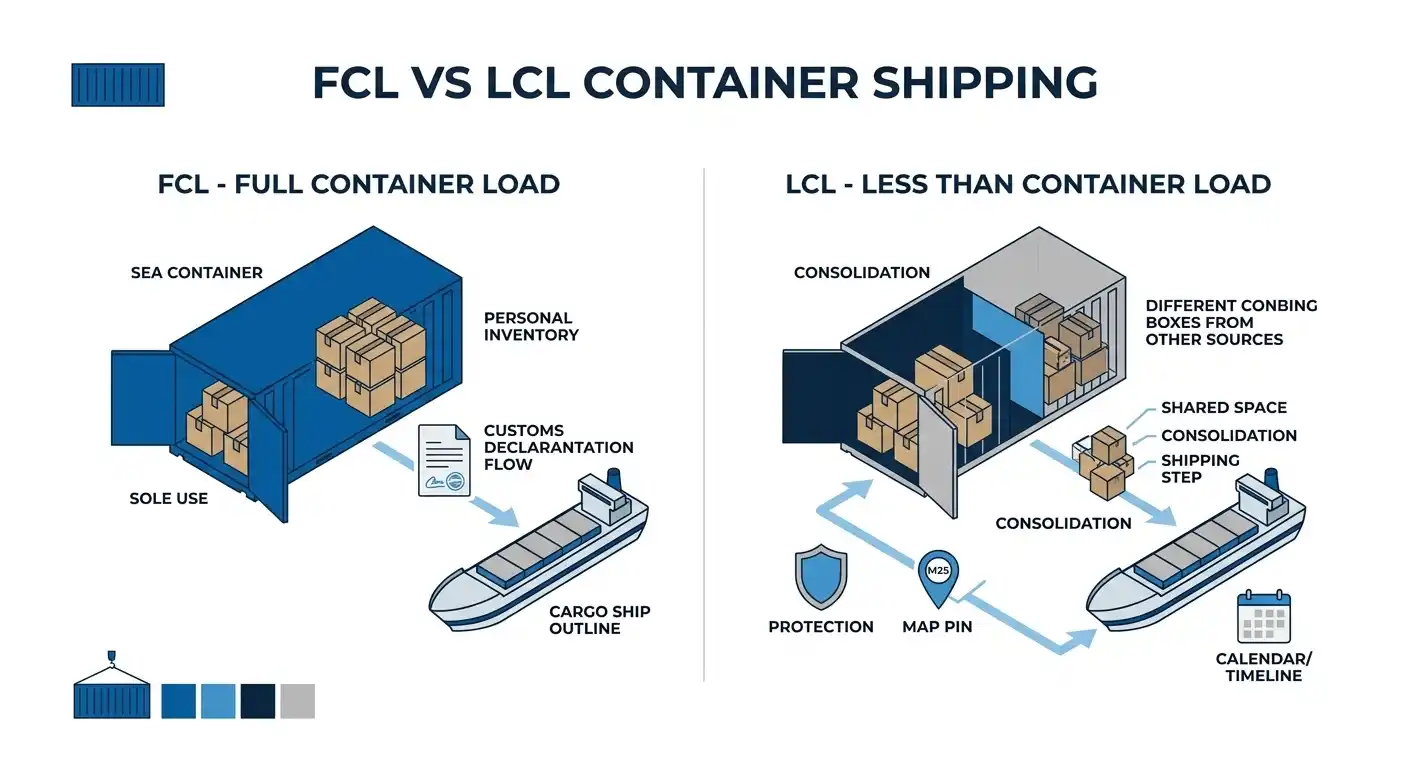
Van size is the variable that decides whether your job takes one trip or two, and it is the one customers most often get wrong. The three common removals vehicles are the medium wheelbase panel van, the long wheelbase panel van and the Luton box van with a tail lift.
| Vehicle | Rough load volume | Typical contents | Works for |
| Medium wheelbase van | Around 6 to 8 cubic metres | 15 to 20 boxes plus a few small items | Single items, small deliveries |
| Long wheelbase van | Around 10 to 12 cubic metres | Studio contents, sofa, mattress, 25 boxes | Studio flats, student moves |
| Luton van with tail lift | Around 18 to 20 cubic metres | One-bedroom flat with white goods | 1 to 2 bedroom flats |
Rather than picking a vehicle yourself, describe the load: the number of boxes, the largest three items, the floor level at both ends and whether there is a lift. EUROBR’s man with a van service page is built around that description rather than a size menu, because a customer who under-books a van pays for the correction in hourly time.
How much does a man with a van cost in 2026?
In 2026 a man with a van in the UK costs roughly £35 to £93 per hour for one operative and £50 to £105 for two, with national averages of around £64 and £78 respectively, according to Checkatrade’s cost guide updated in August 2026. London and the South East sit at the upper end of those ranges.
Those are labour-and-vehicle figures. What lands on the final invoice depends on distance, floor level, the number of crew, road charges and whether materials are supplied. A cost breakdown specific to the capital is set out in the guide to how much a man with a van costs in London.
Hourly rates or a fixed price: which suits your job
Hourly pricing suits jobs where the variables are known and small: a short hop, ground floor to ground floor, everything packed. You pay for the time used and nothing more, and a job that finishes early costs less.
Fixed pricing suits everything else. Once stairs, a long carry, a lift booking or a cross-London journey enters the picture, an hourly quote transfers all the uncertainty to you. A fixed price transfers it to the operator, which is the point of assessing volume and access first. EUROBR’s approach on house and flat removals is to assess volume, access, floor levels and parking at both addresses and then hold the figure, so the price does not move on the day. Ask which model you are being quoted, and ask what happens if the job overruns.
What pushes the price up: stairs, mileage and extra crew
Three factors do most of the work. Stairs are the first: every floor without a lift adds carrying time, and above the second floor the effect compounds because each item makes the journey separately. The second is mileage, which is charged either inside the hourly rate as travel time or separately per mile. The third is crew size, and this one is counter-intuitive. Adding a second person raises the hourly rate but often lowers the total, because two people loading a Luton van do it in well under half the time of one.
A worked example makes it concrete. A one-bedroom flat move from a second floor in Wandsworth to a ground floor in Croydon involves roughly eight miles, two flights of stairs at the collection end and a full Luton load. One operative at the national average of £64 an hour could spend six hours on it. Two at £78 an hour would typically finish in three and a half. The two-person booking costs less and ends earlier.
Hidden fees to watch for: tolls, parking, waiting time and weekend surcharges
A written quote should state what is and is not included. The recurring gaps are road charges, parking, waiting time and out-of-hours loading.
- Road charges: the Ultra Low Emission Zone and the Congestion Charge are usually passed on. Both are covered in the next section.
- Parking: a council bay suspension or dispensation is a real cost and needs booking days ahead.
- Waiting time: if the keys are late or the lift is occupied, the clock normally keeps running.
- Weekend, evening and bank holiday surcharges: common, legitimate, and often not mentioned until the invoice.
- Materials: boxes, tape and blankets may be extra unless the quote says otherwise.
- Disposal: taking items to a recycling centre attracts a tip fee on top of labour.
- Second trips: the most expensive line of all, and the one an accurate volume description prevents.
What road charges and parking add to a man and van booking
In 2026 a van driving into central London on a weekday can attract two separate daily charges plus a parking cost, and none of them are optional. Budget for them before you compare quotes, because an operator who has left them out is not actually cheaper.
The Ultra Low Emission Zone charge is £12.50 a day for a non-compliant vehicle. Transport for London’s ULEZ pages confirm the zone covers all London boroughs, stops short of the M25 itself, and runs 24 hours a day, every day except Christmas Day. Most professional removals fleets are compliant, so this charge should not appear on your bill at all. Ask.
The Congestion Charge rose from £15 to £18 a day on 2 January 2026 and applies between 07:00 and 18:00 Monday to Friday and 12:00 to 18:00 at weekends and on bank holidays, per Transport for London’s Congestion Charge pages. Failing to pay within the deadline results in a penalty charge notice of £180, reduced to £90 if settled within 14 days.
Parking is the third cost and the one that causes most moving-day delay. On a controlled street the vehicle needs a suspended bay or a dispensation, arranged with the borough, and most councils want several working days’ notice. EUROBR’s parking suspension page lists the application routes for all 32 boroughs, with daily fees ranging from £30 to £130 depending on the council and the zone. The Highway Code sets out where a vehicle may legally stop while loading, and the borough-level detail is expanded in the guide to parking suspension for moving in London.
How to check a man with a van service is legitimate and insured
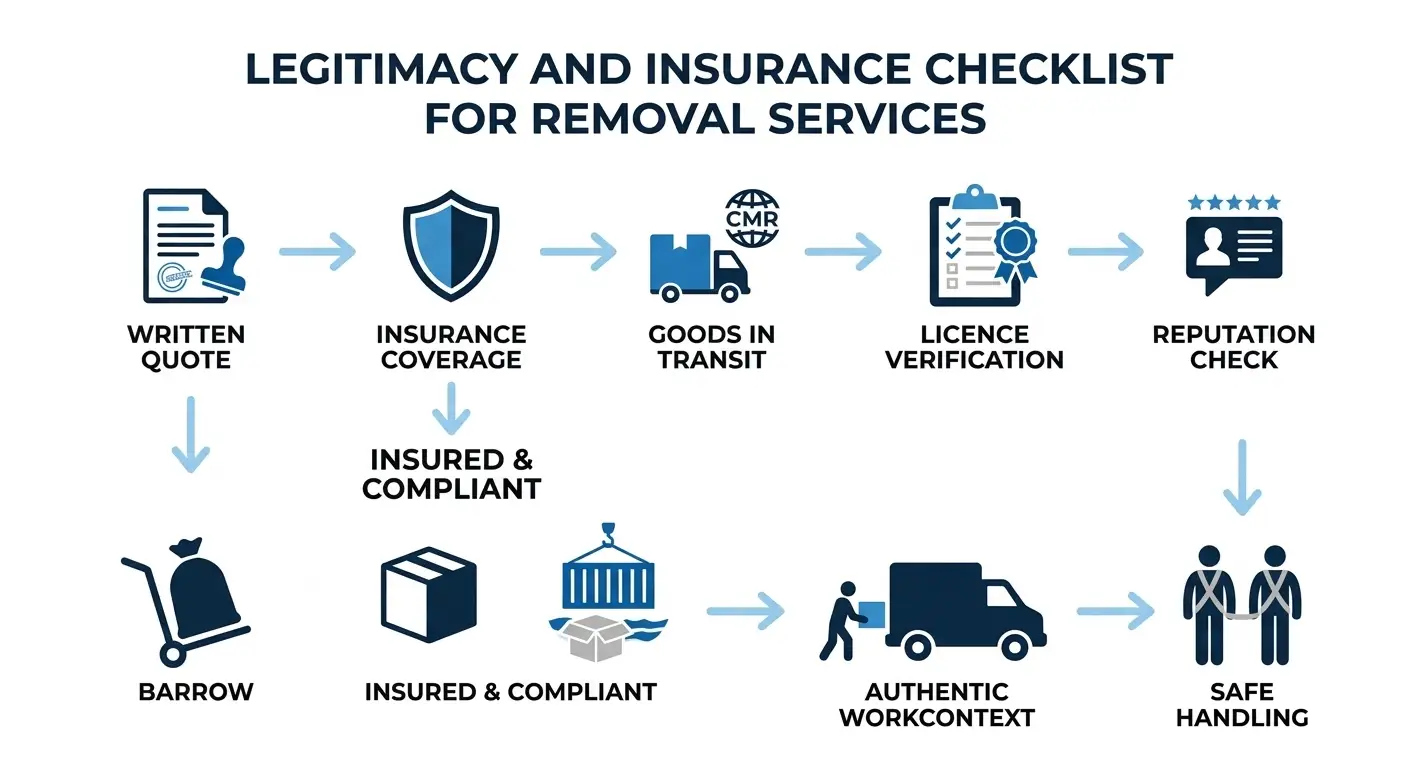
Four checks cover almost all of the risk: insurance, waste registration, a written quote and a traceable business identity. Each one takes minutes and each one filters out the operators who cause the problems.
The sector has no licensing requirement equivalent to a trade register, so the burden sits with the customer. If a supplier resists any of the four, that is your answer.
Goods in Transit and public liability: what each one covers
These two policies cover different things and are routinely confused. Goods in Transit insurance covers your belongings while they are being carried and while they are in the vehicle. Public liability covers damage the crew causes to property, such as a scraped bannister, a cracked floor tile or a damaged communal door.
Goods in Transit cover also carries conditions. EUROBR states Goods in Transit and CMR cover on every move, from a studio to a house, and is explicit that fragile and high-value items, including glass, ceramics, screens, jewellery and artwork, along with plants and pets, fall outside standard cover unless they are professionally packed. CMR is the convention governing international road carriage, explained on the CMR regulations page. The questions to ask are the limit per claim, the limit per item, and what packing standard is required for a fragile item to be covered at all.
Reviews, written quotes and the red flags that matter
A written quote is the single most useful document in this transaction. It should name the business, give an address, state the hourly rate or fixed price, list what is included, and say what happens if the job overruns. A quote sent as a text message with a number and no terms is not a quote.
The red flags are consistent: cash-only payment, no VAT number and no company details, refusal to confirm insurance in writing, a price materially below every other quote, and a mobile number with no fixed business identity. On standards, the British Association of Removers requires members to pass an annual external audit and work to a code of practice approved by the Chartered Trading Standards Institute, which is a useful benchmark even when comparing non-members. If something does go wrong, Citizens Advice guidance on complaining about a service sets out your rights under the Consumer Rights Act 2015, which requires services to be carried out with reasonable care and skill.
How to prepare so your man with a van booking runs to time
Preparation is the cheapest way to cut an hourly bill. In 12 years of London moves, the EUROBR team finds the two things that decide whether a van job runs to time are whether parking was arranged in advance and whether the boxes were sealed before the crew arrived. Neither costs anything to get right.
Treat the hour before arrival as part of the job. Everything the crew has to wait for is billed at the same rate as everything they carry.
Packing and dismantling in advance to cut the hourly cost
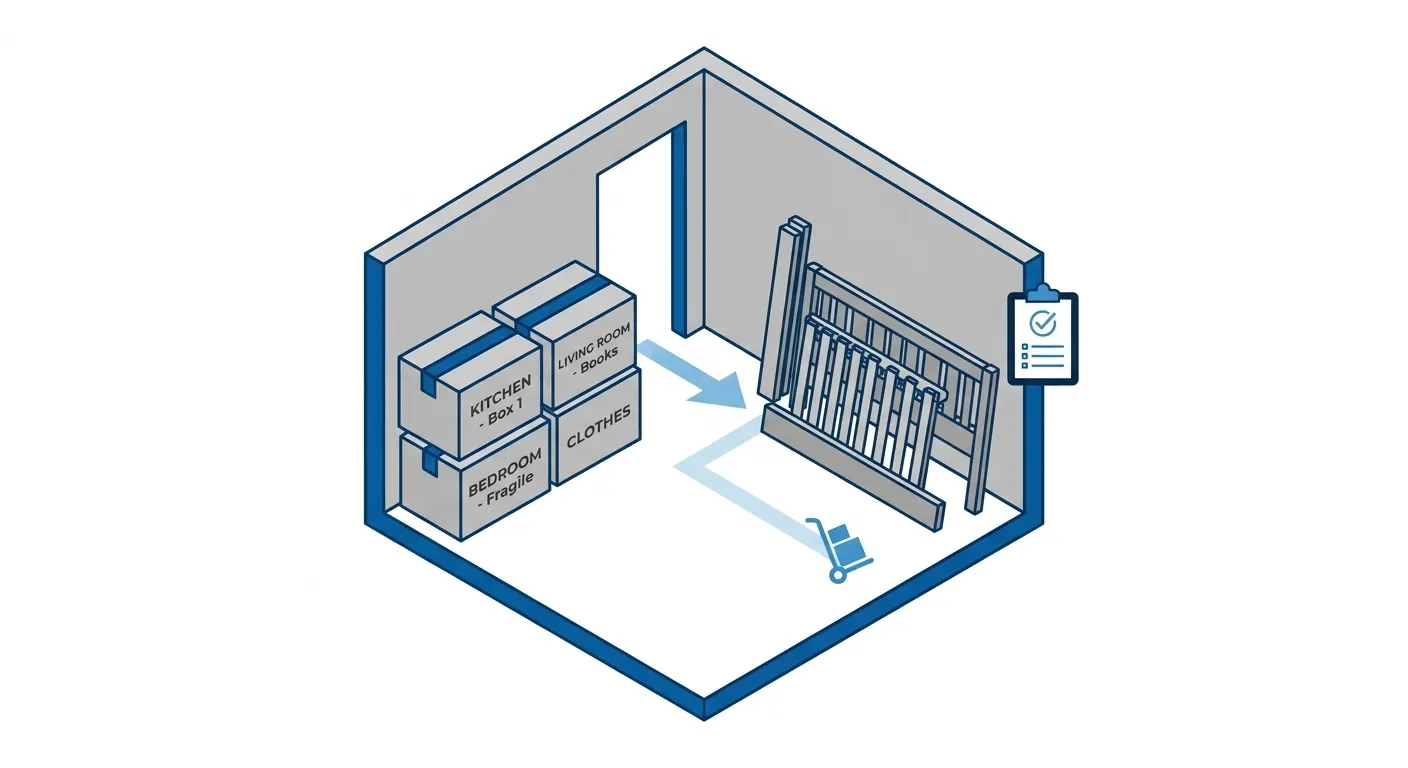
Boxes should be packed, taped and labelled by room before the van arrives. Half-filled open boxes cannot be stacked, which wastes van space and forces a second trip. The guide to the best packing box sizes for moving house covers how to match box size to contents, and materials can be ordered through the packing boxes and materials page if you would rather not source them yourself.
Bed frames, table legs and large flat pack units should come apart in advance where you are confident doing it. Where you are not, book it as part of the job rather than discovering the problem at 9am. A wardrobe that will not fit through a door costs more in improvised dismantling time than it would have cost to plan. If you want the crew to handle packing as well, the options are set out in the guide to professional packing services in London.
Securing parking at both addresses
Parking must be arranged at both ends, and the destination is the one people forget. A suspended bay outside the collection address does nothing if the van has to double-park 60 metres from the new front door.
Apply early. Most London boroughs want between five and fifteen working days’ notice for a bay suspension, and the fee varies widely by council and zone. If your street is uncontrolled, you still want a plan: a neighbour’s cooperation, a cone put out the night before, or a confirmed loading bay. The moving checklist sets out the sequence, and the common errors are catalogued in 10 mistakes people make when moving house.
Frequently asked questions about man with a van hire
How much does a man with a van cost per hour in 2026?
Checkatrade’s cost guide, updated in August 2026, gives a UK average of around £64 per hour for one operative with a van, within a range of £35 to £93, and around £78 per hour for two operatives, within a range of £50 to £105. Three operatives average around £94 per hour. London and the South East sit towards the top of each range because of higher labour costs, road charges and parking constraints. Those figures cover the vehicle, fuel and labour. They do not automatically include packing materials, disposal fees, bay suspensions or road charges, so the useful comparison is not the hourly rate but the total expected cost of the job. A written quote should state the rate, the minimum booking length, what happens if the job overruns, and which extras are charged separately. For smaller jobs many operators offer a fixed price instead, which removes the risk of an overrun landing on the customer. A London-specific breakdown, including worked examples by property size, is set out in the guide to how much a man with a van costs in London.
Is a man with a van cheaper than a removals company?
For small loads, usually yes. Reallymoving data from November 2025, published by the HomeOwners Alliance, puts an average one-bedroom removal at £432 and a two-bedroom at £603, while a two-person van team at around £78 per hour can complete many one-bedroom jobs in three to five hours. The saving comes from paying for time actually used rather than for a surveyed, fixed-price project with a larger crew and included materials. That advantage reverses as volume grows. Once a load needs two trips, the hourly model starts charging for driving instead of carrying, and a single larger vehicle with more crew becomes cheaper. Fixed deadlines change the calculation too: where a key handover or a tenancy end time is immovable, a fixed-price removals contract transfers the risk of overrunning away from the customer. The practical rule is that studios, one-bedroom flats and single items favour the van, while two bedrooms and above generally favour a full house and flat removals service.
Does a man with a van help with loading and carrying?
A professional service loads, carries and unloads as part of the booking. The exception is the cheapest end of the market, where some listings quote a driver-only rate and expect the customer to do the carrying, so the question is worth asking explicitly before booking rather than assuming. Customers are generally not permitted to work alongside the crew, because employer’s liability insurance covers employees rather than members of the public handling loads on site. There is a safety reason as well as a contractual one. HSE statistics for 2024/25 record 59,219 non-fatal injuries reported by employers under RIDDOR, with 17 per cent arising from handling, lifting or carrying, making it the single largest category. The duty to assess and reduce manual handling risk sits with the employer under the Manual Handling Operations Regulations 1992. What is reasonable to ask of a customer is preparation: boxes sealed and labelled, furniture emptied, and a clear route to the door. That list is set out in the moving checklist.
What size van do I need for a one-bedroom flat?
A Luton box van with a tail lift, holding roughly 18 to 20 cubic metres, is the usual vehicle for a one-bedroom flat, including white goods and a double bed. A long wheelbase panel van at around 10 to 12 cubic metres handles a studio or a student move. A medium wheelbase van at around 6 to 8 cubic metres suits single items and small deliveries rather than a whole home. Volume is not the only constraint. A tail lift matters for anything heavy that cannot be carried up a ramp, and vehicle height matters for underground car parks and barriered estates, where a Luton often will not fit. Rather than choosing a size yourself, describe the load: the number of boxes, the three largest items, the floor level at both addresses and whether a lift is available. Under-booking a vehicle is the most expensive mistake in an hourly job, because the correction is a second trip. EUROBR’s man with a van service prices from that description rather than from a size menu.
How do I check a man with a van is insured?
Ask for the insurance in writing and read the conditions rather than the headline. Two policies matter and they cover different things. Goods in Transit insurance covers your belongings while they are in the vehicle and being carried. Public liability covers damage the crew causes to buildings, such as a scraped bannister, a damaged communal door or a cracked floor tile. Request the limit per claim, the limit per item and the packing standard required for fragile goods, because most Goods in Transit policies exclude items the customer packed themselves and exclude high-value categories unless they are declared. EUROBR states Goods in Transit and CMR cover on every move, and is explicit that glass, ceramics, screens, jewellery, artwork, plants and pets sit outside standard cover unless professionally packed. If disposal is involved, also check the waste carrier registration number against the Environment Agency public register. Membership of a trade body such as the British Association of Removers adds an audited code of practice, which is explained further on the about us page.
Can a man with a van take rubbish or old furniture away?
Only if the operator holds a valid waste carrier registration, and it is your legal responsibility to check. Under the householder duty of care, you must make sure that whoever takes waste away is authorised to carry it. If items are later fly-tipped and traced back to you, enforcement can follow even though you did not dump them. Upper tier registration costs £191.02 in 2026 with a £130.25 renewal every three years, and carrying waste without registering can attract an unlimited fine. Verification takes a minute: ask for the registration number and search it on the Environment Agency public register of waste carriers, brokers and dealers. A legitimate operator will also issue a record of what was taken and where it went. Costs for disposal are usually charged on top of labour, because the recycling centre itself charges by load or by item type. EUROBR is a registered waste carrier and routes collected items to licensed recycling facilities, as described in the guide to house clearance in London.
How far in advance should I book a man with a van?
Two to three days is enough for a straightforward job, and many operators hold same-day and next-day slots. Three situations need longer. The first is a controlled parking street, where a council bay suspension typically needs five to fifteen working days’ notice depending on the borough, which makes parking rather than van availability the binding constraint. The second is the end of the month, and Fridays in particular, when tenancy ends and completions cluster and capacity in London tightens. The third is a managed block with a booked service lift, where the building’s own calendar sets the date. Booking early also produces a better price, because a supplier quoting for next month can route the job efficiently, whereas a same-day booking is priced for disruption. If a late booking is unavoidable, be precise about volume and access so the right vehicle arrives first time. Availability, including late hours and weekends, is covered in the guide to same day man and van in London.
Booking a man with a van you can rely on
The decision comes down to three questions: is the load genuinely one van, is the operator insured and registered, and is the quote written down with the extras named. Get those right and the hourly model is the cheapest way to move a small home in the UK. Get them wrong and the saving disappears into a second trip, a penalty charge notice or an uninsured claim.
EUROBR has been running van jobs and full removals across Greater London and the M25 since 2013, with Goods in Transit and CMR cover on every move, a registered waste carrier licence for anything taken away, and starting prices published from £50 plus VAT for a single item. Describe your load, the floor levels and the postcodes, and you will get a clear figure rather than a rate with conditions attached. Message the team on WhatsApp at +44 7878 921856 or request a quote online.