

The cost of shipping a container to Brazil from the UK starts at about £6,000 for a 20ft and £9,000 for a 40ft in 2026, excluding taxes, before customs and port charges.
The cost of shipping a container to Brazil from the UK starts at about £6,000 for an exclusive 20ft container of around 33 cubic metres and about £9,000 for a 40ft container of around 65 cubic metres, excluding taxes, based on the prices EUROBR publishes for 2026. Smaller loads go in a shared container, priced by the cubic metre above 5 cubic metres or by the box below that. The final figure depends on volume, packing, the delivery city in Brazil and the paperwork. Most surprise costs appear at the Brazilian end: port storage while customs clear the goods, duties on undeclared new items, and currency movements between quote and collection. A door-to-door quote that lists every component in writing is the only reliable way to compare prices.
The cost of shipping a container to Brazil is the question most Brazilians in the UK ask first when they decide to go home, and the answers online range from a few hundred pounds to more than ten thousand. That spread is real, because a container price bundles very different things: packing in London, the sea crossing, customs clearance under Brazilian rules and delivery to a flat in São Paulo or a house in Minas Gerais. This guide breaks the price down component by component, using the figures EUROBR publishes for its monthly sailings, and explains where extra charges come from after you book. It also shows how to work out whether an exclusive or a shared container costs less for your volume. For the wider move, from documents to timing, see the EUROBR guide to removals to Brazil from the UK.
What is the cost of shipping a container to Brazil from the UK in 2026?
An exclusive container to Brazil costs from about £6,000 for a 20ft unit and £9,000 for a 40ft unit, excluding taxes, as of 2026. A shared container costs less for smaller loads because you pay only for the space your belongings occupy.
20ft and 40ft exclusive container prices
An exclusive container is a container booked for one household, loaded at your address and sealed until it reaches Brazil. It matters because the whole box is yours: nothing else is loaded alongside your furniture, and the price is the same whether you fill it or not. EUROBR publishes these starting prices on its removals to Brazil service page, with the final figure confirmed at collection and subject to currency and market changes:
| Container | Approximate capacity | Approximate dimensions | Starting price (2026, ex. taxes) |
| 20ft exclusive | 33 m³ | 6m x 3.35m x 2.4m | from £6,000 |
| 40ft exclusive | 65 m³ | 12m x 3.35m x 2.5m | from £9,000 |
| Shared container | Pay per cubic metre | Above 5 m³ | quoted per move |
| Boxes and suitcases | Per item | Below 5 m³ | quoted per move |
Shared container pricing by cubic metre and by box
A shared container, known in the trade as LCL or less than container load, is a container that carries several households’ belongings, each paying for its own share. Maersk’s guide to FCL and LCL ocean freight explains that with LCL you pay only for the container space you use, measured in cubic metres, while a full container load is booked by one shipper even if it is not completely full. EUROBR prices shared shipments by the cubic metre above 5 m³ and by item below that, using a suitcase of up to 32kg, a regular box of up to 40kg and a larger box of up to 80kg. The detail of how a consolidated sailing works is covered in the EUROBR guide to the shared container to Brazil.
What is included in the cost of shipping a container to Brazil?
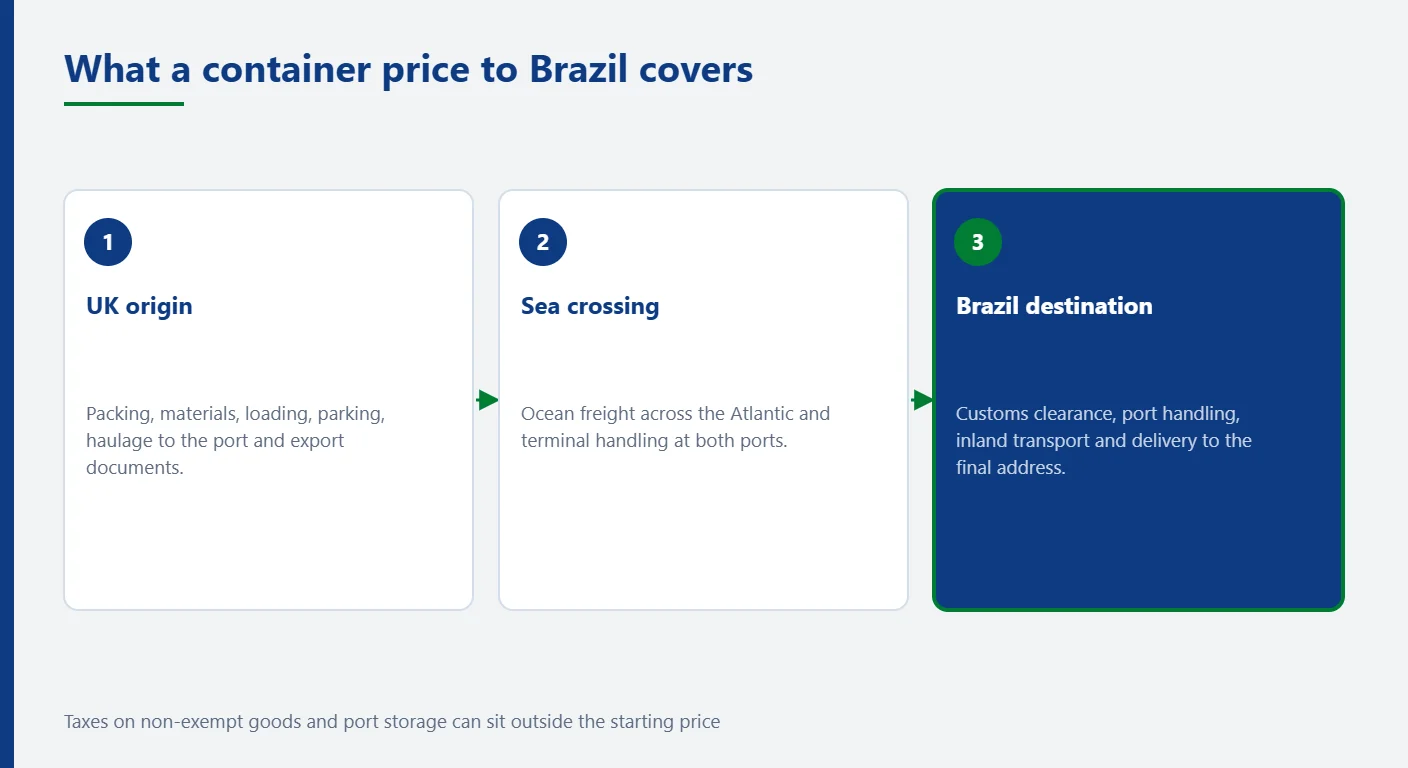
A door-to-door container price covers three stages: work in the UK, the sea crossing and the Brazilian side. EUROBR lists collection, delivery and loading, sea freight and final delivery, and customs clearance and documentation as the components of its fees, with import and local taxes that may apply on top.
UK-side costs: packing, collection and export paperwork
UK-side costs are everything that happens before the container sails. They include packing materials and labour, loading at your address, any parking suspension the street needs, road haulage to the port and the export documentation. Packing is the most variable part: the HomeOwners Alliance removal cost guide puts a professional packing service for a three-bedroom house at around £400 to £500 for a domestic move in 2026, and export packing for a sea crossing takes more care than a local move. In practice, packing your own boxes can lower the price but changes the insurance position, because many policies cover only what the crew packed. EUROBR offers full or part packing with all materials through its packing services.
Sea freight and the port of arrival
Sea freight is the charge for carrying the container across the Atlantic and handling it at both terminals. It is the part of the price most exposed to the global freight market, which is why quotes carry a validity period. Most UK household shipments to Brazil arrive through Santos, the country’s largest port complex, which handled a record 186.4 million tonnes in 2025, a rise of 3.6%, according to A Tribuna’s report on the Port of Santos. A busy port matters for cost because terminal congestion lengthens the time a container waits, and waiting is billed by the day.
Brazil-side costs: clearance, delivery and taxes
Brazil-side costs cover customs clearance, terminal handling at the port of arrival, inland transport and delivery to the final address. Delivery distance matters: a container cleared in Santos and delivered in São Paulo costs less to truck than one going to the interior. Import taxes apply only when goods fall outside the duty-free rules for personal belongings, which are explained below. No English-language authority publishes current destination charges for Brazilian ports, so the figures to insist on are the ones written into your own quote.
| Stage | What it typically covers | Who usually arranges it |
| UK origin | Packing, materials, loading, parking, haulage to port, export documents | The remover |
| Sea crossing | Ocean freight, terminal handling at both ports | The remover with the shipping line |
| Brazil destination | Customs clearance, port handling, inland transport, delivery | The remover’s agent in Brazil |
| Possible extras | Taxes on non-exempt goods, port storage, inspection costs | Depends on paperwork and timing |
What can make the price go up after you book?
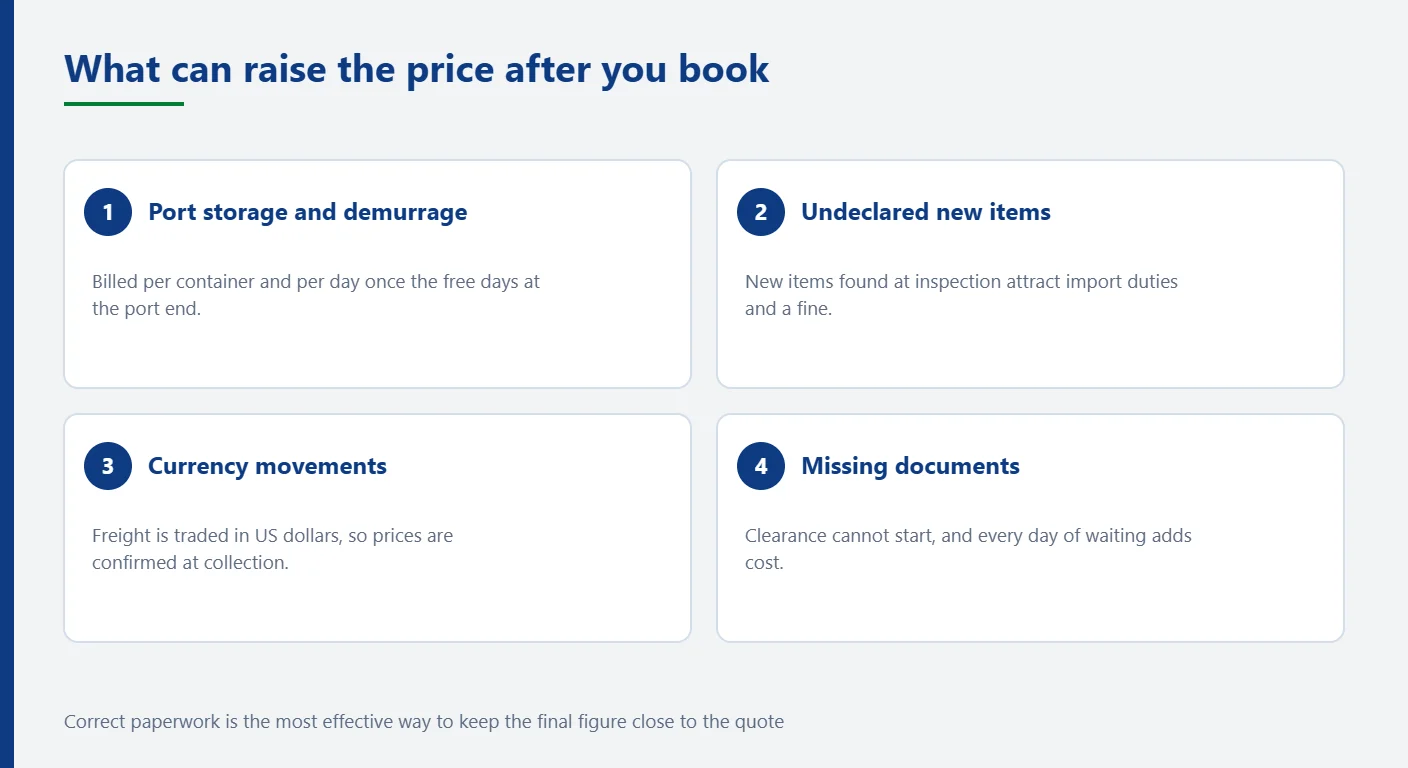
Most price increases after booking come from time spent waiting at the Brazilian port, from customs findings during inspection and from exchange-rate movements. All three can be reduced with correct paperwork and a clear quote.
Demurrage, detention and storage at the port
Demurrage is a daily charge for using a container inside the port terminal beyond the free days, detention is the equivalent charge once the container leaves the terminal, and storage is the fee for the space the container occupies. DHL’s guide to demurrage, detention and storage charges explains that each is billed per container and per day, and that the number of free days depends largely on the location and the ocean carrier. For a household shipment to Brazil, these charges usually start when clearance cannot begin, most often because the owner has not yet arrived or a document is missing. In 12 years of shipping UK households to Brazil, the EUROBR team finds that incomplete paperwork, rather than the sea crossing, is what turns a fair quote into an expensive one.
Customs inspection, undeclared new items and fines
Customs inspection is a physical check of the container by the Brazilian authorities, and it can happen to any shipment. The cost risk lies in what the inspection finds. The International Association of Movers’ Brazil country guide states that new items must appear on the packing list and that undeclared new items found during inspection are subject to import duties and a fine. In practice, the safest approach is to declare everything accurately, separate new items on the inventory and leave out anything that could be read as goods for resale.
Currency and market changes
Currency and market changes affect container prices because freight is traded in US dollars while UK quotes are in pounds. EUROBR states that its container prices are confirmed at collection and subject to currency and market changes, so a quote obtained months before the move is a guide rather than a fixed figure. Booking a collection date and asking how long the quote is valid gives you a firmer number to plan around.
Full or shared container: which costs less for your volume?
An exclusive container costs less per cubic metre when you fill it, while a shared container costs less when your volume is well below a full 20ft. The way to decide is to compare cost per cubic metre for your actual volume.
Working out the cost per cubic metre
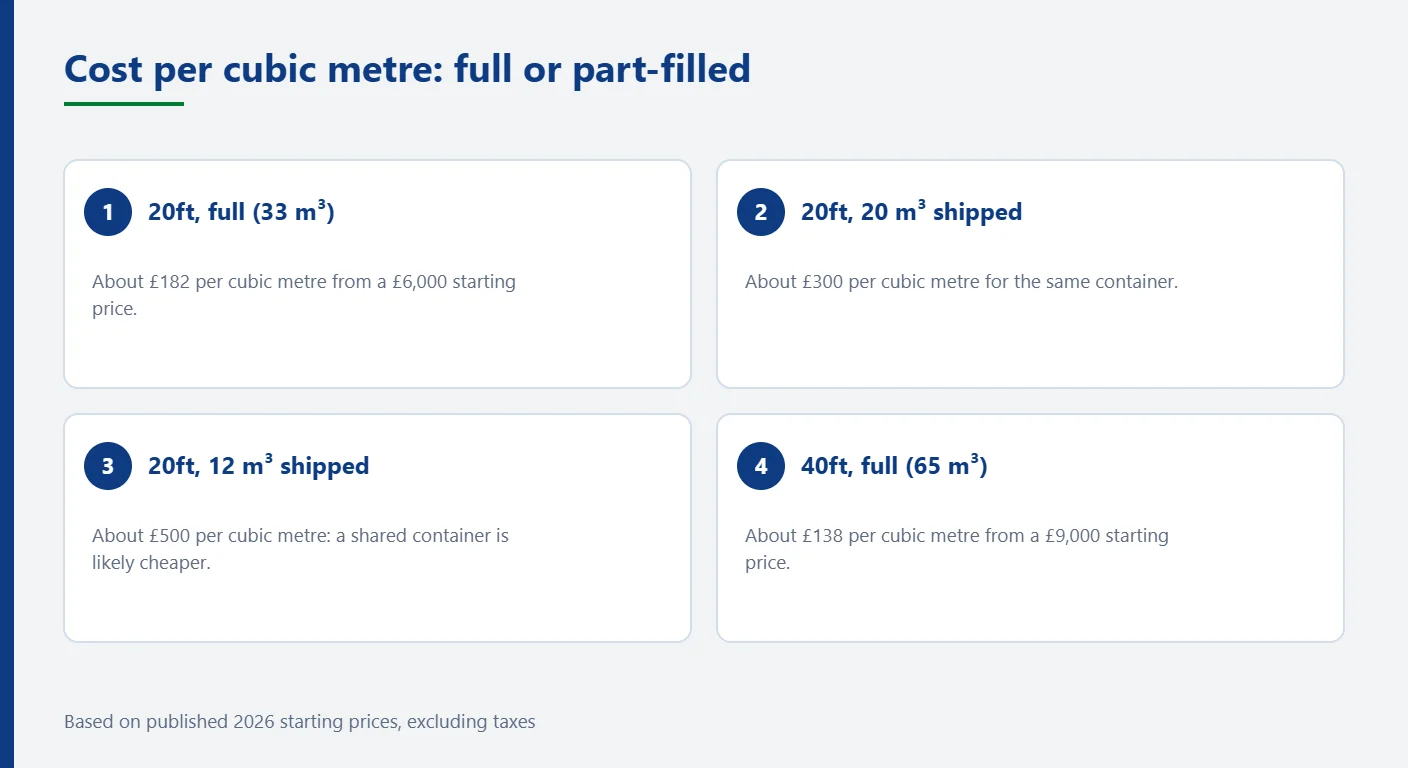
Cost per cubic metre is the container price divided by the volume your belongings actually occupy. Using EUROBR’s published starting prices for 2026, the arithmetic looks like this:
| Scenario | Starting price | Volume shipped | Approximate cost per m³ |
| 20ft exclusive, full | £6,000 | 33 m³ | £182 |
| 20ft exclusive, part full | £6,000 | 20 m³ | £300 |
| 20ft exclusive, part full | £6,000 | 12 m³ | £500 |
| 40ft exclusive, full | £9,000 | 65 m³ | £138 |
The table shows why an exclusive container only makes sense for a large volume: the same box costs almost three times as much per cubic metre when it travels a third full. To compare it with a shared option, multiply the shared rate per cubic metre in your quote by your volume and set the total against £6,000. Below the point where the two meet, the shared container is the cheaper route.
How much space a typical home needs
The space a home needs is measured at the survey, because two flats with the same number of bedrooms can hold very different volumes. A 20ft container of around 33 m³ is roughly the floor area of a single garage with a ceiling a little lower than a typical room, and the 40ft doubles the length. EUROBR describes the exclusive container as best value for a full house or a large volume and the shared container as most economical for smaller loads. In practice, three factors decide the volume more than the bedroom count:
- large furniture such as wardrobes, sofas and beds, which take far more space than boxes
- white goods, which may not be worth shipping against the cost of replacing them in Brazil
- how many items you sell or donate before the survey, since every cubic metre removed lowers the price
How do Brazilian customs rules affect the cost?
Brazilian customs rules decide whether your belongings enter without import duty, which is the single biggest variable in the final cost. Used personal belongings can enter duty-free when the owner qualifies and the paperwork is correct.
The duty-free baggage regime and who qualifies
The baggage regime is the set of rules under which Brazil’s federal revenue service, the Receita Federal, allows used household goods and personal effects to enter without import duty when someone moves home. According to the IAM Brazil country guide, the main conditions are that the owner has lived abroad for at least 12 consecutive months, has not spent more than 45 days in Brazil during those 12 months, and starts clearance within 90 days of arriving, with the shipment arriving within 180 days of the owner. The guide also states that a CPF number is mandatory for all shipments. The official rules are published in Portuguese only, so EUROBR explains them in English and prepares the paperwork at both ends; the UK government’s guidance on living in Brazil covers the wider practical steps of settling there.
Documents that keep extra charges away
The documents that keep charges down are the ones that let clearance start on the day the container arrives. EUROBR lists a Brazilian passport with all pages legible, an RG or CNH identity document, proof of residence abroad, signed customs forms, the boarding pass for the owner’s flight and proof of address in Brazil. The IAM guide adds that the inventory should be in Portuguese, show values in Brazilian Real and include brand, model and serial number for electronics. The EUROBR guide to packing tips and the customs list explains how to build that inventory as you pack.
How do you compare container quotes to Brazil?
Compare container quotes by checking what each one includes from your door to the final address, not by the headline figure. Two quotes with the same price can cover very different work.
Door to door or port to port
A door-to-door quote covers packing, collection, sea freight, clearance and delivery to the final address in Brazil. A port-to-port quote covers only the sea crossing between terminals, leaving clearance, port handling and inland transport to you or to an agent you appoint. Port-to-port prices look lower but often end up higher once the Brazilian side is added, and they leave the customs risk with the owner. EUROBR quotes door to door, with the UK and Brazilian customs paperwork handled end to end.
Questions to ask before you pay
Ask every remover the same questions so the quotes can be compared line by line:
- Is the price door to door, and which Brazilian city does it deliver to?
- Which taxes are excluded, and when could import duty apply?
- How many free days at the Brazilian port are included, and what happens after that?
- Is the price fixed at booking or confirmed at collection?
- What insurance is included, and what is excluded?
- How will you track the shipment while it is at sea?
EUROBR includes standard insurance against loss of cargo on every shipment, sets out its transport terms on the CMR regulations page and lets customers follow a shipment through its online tracking form.
Frequently asked questions
How much does it cost to ship to Brazil from the UK?
Shipping to Brazil from the UK costs from a few hundred pounds for a handful of boxes to around £6,000 or more for a full container, depending on volume and method. For household moves, the main options are an exclusive container, a shared container and individual boxes or suitcases. An exclusive 20ft container of around 33 cubic metres starts from about £6,000 excluding taxes and a 40ft container of around 65 cubic metres from about £9,000, based on prices published for 2026. Shared containers are priced by the cubic metre for loads above 5 cubic metres, and individual boxes and suitcases are priced per item for smaller shipments. The total also reflects packing, collection, export documents, clearance in Brazil and delivery to the final address, and it can rise if goods are not eligible for duty-free entry or if the container waits at the port. Exchange rates matter as well, because ocean freight is traded in US dollars. Since every move differs in volume and destination, a written door-to-door quote is the only reliable figure. The published prices and options are listed on the removals to Brazil service page.
How much does it cost to send a container to Brazil?
Sending an exclusive container to Brazil from the UK costs from about £6,000 for a 20ft unit and about £9,000 for a 40ft unit, excluding taxes, according to starting prices published for 2026. The 20ft container holds roughly 33 cubic metres and the 40ft roughly 65, so the cost per cubic metre falls as the container fills: about £182 per cubic metre for a full 20ft and about £138 for a full 40ft. A part-filled container costs the same as a full one, which pushes the effective price per cubic metre up sharply, to around £500 when only 12 cubic metres travel in a 20ft. For that reason, households with smaller volumes usually choose a shared container, where only the occupied space is charged. The starting price is confirmed at collection and can move with currency and market changes. Destination costs in Brazil, such as port storage beyond the free days and duties on goods that are not exempt, sit outside the starting price and depend on paperwork and timing. How space is shared and charged on a consolidated sailing is explained in the guide to the shared container to Brazil.
How much does it cost to ship a 40-foot container internationally?
The cost of shipping a 40-foot container internationally depends mainly on the route, the season, the fuel and freight market and whether the price covers only the sea crossing or the full door-to-door service. For household moves from the UK to Brazil, an exclusive 40ft container of around 65 cubic metres starts from about £9,000 excluding taxes, based on prices published for 2026, and that figure covers collection, sea freight, clearance and delivery rather than freight alone. Pure ocean freight rates for commercial cargo are quoted in US dollars and change weekly, so they are a poor guide to the cost of a household move, which also involves packing, loading, documentation and customs work at both ends. A 40ft container offers the lowest cost per cubic metre when it is filled, at roughly £138 per cubic metre against about £182 for a full 20ft, but it is only economical for very large homes or combined shipments. Access matters too, because a 40ft container needs space on the street for loading. The wider planning steps for a household move are set out in the guide to removals to Brazil from the UK.
What is the import duty rate to Brazil?
Import duty on used household goods shipped to Brazil is normally zero when the owner qualifies for the duty-free baggage regime and declares the shipment correctly. The International Association of Movers’ Brazil guide sets out the main conditions: at least 12 consecutive months living abroad, no more than 45 days spent in Brazil during that period, a CPF number for the shipment, clearance starting within 90 days of the owner’s arrival and the goods arriving within 180 days of it. Goods outside those rules are treated as imports and taxed, and the same guide warns that undeclared new items found during inspection attract import duties and a fine. New items can be included when they are listed separately on the packing list. If the owner spent more than 45 days in Brazil during the qualifying year, duties apply to most items except clothes, shoes, books and documents. The official rules are published in Portuguese by the Receita Federal, so requirements should be confirmed with the remover before packing. The inventory and documents that support a duty-free claim are explained in the guide to packing tips and the customs list.
How expensive is it to ship to Brazil?
Shipping to Brazil is expensive mainly because of distance, volume and the work involved at both ends of the journey rather than the sea crossing alone. A container crosses the Atlantic over several weeks, and EUROBR publishes an average of 60 to 120 days from collection to final delivery, with shared containers taking 70 to 120 days because they wait to be filled and combined. Brazilian customs procedures for personal belongings require detailed inventories, identity documents and proof of residence abroad, and the work of preparing them is part of the price. The Brazilian side adds port handling, clearance and inland transport, which grows with the distance from the port of arrival to the final address. Costs rise further when a container waits at the port, because demurrage and storage are billed per container and per day once the free days end. The expense can be managed by reducing volume before the survey, choosing a shared container for smaller loads and preparing documents early so clearance starts on arrival. Smaller shipments of boxes and suitcases, and their costs, are compared in the guide to shipping boxes to Brazil from the UK.
What can I not ship to Brazil?
Items that cannot be shipped to Brazil in a household move include anything that breaches Brazilian import law, and such items may be seized or destroyed by customs. The International Association of Movers’ Brazil guide lists live plants, drugs and narcotics, flammable or corrosive materials, tins, high-value coins, stamp collections and food among the prohibited items, and advises against including food, beverages or medicines. EUROBR’s own published list adds plants, herbs, animals and their derivatives, and certain media such as pen drives, CDs and DVDs, alongside industrial and power tools. Removals to Brazil are for personal belongings only, so every item should show signs of prior use and must not be intended for resale; goods that look commercial, such as several identical new items, can lose duty-free treatment. Wooden packing material must be fumigated to the international ISPM-15 standard. Vehicles are restricted, and the IAM guide states that only foreign diplomats and members of international organisations may import motor vehicles for personal use. Checking the list before packing avoids fines and inspection delays. What can and cannot go into a box or suitcase is explained in the guide to shipping boxes to Brazil from the UK.
Getting an accurate price for your container to Brazil
The cost of shipping a container to Brazil becomes predictable once three things are fixed: your real volume, the delivery city and complete paperwork. The published starting prices of £6,000 for a 20ft and £9,000 for a 40ft, excluding taxes, give you a benchmark, and the cost-per-cubic-metre arithmetic shows whether a shared container would cost less. Moving abroad from the UK is common: an estimated 246,000 British nationals alone left the UK in 2025, according to the ONS emigration analysis, and the households that move most smoothly are the ones that prepare the inventory before the survey. EUROBR has run London moves since 2013, ships to Brazil on monthly departures, is fully insured and handles the customs paperwork at both ends with a bilingual team.
Planning a move to Brazil? EUROBR runs monthly departures and handles the customs paperwork end to end. Get an international quote today: message on WhatsApp at +44 7878 921856 or request a price online.