
A shared container to Brazil, known in the freight trade as LCL or less than container load, is sea freight in which your boxes and furniture travel inside a container alongside other people’s consignments, and you pay only for the cubic metres you occupy rather than for the whole box.
EUROBR prices shared space by the cubic metre for shipments above 5m³ and offers suitcase and box options below that, with a published door to door window of 70 to 120 days for shared containers as of 2026. The shipping is rarely what causes trouble. Brazilian customs requires a CPF, an itemised inventory valued in Brazilian Real, and proof that the owner lived abroad for at least 12 continuous months. Clearance cannot begin until the owner has arrived in Brazil.
Choosing a shared container to Brazil makes sense the moment you have more than a few boxes but nowhere near enough furniture to justify paying for a sealed 20ft container on your own. A 20ft unit holds roughly 33m³, which is close to the contents of a three bedroom house. Most people moving from the UK to Brazil have between 5m³ and 15m³, so three quarters of that container would travel empty at full price. Sharing removes that waste. What it adds is handling, paperwork and a timetable you do not control alone, and this guide covers all three honestly. The Office for National Statistics estimated in its UK emigration analysis published on 21 May 2026 that 246,000 people left the UK in the year ending December 2025, and a large share of them face exactly this calculation.
What is a shared container to Brazil and how does it work?
A shared container to Brazil is a sea freight service in which a forwarder loads several customers’ goods into one container, ships it, then separates the consignments at the destination for individual delivery. You buy space, measured in cubic metres, rather than a container.
The mechanics matter because they explain both the saving and the extra time. Your goods are collected in the UK, wrapped and inventoried, then taken to a consolidation warehouse where they wait for the container to be filled and for the sailing. At the Brazilian port the container is opened and broken down into its separate consignments, each of which clears customs on its own documents before inland delivery. Every one of those steps is a handover, and every handover is a place where a missing document stops the goods rather than the ship.
Shared container (LCL) against full container load (FCL)
Maersk’s explainer on understanding ocean freight sets out the distinction in terms worth quoting. With LCL, “you pay only for the container space you use, measured in cubic metres (CBM)”, and the logistics provider is “responsible for consolidation (grouping your shipment with others to fill a container) and deconsolidation (unpacking and separating the cargo for delivery at the destination)”. FCL, by contrast, “is when a shipping container is fully booked and loaded by one shipper, even if the container isn’t 100% full”, and you pay a flat rate for exclusive use.
The trade-offs follow directly from that. Maersk describes LCL as “cost-efficient for low-volume shipments” with “frequent departures”, but also as carrying “more handling, higher risk exposure”. FCL is “faster, direct routing with fewer touchpoints and no consolidation delays” and “sealed from origin to delivery”.
| Point of comparison | Shared container (LCL) | Full container (FCL) |
| What you pay for | Cubic metres occupied | The whole container |
| Typical fit from the UK to Brazil | 5m³ to around 15m³ | Above roughly 20m³ |
| Handling | Loaded, consolidated, deconsolidated, delivered | Sealed at origin, opened at destination |
| Seal | Container shared with other consignments | Your seal only |
| Departure flexibility | Frequent, but subject to the container filling | Books to a named sailing |
| Realistic transit, EUROBR published window 2026 | 70 to 120 days door to door | 60 to 120 days door to door |
| Risk profile | More touchpoints, so packing quality matters more | Fewer touchpoints |
What consolidation and deconsolidation involve in practice
Consolidation is the stage most people have never heard of and the one that sets the real departure date. Your consignment sits in a warehouse until the container has enough cargo to sail economically, which is why a shared container cannot be promised to a specific day the way a dedicated van to Portugal can. Deconsolidation at the Brazilian end is the mirror image, and it is where storage charges begin to accumulate if your paperwork is not ready. DHL Global Forwarding’s guide to demurrage, detention and storage charges defines demurrage as the charge for “usage of container equipment inside the port terminal”, detention as the charge that arises “outside the port terminal”, and storage as the cost of the “storage space occupied by the container on terminal grounds, inside a warehouse or at the container yard”. All three are “billed per container and per day”, and the free period before they start “depends to a large extent on the location and selected ocean carrier”.
Read that in plain terms: paperwork delay in Brazil is not a neutral wait. The charges accrue against your consignment from the day the free period ends.
How much does a shared container to Brazil cost in 2026?
The price of a shared container to Brazil is built from the volume you occupy, the origin and destination pairing, and a set of destination charges that are paid in Brazil rather than in the UK. Volume is the dominant variable.
Freightos, which publishes a public LCL calculator, explains that LCL cost is worked out primarily by volume in cubic metres, with weight treated as a secondary factor because container ships can carry far more weight than most consignments ever present. That is the single most useful thing to understand before you ask for a quote: reducing the number of cubic metres you ship reduces the freight cost almost proportionally, while shedding a few kilograms usually changes nothing.
The published EUROBR figures, and the arithmetic they allow
EUROBR publishes its container pricing openly on the removals to Brazil from the UK service page, which lets you do the comparison yourself rather than take a saving on trust.
| Option | Capacity and dimensions | Published price, 2026 |
| 20ft exclusive container | Approx. 33m³, 6m x 3.35m x 2.4m | From £6,000 ex. taxes |
| 40ft exclusive container | Approx. 65m³, 12m x 3.35m x 2.5m | From £9,000 ex. taxes |
| Shared container | Priced per cubic metre for shipments above 5m³ | Quoted per m³ |
| Suitcase | Up to 32kg, 77 x 45 x 29cm | Quoted per item |
| Regular box | Up to 40kg, 49 x 41 x 61cm | Quoted per item |
| Royal box | Up to 80kg, 73 x 58 x 64cm | Quoted per item |
Run the numbers on the 20ft figure. At 33m³ from £6,000, a container filled to capacity works out at roughly £182 per cubic metre. Ship only 12m³ in that same exclusive container and the effective rate rises to about £500 per cubic metre, because you are still paying for 33m³ of space. That gap, not a generic percentage, is where the saving on a shared container actually lives, and it widens the smaller your consignment is.
Destination charges, port tariffs and taxes in Brazil
This is the part of a shared container quote that catches people out, because several of the charges are levied in Brazil, in Brazilian Real, after the goods have sailed. Ask for each of the following to be named in writing before you commit, with an indication of whether it is included in your quote or payable separately on arrival:
- Terminal handling and deconsolidation at the port of discharge
- Customs clearance and documentation handling in Brazil
- Port storage from the end of the free period, plus demurrage or detention if applicable
- Any duty or state tax assessed on items that fall outside the household goods relief
- Inland transport from the port to your delivery address
- Notarisation and translation of documents required in Brazil
- Handling of a customs inspection, if your consignment is selected for one
No English-language authority publishes current terminal handling tariffs for Brazilian ports, so treat any single headline figure with suspicion and insist on the itemised list instead. EUROBR’s own published position on the Brazil route is blunt and worth holding onto: “Correct paperwork is what keeps a shipment moving.”
How do you measure the volume you are paying for?
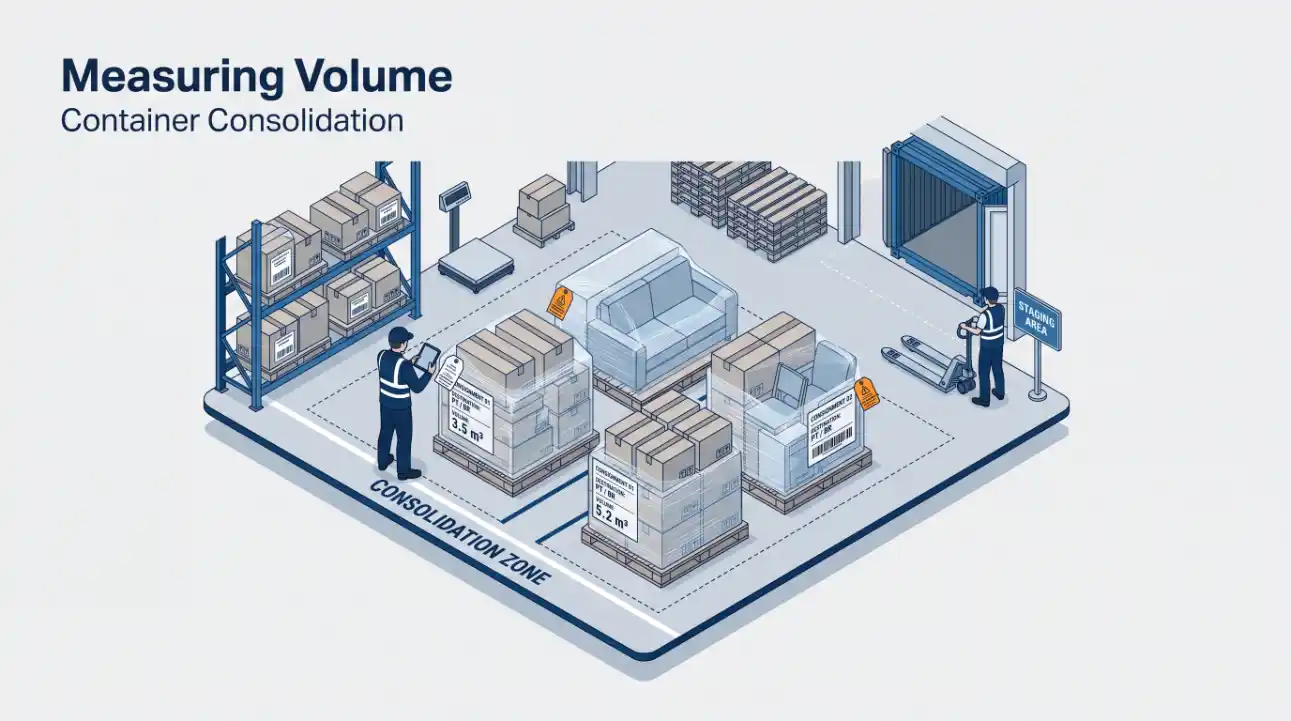
Volume is measured as the space your goods occupy once they are packed and stacked, not the space the bare furniture would take up. That distinction routinely adds 15 to 25 per cent to an owner’s own estimate.
A wardrobe measured as a box is one figure. The same wardrobe wrapped in protective material, loaded onto a pallet and stacked so nothing can shift at sea is a larger figure, and the larger figure is what you pay for. Sofas cannot be compressed, mattresses have to be boxed, and the gaps between irregular items are chargeable space rather than free space.
As a working reference before a survey, a studio or one bedroom flat usually produces 10m³ to 15m³, a two bedroom home 18m³ to 25m³, and a three bedroom home 28m³ to 35m³. Those bands are an industry reference rather than a quote: the only figure that binds anyone is the one on a written quotation after your inventory has been assessed. For comparison, a London move of the same size is costed on access and crew rather than on cubic metres, as the house and flat removals service explains. Our guide to packing box sizes for moving house explains how box choice changes the final cube, and the professional packing service guide covers what export-grade wrapping involves.
Two practical consequences follow. First, decluttering before the survey is the cheapest intervention available to you, because every cubic metre removed is a cubic metre not billed. Second, a quote given over the phone without any assessment of what you own is a guess, and a guess that is revised upwards after the van arrives is the most common complaint in international moving.
How long does a shared container to Brazil take?
EUROBR publishes a door to door window of 70 to 120 days for shared containers to Brazil and 60 to 120 days for exclusive containers, as of 2026. That window is wide because it covers three separate processes, only one of which is the ocean voyage.
The sailing itself is the most predictable element. Maersk’s Brazil routes page shows that the service connecting North Europe to Brazil is the NEO Samba, calling at Southampton Container Terminal on the British side. The page does not publish a fixed transit figure per port pairing, so no honest guide can give you a guaranteed sailing time, and anyone who does is quoting a schedule they cannot control.
The three stages behind the published window
| Stage | What happens | What governs the time |
| UK side | Collection, export packing, inventory, delivery to the consolidation warehouse, waiting for the container to fill | Your readiness and the consolidation schedule |
| Ocean leg | Loading, sailing, any transhipment, discharge at the Brazilian port | Carrier schedule and port congestion |
| Brazil side | Deconsolidation, customs clearance, release, inland delivery | Your documents, your arrival date, Receita Federal |
Why clearance and inland delivery add the days people do not budget for
Two Brazilian rules shape the end of the timeline more than any shipping decision. Clearance cannot begin before the owner of the goods has arrived in Brazil, and once the owner has arrived, clearance should begin within 90 days or the shipment risks being seized. Pair that with the storage charges described above and the pattern becomes obvious: a consignment that arrives before its owner, or whose owner delays, costs money every day it waits.
Santos is where most of this traffic lands, and its scale explains why clearance queues are a real factor rather than an excuse. The English edition of A Tribuna reported on 16 January 2026 that the Port of Santos handled 186.4 million tonnes in 2025, a rise of 3.6 per cent and the best performance in the complex’s history.
Which documents does Brazilian customs require?
Brazilian customs requires a CPF for every shipment, a detailed inventory valued in Brazilian Real, and documentary proof that the owner has lived abroad long enough to qualify for the household goods regime. Missing any of the three stops the consignment rather than slowing it.
The CPF and the inventory
The CPF is the Brazilian taxpayer registration number, and it is non-negotiable. The International Association of Movers’ Brazil country guide states that “a CPF number is mandatory for all shipments”, and that the registered address should match the delivery address. The same requirement applies even to small parcels: Parcelforce’s Brazil worldwide directory entry records that “the Federal Revenue Department of Brazil requires the Taxpayer Identification Number (CPF) and a local telephone number on all shipments”.
The inventory is the document that decides how smoothly clearance goes. It must be itemised, written in Portuguese, and show brand, model and serial number for each relevant item, with values in Brazilian Real. New items have to be identified separately from used ones. A box labelled “kitchen” will not do. A line reading “Samsung microwave, model MS23F301TAK, serial number …, used, R$ …” will.
The residence conditions behind a duty-free entry
The household goods regime exists for people genuinely moving their lives, and the conditions are specific. According to the IAM country guide, returning citizens and holders of a permanent visa must have lived abroad for at least 12 contiguous months before relocating, and must not have spent more than 45 days inside Brazil during those 12 months. Shipments must arrive within 180 days of the owner’s own arrival. Exceed the 45 day limit and duty becomes payable on most items.
| Document | When it is needed | What it proves |
| Brazilian passport, all pages legible | Before shipping | Identity and travel history |
| RG or CNH, front and back | Before shipping | Identity |
| Proof of residence abroad: 14 months of bank statements or a consular certificate | Before shipping | The 12 month residence condition |
| Signed shipping guides | Before shipping | Authority to ship on your behalf |
| CPF | Throughout | Taxpayer registration, mandatory |
| Itemised inventory in Portuguese, valued in Brazilian Real | Before shipping | What is in the container and what it is worth |
| Boarding ticket to Brazil | On the day of shipping | Intention and date of relocation |
| Proof of Brazilian address | In Brazil | Where the goods are going |
| Notarised shipping guides | In Brazil | Local legal authority to clear |
The deadlines that can cost you the shipment
Four dates run in parallel, and losing track of them is the single most expensive mistake on this route.
- At least 12 contiguous months of residence abroad before the move
- No more than 45 days spent inside Brazil during those 12 months
- Shipment must arrive within 180 days of the owner’s arrival in Brazil
- Clearance must begin within 90 days of the owner’s arrival, or customs may seize the shipment
What can and cannot travel in a shared container to Brazil?
Used household goods and personal effects are the core of what the regime is designed for. Vehicles, live plants, food and several other categories are either prohibited outright or lose the relief, and a shared container gives you less room to negotiate than an exclusive one because your goods sit alongside other people’s.
Can you ship a car to Brazil in a shared container?
No, not as a private individual. The IAM Brazil country guide is unambiguous: “only foreign diplomats or members of international organizations such as UNO, UNESCO, IMF, etc. may import motor vehicles for personal use.” That restriction applies to returning Brazilian citizens and to foreign nationals with permanent or temporary visas alike. EUROBR does not publish a vehicle shipping service to Brazil, and its international services list sea container shipping to Brazil and road routes to Portugal and Europe, so treat the rule above as information to plan around rather than a service to request.
Items that are refused, taxed or destroyed
The prohibited list in the IAM guide covers live plants, drugs and narcotics, flammable and corrosive materials, tins, high-value coins, stamp collections and food. Parcelforce’s Brazil entry carries a warning that applies with equal force to a container consignment and deserves to be read twice: “used goods are also prohibited and will be destroyed if found inside items.” That rule bites on parcels rather than on a properly declared household goods shipment, but it illustrates how literally Brazilian customs treats an undeclared item inside a declared one.
Three practical rules follow. Declare everything, including the half-used bottles you were going to slip into a box. Keep new and unused items on a separate line of the inventory, because they are assessed differently. Do not let anyone else’s goods travel under your documents, which is a real risk in a shared container and a reason to insist that your consignment is inventoried and sealed as a unit before consolidation.
How does insurance work when your goods share a container?
EUROBR states on its Brazil service page that “all shipments include standard insurance against loss of cargo”, with extended cover available, and that Goods in Transit and CMR cover apply to its moves. Cover of this kind is tied to who packed the goods, which matters more on a shared container than on any other service because the consignment is handled several more times.
Two terms are worth defining once, because quotes use them without explanation. Goods in Transit insurance covers your belongings while they are in the carrier’s custody, within the limits and exclusions in the policy. CMR is the Convention on the Contract for the International Carriage of Goods by Road, the international treaty that governs a road carrier’s liability on cross-border journeys, and it sits behind the road legs of an international move rather than the sea leg. EUROBR publishes the convention on its CMR regulations page.
What professional packing changes
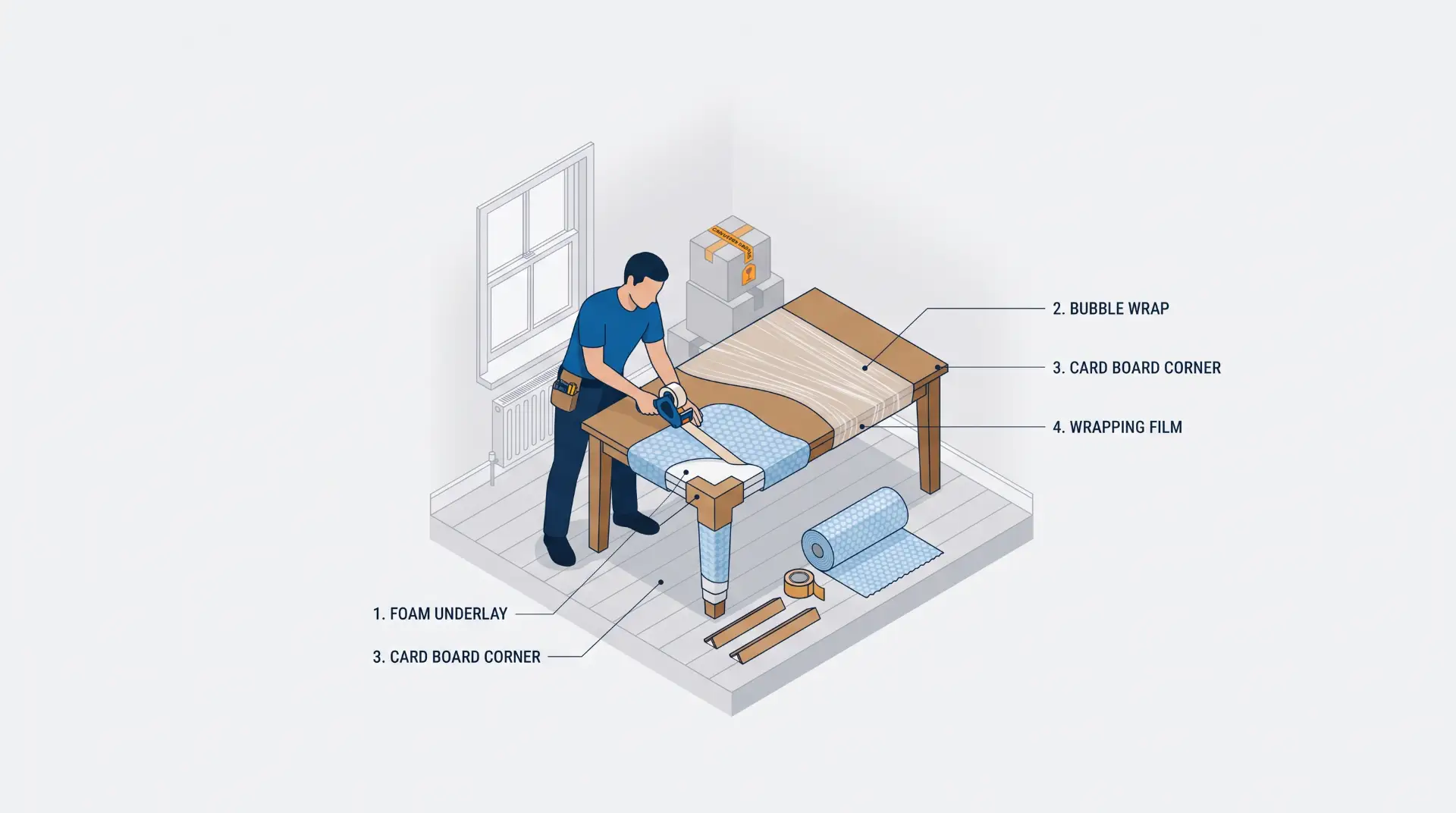
EUROBR’s published terms on the European route state that standard Goods in Transit insurance covers items professionally packed by its team, and that items packed by the customer are the customer’s own responsibility. The published exclusions on the Brazil route are fragile items such as glass, ceramics, jewellery and artwork, together with plants and pets. The same rule sits behind the packing services and materials offer, where export-grade wrapping is specified for long journeys. On a shared container this is not a technicality. Your boxes will be lifted, stacked, moved to make room for someone else’s consignment, shipped, then unstacked and separated at the other end. Packing that would survive a van ride across London will not necessarily survive that.
There is a safety dimension too. The Health and Safety Executive’s figures for 2024/25 record 59,219 non-fatal injuries reported by employers under RIDDOR, with 17 per cent arising from handling, lifting or carrying, and its guidance on the law on manual handling sets out the duty to avoid, assess and reduce such risks. Heavy boxes packed for a long sea journey are exactly the scenario those rules address.
What to ask for in writing
In 12 years moving London households, and running the monthly road route covered on the removals to Europe page alongside the Brazil container service, the EUROBR team finds the consignments that clear cleanly are the ones where the inventory was built properly before anything was loaded, not the ones where the paperwork was chased afterwards. Ask your mover for the following, on paper:
- The total limit of the Goods in Transit cover and any per item limit
- Whether the sea leg and the road legs are covered under the same policy
- Which items are excluded, and whether professional packing changes that
- What happens if a shared container is delayed in consolidation
- Who pays port storage if clearance is held up, and from which date
- The claims procedure and the deadline for notifying damage
Consumer protection in the UK also applies to the service itself. Citizens Advice explains that under the Consumer Rights Act 2015 a service must be carried out with reasonable care and skill, and that the remedies are repeat performance or a price reduction. For standards specifically, the British Association of Removers requires members to pass an external audit each year and to follow a Chartered Trading Standards Institute code of practice.
Frequently asked questions about shipping a shared container to Brazil
How much does a shared container to Brazil cost?
The cost of a shared container is quoted per cubic metre rather than as a single headline price, because the volume you occupy is the dominant variable. EUROBR prices shared space per cubic metre for consignments above 5m³ and offers suitcase and box options below that threshold, with published sizes of 32kg, 40kg and 80kg respectively. For comparison, the same published price list shows an exclusive 20ft container of roughly 33m³ from £6,000 excluding taxes and a 40ft of roughly 65m³ from £9,000, which works out at about £182 per cubic metre when a 20ft unit travels full. Beyond the freight itself, a realistic budget allows for destination charges payable in Brazil: terminal handling, deconsolidation, customs documentation, inland delivery and any port storage incurred after the free period ends. Duty may also apply to items that fall outside the household goods regime. Because several of these charges are levied in Brazilian Real after the goods have sailed, the only figure that means anything is an itemised written quote that states which charges are included and which are payable on arrival. Full pricing is published on the removals to Brazil service page.
How long does a shared container take to reach Brazil?
EUROBR publishes a door to door window of 70 to 120 days for shared containers to Brazil as of 2026, against 60 to 120 days for an exclusive container. The width of that window reflects three separate processes rather than uncertainty about the voyage. On the UK side, the consignment is collected, export packed, inventoried and delivered to a consolidation warehouse, where it waits for the container to fill and for a sailing. The ocean leg then follows the carrier’s schedule, and the service linking North Europe to Brazil calls at Southampton. On arrival the container is deconsolidated, each consignment clears customs on its own documents, and inland delivery follows. The Brazilian stage is the one most affected by the owner’s own actions, because clearance cannot begin until the owner has arrived in the country and must start within 90 days of that arrival. A shared container is therefore slower than an exclusive one by design, not by failure. Shipments can be followed through the tracking form.
Do I need a CPF to ship a shared container to Brazil?
Yes. A CPF, the Brazilian taxpayer registration number, is mandatory for every shipment entering Brazil, and the registered address on it should match the address where the goods will be delivered. The International Association of Movers states the requirement without qualification, and Parcelforce records that Brazil’s Federal Revenue Department requires a CPF and a local telephone number on all shipments, including small parcels. Without a CPF the consignment cannot be cleared, which means it sits in the port accruing storage charges while the problem is resolved. Anyone who has lived in Brazil will usually hold one already, but it is worth checking that the registration is active and that the address on it is current before the container sails rather than afterwards. Foreign nationals shipping household goods to a Brazilian address also need one. The CPF sits alongside the itemised inventory and the proof of residence abroad as the three documents that decide how smoothly clearance goes, and it is covered in the removals to Brazil guide.
Can I ship a car to Brazil in a shared container?
No. Private vehicle imports are closed to ordinary individuals. The International Association of Movers’ Brazil country guide states that only foreign diplomats or members of international organisations such as the United Nations, UNESCO or the International Monetary Fund may import motor vehicles for personal use. The restriction applies to returning Brazilian citizens and to foreign nationals holding either permanent or temporary visas, so there is no household goods route that allows a car to travel with the rest of a consignment. Motorcycles and other motor vehicles fall under the same rule. The practical consequence is that a vehicle has to be sold or otherwise disposed of in the UK before the move, and replaced in Brazil. EUROBR does not publish a vehicle shipping service on the Brazil route, so this is set out here as regulatory information to plan around rather than as something to request a quote for. Household goods, furniture and personal effects remain the core of what the shared container service is designed to carry, as described on the removals to Brazil service page.
What is the difference between LCL and FCL shipping?
LCL stands for less than container load and FCL for full container load. With LCL you buy space inside a container that several customers share, priced by the cubic metre, and the forwarder groups your goods with other consignments to fill the unit and then separates them again at the destination. Maersk describes those two stages as consolidation and deconsolidation. With FCL you book the whole container and pay a flat rate for exclusive use, even if it is not completely full, and it travels sealed from origin to delivery. The practical differences follow from that. LCL suits smaller volumes and has frequent departures, but involves more handling and therefore more risk exposure, and it is slower because the container has to fill before it sails. FCL is faster and more secure, with fewer touchpoints, and becomes cheaper per cubic metre once your volume approaches the capacity of the container. For a UK to Brazil household move, the crossover usually sits somewhere above 20m³, which the removals to Brazil guide covers in more detail.
How is the volume of a shared container shipment calculated?
Volume is measured as the space your goods occupy once they have been packed, wrapped and stacked, which is consistently larger than the space the bare furniture would take. Protective wrapping, pallets, boxed mattresses and the unavoidable gaps between irregular items all count as chargeable cubic metres, and an owner’s own estimate is typically 15 to 25 per cent below the measured figure. As a rough industry reference before any survey, a studio or one bedroom property tends to produce 10m³ to 15m³, a two bedroom home 18m³ to 25m³, and a three bedroom home 28m³ to 35m³. Those bands are useful for deciding whether shared or exclusive shipping is the right question to ask, not for budgeting. Because freight cost scales almost directly with volume, reducing what travels is the most effective way to reduce the bill, and sorting through belongings before the survey rather than after it is where the saving is made. Box choice also changes the final cube, which the guide to packing box sizes explains.
What cannot be shipped to Brazil in a container?
The prohibited list for Brazil covers live plants, drugs and narcotics, flammable and corrosive materials, tins, high-value coins, stamp collections and food items, according to the International Association of Movers’ country guide. Motor vehicles are separately closed to private individuals. Beyond outright prohibitions, a second category causes more problems in practice: items that are permitted but lose the household goods relief because they are new, unused or clearly commercial, and are therefore assessed for duty and state tax. New items must be identified separately on the inventory rather than mixed in with used household goods. A third risk is the undeclared item inside a declared box, which Brazilian customs treats strictly. Parcelforce’s Brazil guidance warns that used goods found inside parcels are destroyed, which indicates how literally declarations are read. The safe approach is to declare everything, keep new and used items on separate lines, and let the inventory be built before packing rather than reconstructed afterwards, as set out in the moving from the UK customs checklist.
Ready to get your shared container to Brazil quoted properly
The decision between a shared and an exclusive container is settled by one number, which is how many cubic metres you actually need to move. Everything else follows from it: the price per cubic metre, the realistic transit window, and whether the paperwork has time to be built properly before the container sails.
EUROBR runs a sea container service from the UK to Brazil with exclusive and shared options, monthly departures, full or part packing with materials, and door to door collection and delivery, and the team prepares the customs documentation at both ends. The published door to door window for shared containers is 70 to 120 days as of 2026, and delivery timing depends on sailing schedules and on clearance by Receita Federal, so the team gives you a realistic window with your quote rather than a date it cannot control. The removals to Brazil service page carries the published container prices and the full document list, and the moving checklist covers the UK side of the preparation.
Planning a move to Brazil? EUROBR runs monthly departures and handles the customs paperwork end to end. Message on WhatsApp at +44 7878 921856, email [email protected], or request an international quote today.