
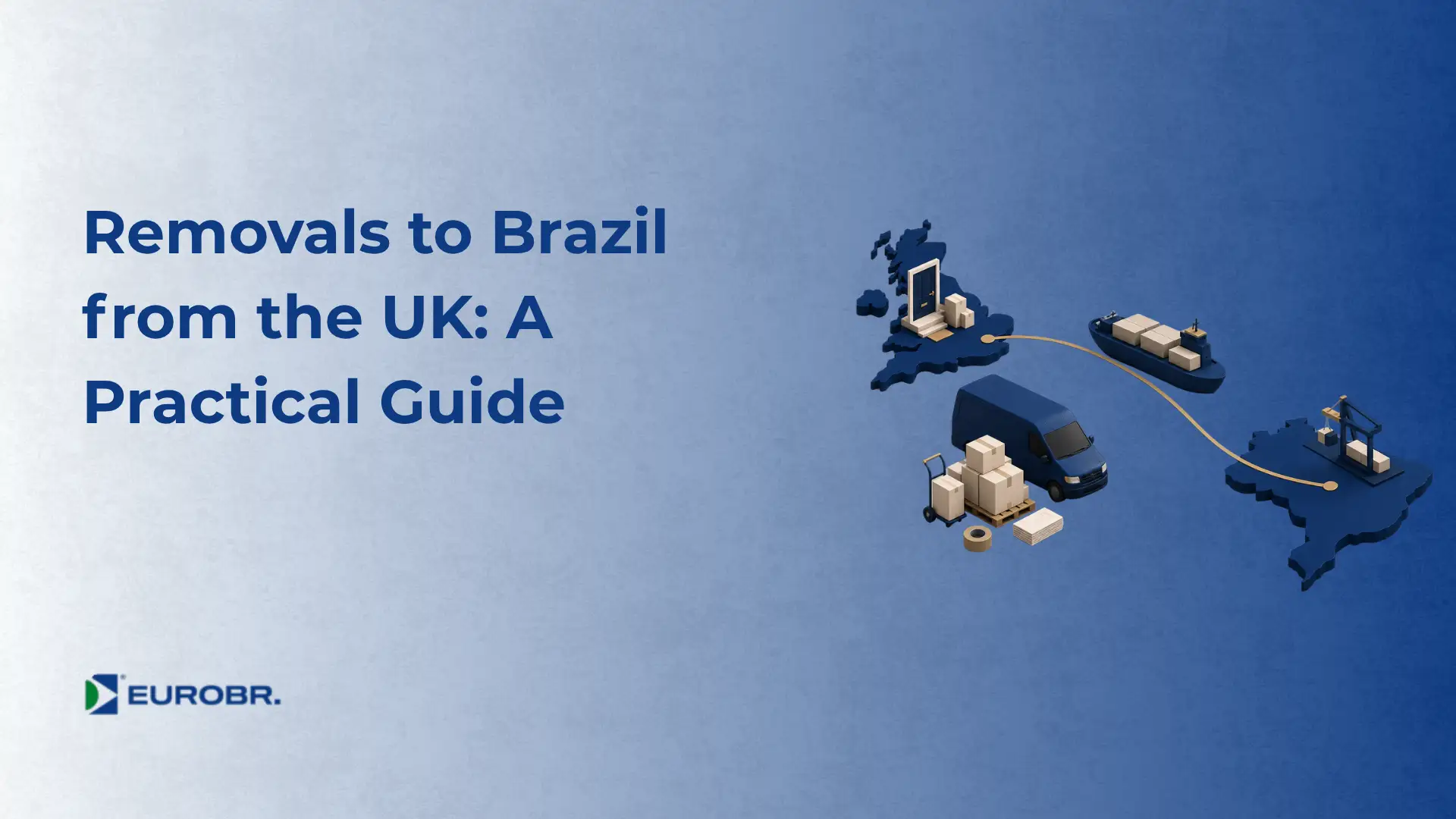
Removals to Brazil from the UK normally travel by sea container, either as a full container for a whole household or as a shared container where you pay for the cubic metres you use.
The sailing itself is the short part. Ocean carriers put transatlantic voyages in a 20 to 45 day band, but door to door timings run far longer once export packing, consolidation, Brazilian customs clearance and inland delivery are added. EUROBR publishes an estimated 60 to 120 days door to door on its removals to Brazil service as of 2026. The single biggest cause of delay and unexpected cost is not the ship. It is paperwork that does not match the cargo, which leaves a container sitting at Santos or Rio de Janeiro accumulating daily storage charges.
Why removals to Brazil from the UK are a paperwork problem before they are a logistics problem
Removals to Brazil from the UK are governed by a customs regime for used personal belongings, and qualifying for it depends almost entirely on documents prepared before the container sails. Most people planning the move focus on volume, dates and price. Those matter, but they are the solvable part. Brazilian customs clearance is where a well-run move separates from a badly run one, because a container whose inventory does not match its contents can be held for inspection while port storage accrues daily. The Office for National Statistics estimated in its analysis of UK emigration that 246,000 British nationals left the UK to live abroad long term in the year ending December 2025, in figures published on 21 May 2026, and every one of those households faced some version of the same question: what travels, what stays, and what does the destination country need to see in writing.
Planning your relocation: removals to Brazil from the UK
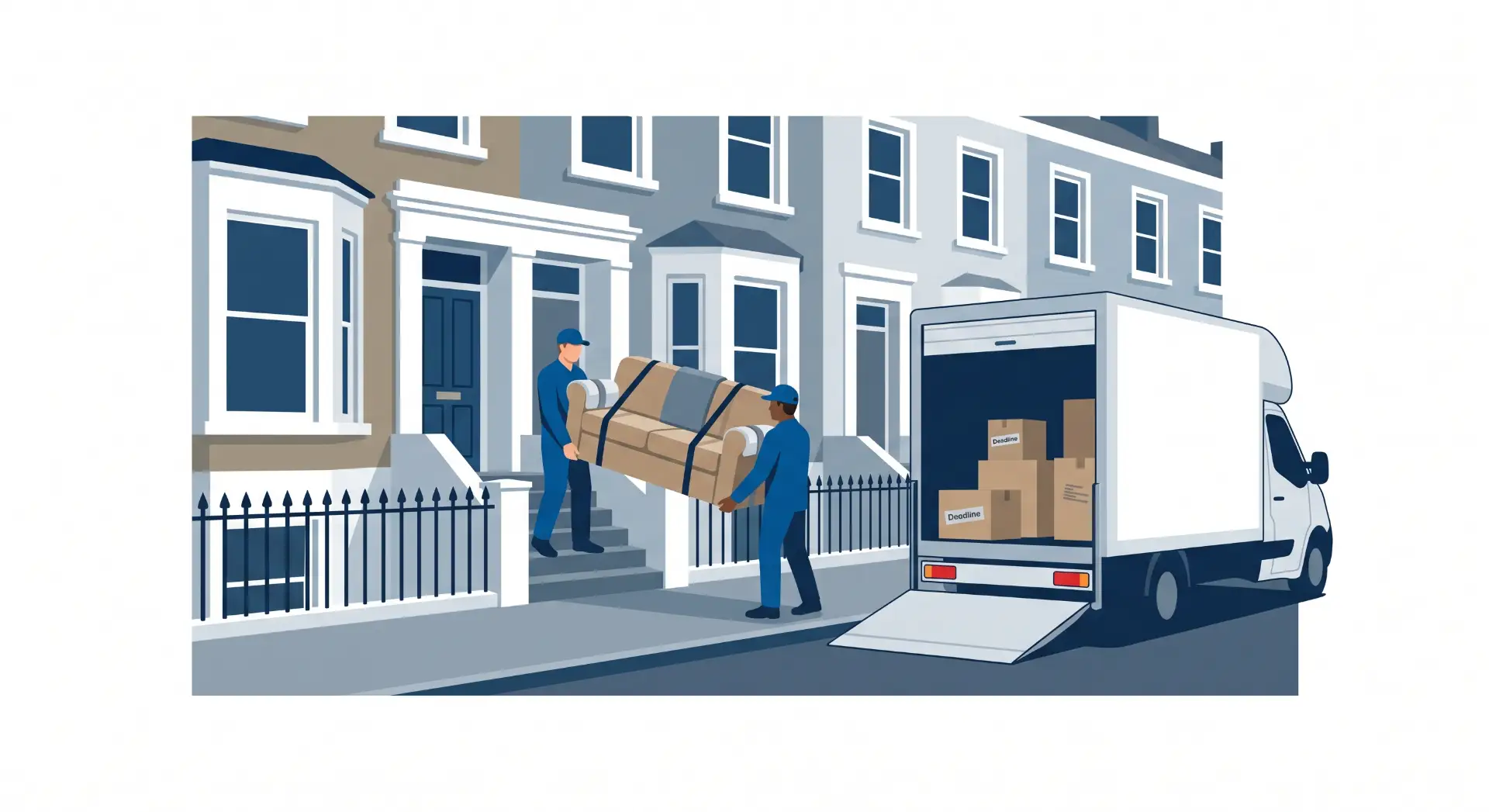
An international move to Brazil has four moving parts: the survey and quote, export packing and collection in the UK, the ocean leg, and clearance and delivery in Brazil. Planning backwards from the date you want your belongings in Brazil is more reliable than planning forwards from the date you want to leave.
The practical sequence looks like this:
- Book a survey and get a written quote that states the volume in cubic metres, the service level and what is excluded
- Confirm your Brazilian documentation is in progress, because several items take weeks to obtain
- Agree a collection date that fits the monthly sailing schedule rather than your tenancy end date alone
- Have the inventory prepared and signed before the shipment leaves, not after
- Keep a copy of every document with you, because clearance in Brazil is triggered by your arrival, not the container’s
EUROBR runs a fixed monthly departure to Brazil by sea container and handles the export documentation in the UK and the clearance paperwork in Brazil. The same monthly rhythm applies on the road route covered by the removals to Europe service and the removals to Portugal service, which is why the London to Portugal to Brazil corridor works as one planning conversation rather than three.
How long does shipping to Brazil take? Sea freight and air freight timelines
Sea freight from the UK to Brazil takes roughly three weeks on the water and considerably longer door to door. Maersk states in its ocean freight guide that “sea freight shipping can range from 20-45 days” and makes the distinction explicit: “The time spent on water and the time shipments take from door-to-door are different.” The carrier operates a direct Europe to Brazil service calling at Southampton, so a UK origin does not require a transhipment detour.
The numbers that matter to a household are the ones either side of the voyage. Export packing and collection add days. Consolidation into a shared container adds more, because the container waits until it is full. Clearance in Brazil depends on the documents, the port and whether the shipment is selected for physical inspection. Inland delivery from Santos to a flat in São Paulo is short; delivery to Fortaleza or Porto Alegre is not.
| Stage of the move | Typical contribution to the timeline | What moves it |
| Survey, quote and booking | 1 to 3 weeks before collection | How quickly you confirm and pay the deposit |
| Export packing and collection in the UK | 1 to 2 days on site | Volume, access, stairs, parking |
| Consolidation and departure | Tied to the monthly sailing | Shared containers wait for space to fill |
| Ocean leg, UK to Brazilian port | Around 20 to 45 days (Maersk, 2026) | Routing, port congestion, transhipment |
| Brazilian customs clearance | Days to several weeks | Document accuracy, inspection selection |
| Inland delivery in Brazil | 1 day to over a week | Distance from the port of entry |
Air freight is faster and is priced by weight rather than volume, which makes it sensible for a small, urgent consignment and expensive for a household. A wardrobe of clothes and a laptop can fly. A sofa should not. If you need a handful of boxes to arrive quickly while the bulk of your belongings travel by sea, splitting the shipment is a legitimate strategy, and the smaller consignment follows the rules set out in the companion guide to shipping boxes to Brazil from the UK.
Door to door or port to port: which service suits your move
Door to door means the remover collects from your UK address and delivers into your Brazilian address, handling export documentation, the ocean leg, clearance and inland transport. Port to port means you receive the cargo at the destination port and arrange clearance and onward transport yourself.
Port to port looks cheaper on the quote and very often is not, for one reason: Brazilian customs clearance is not a form you fill in at a counter. It is a process that expects a correctly registered inventory, a valid tax number and a party in Brazil able to respond to queries. If the process stalls, the container does not wait politely. It accrues charges.
- Door to door suits anyone moving a household, anyone without a trusted contact in Brazil, and anyone who will not be in the country when the shipment lands
- Port to port suits experienced importers with their own customs agent already appointed
- A shared container suits shipments under roughly a third of a 20ft container, where paying by the cubic metre beats paying for empty space
- A full container suits a two bedroom household upwards, and gives you a container that is not waiting on anybody else’s paperwork
EUROBR offers both full and shared containers on the Brazil route and quotes shared shipments by the cubic metre. Shipments are trackable through the EUROBR shipment tracking page using the consignment number issued when the move is booked.
Brazilian customs and the Receita Federal: how the exemption actually works
Used household goods and personal effects can enter Brazil free of import tax under the customs regime for unaccompanied baggage, provided the owner qualifies as a resident arriving to live in the country and the goods are correctly declared. Receita Federal is the Brazilian federal revenue authority that administers this.
The word that does the work in that sentence is “used”. The regime exists for the belongings of a person relocating, not for goods being imported. That single distinction explains most of the rules that follow, and it is why a shipment full of newly purchased items in sealed boxes attracts attention that the same shipment, unpacked and used, would not.
One documentation note before the detail. The official rules for this regime are published by Receita Federal in Portuguese only, and there is no equivalent English-language source with the same authority. The explanations below are stated in plain English and cross-checked against the published country guidance used by the international moving industry, including the International Association of Movers Brazil country guide. Confirm the current position with your remover and the Brazilian consulate before you ship.
The unaccompanied baggage exemption and who qualifies
Unaccompanied baggage is the customs category for personal belongings that travel separately from their owner, rather than in the aircraft hold alongside them. On Brazilian paperwork it appears under the Portuguese term bagagem desacompanhada, which is worth recognising because it will be printed on forms you sign.
The conditions that decide whether the exemption applies are time-based and unforgiving:
- The owner must have lived abroad for at least 12 continuous months before relocating to Brazil
- Time spent inside Brazil during that period must not exceed 45 days in total
- The shipment must arrive in Brazil within 180 days after the owner arrives
- Customs clearance must be started within 90 days of the owner’s arrival
- The goods must be used, owned by the person moving, and intended for personal use
Those windows are the reason the order of events matters. If you ship six weeks before you fly, and then your flight is pushed back three months, you have not simply inconvenienced yourself. You have parked a container in a Brazilian port before the clock that authorises its clearance has started.
Returning Brazilians and foreign residents: how the rules differ
Both groups can use the unaccompanied baggage regime, but they prove eligibility with different documents and one group may be asked for a financial guarantee.
A returning Brazilian citizen proves the 12 months abroad, typically with a consular certificate of residence or with a year or more of UK utility bills, tenancy agreements or employment records showing continuous life in the UK. A foreign national moving to Brazil proves the right to reside there instead, through the visa and the migration registration that follows arrival. Industry country guidance records that foreign nationals holding temporary visas may be required to sign a guarantee covering duties based on 50 per cent of the declared value, released once residence is confirmed.
| Requirement | Returning Brazilian citizen | UK or other foreign national |
| Proof of 12 months abroad | Consular certificate of residence, or 12 to 13 months of utility bills and tenancy records | Usually covered by the visa and residence process |
| Identity documents | Passport, and Brazilian identity or driving document | Passport, plus migration registration in Brazil |
| Tax number | CPF required | CPF required |
| Visa validity | Not applicable | Must generally be valid for more than 180 days |
| Possible guarantee | Not normally requested | May be requested on temporary visas |
| Inventory | Required, in Portuguese, signed and registered | Required, in Portuguese, signed and registered |
The Foreign, Commonwealth and Development Office guidance on living in Brazil confirms the residence side of this for British nationals, including that “you’ll need to register as a foreigner with the Federal Police” after arrival and that a CPF is needed to own assets subject to tax in Brazil.
Essential documents for shipping your belongings to Brazil
The document set is the shipment. Everything else is transport. A container with perfect packing and an incomplete file will clear more slowly than a modest shipment with a complete one.
The core file for a household move to Brazil generally includes the bill of lading, notarised copies of the owner’s passport, the CPF, the flight ticket or boarding pass evidencing arrival, proof of residence abroad, and the itemised inventory. Requirements vary with visa type and port, which is why the remover assembles the file rather than the customer guessing at it.
Proof of residence abroad for returning Brazilian citizens
Returning Brazilian citizens need documentary proof that they genuinely lived in the UK for at least 12 continuous months. The cleanest route is a certificate of residence issued by the Brazilian consulate, because it is a single document produced specifically for this purpose. The alternative is a stack of evidence: council tax statements, utility bills, a tenancy agreement, payslips or an employer letter covering a continuous 12 to 13 month period.
Gather this before you cancel accounts. Closing a utility account and moving out of a flat in the same fortnight can leave you trying to obtain a 2024 bill from a supplier who no longer recognises you as a customer. The EUROBR moving checklist is a useful place to build this into the wider sequence of cancellations and notifications.
CRNM and CPF for UK nationals moving to Brazil
Two Brazilian registrations matter for a UK national. The CPF is the individual taxpayer registration number, and the CRNM is the national migration registration card issued to foreign residents after arrival.
The CPF is the one that blocks shipments. Industry country guidance is blunt that a CPF number is mandatory for all shipments and that the address registered against it should match the delivery address. It can be obtained through the Brazilian consulate in London before departure, which is far easier than trying to arrange it remotely once a container is already at sea. The CRNM follows the Federal Police registration described in the GOV.UK living in Brazil guidance and is generally issued after you arrive, which is one more reason the 90 day clearance window is tight rather than generous.
The translated, registered packing list
The inventory is the document Brazilian customs reads against the container. It must be in Portuguese, itemised, and prepared to a standard well beyond a handwritten list of rooms.
What a compliant inventory contains:
- Every item or box, numbered, with a description and a quantity
- A declared value per line, expressed in Brazilian reais, and a total
- Brand, model and serial number for every electrical and electronic item
- New items listed separately and clearly identified as new
- The owner’s signature, with the list registered at a Brazilian register office
Two failures cause most problems. The first is a vague inventory: “kitchen items, one box” invites the inspection that a line-by-line list avoids. The second is undeclared new goods, which industry guidance warns will attract duties and fines if found during inspection. Declaring a new kettle costs you a small amount of tax. Hiding one costs you the inspection, the penalty and the storage bill while it is resolved. The general principles behind a good customs inventory are covered in the EUROBR guide to moving from the UK, packing tips and customs lists.
What you can bring: restricted and prohibited items
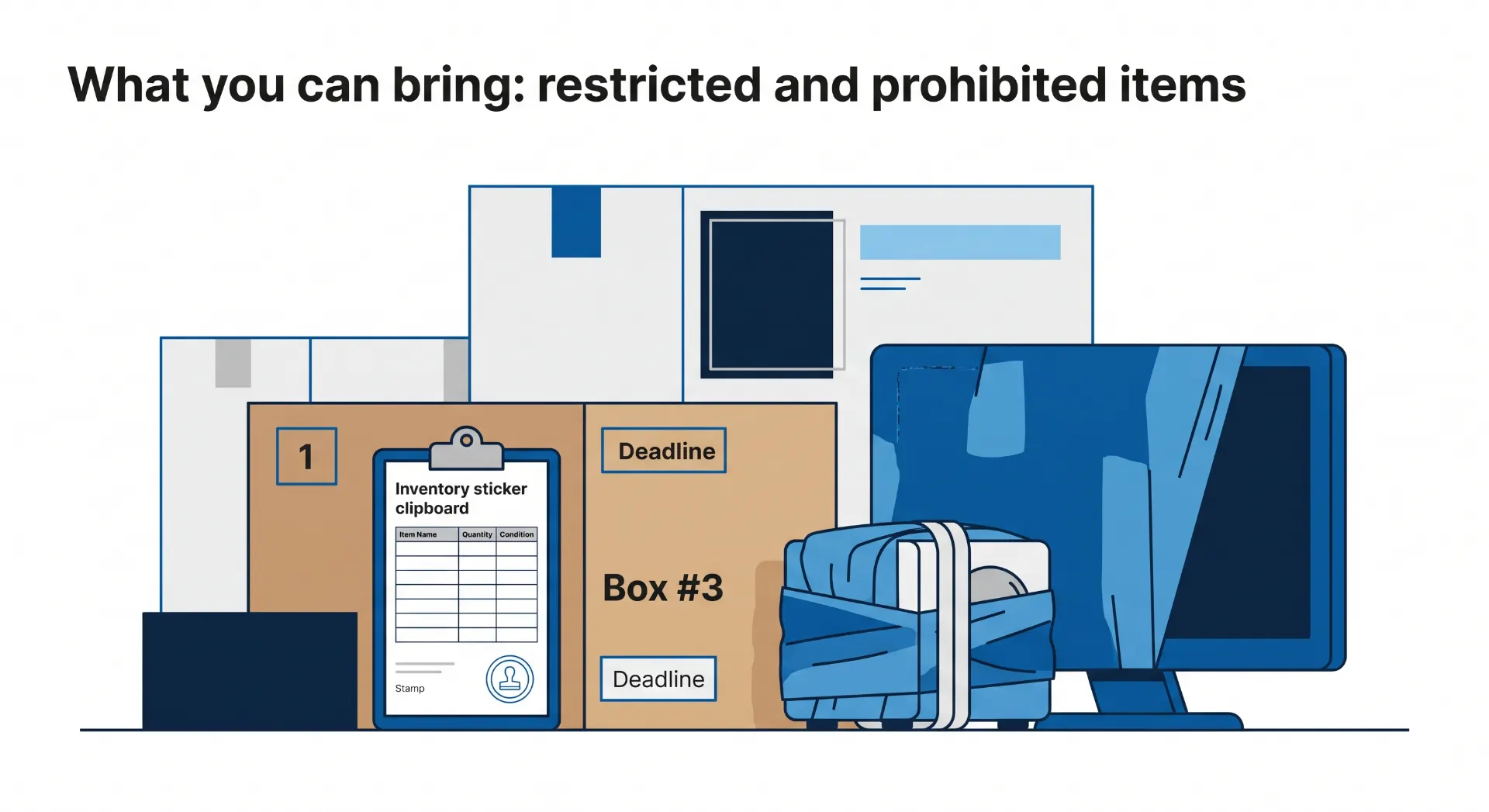
Most ordinary household contents travel without difficulty. The exceptions cluster around vehicles, food, plants, weapons, hazardous materials and anything new enough to look like an import rather than a personal effect.
Items that international moving guidance lists as prohibited or heavily restricted for Brazil include live plants, narcotics, flammable and corrosive materials, food items, alcohol and tobacco beyond strict limits, prescription medicines without documentation, and firearms. Cosmetics, beverages and foodstuffs, where allowed at all, generally attract duty rather than the exemption.
Can you ship a car or a motorcycle from the UK to Brazil?
For almost every private individual, no. Industry country guidance for Brazil states that “the importation of motor vehicles is prohibited for citizens and foreigners holding permanent and temporary visas”, with importation for personal use available only to foreign diplomats and members of certain international organisations.
This surprises people, so it is worth stating plainly rather than hedging. Selling the car in the UK and buying in Brazil is the normal route, and it usually works out better financially than the alternative once shipping and duties are considered. The same guidance warns that if a vehicle is shipped alongside household goods without separate documentation, penalties can follow. Motorcycles fall under the same restriction. A bicycle is household goods and travels normally. If you are weighing up the cost of replacing a vehicle, the FCDO notes on the living in Brazil guidance that a UK photocard licence is accepted for up to 180 days before you must exchange it locally, which is the practical timeline for buying in Brazil.
Electronics, appliances and brand new items in original packaging
New items still in their original packaging are the most common cause of a customs problem in an otherwise ordinary household shipment, because they read as imported goods rather than personal effects.
The rule to work to is simple: declare everything new, separately and honestly, and accept that it may be taxed. Do not buy a new television the week before collection and pack it sealed. If you genuinely need to ship something new, list it on the new-items section of the inventory with brand, model, serial number and value.
For used electricals, the serial number requirement is not a formality. Customs uses it to match the item in the box to the line on the list, so a television described only as “television” is a line that cannot be verified. Brazil runs on both 127V and 220V depending on the region, so check the voltage of anything with a motor or a heating element before you pay to ship it. Appliances are heavy, they consume container volume, and a UK washing machine that needs a transformer to run is rarely worth the cubic metres. Export packing for electricals is a specific skill, and the EUROBR packing service supplies export-grade materials for exactly this reason.
Moving with pets: taking cats and dogs from the UK to Brazil
Pets do not travel in a removal container. They travel by air, under a separate process that starts with UK export paperwork and ends with Brazilian veterinary clearance.
From Great Britain to a non-EU country such as Brazil, GOV.UK states that “you’ll need to get an export health certificate (EHC)” and that you “must nominate an official vet who will be sent the EHC”. The certificate is issued through the Animal and Plant Health Agency, and you also complete an export application form. On top of the UK requirements, Brazilian rules apply: cats and dogs only for ordinary private imports, with a vaccination record and a veterinary health certificate, and industry guidance notes that certificates must be stamped by the Brazilian consulate at origin.
Start this three to four months before departure, not three weeks. Vaccination timing, vet appointments, consular legalisation and airline booking all have their own lead times, and they stack. The GOV.UK pages on taking your pet to a non-EU country and on export health certificates set out the UK side. EUROBR does not publish a pet relocation service, so treat this as a separate booking with a specialist pet travel agent.
How much do removals to Brazil from the UK cost?
The cost of a removal to Brazil is driven by volume, container type, service level and destination, and a credible quote states all four. EUROBR publishes indicative container pricing on its removals to Brazil page as of 2026: a 20ft exclusive container of around 33 cubic metres from £6,000, and a 40ft exclusive container of around 65 cubic metres from £9,000, with shared container space priced by the cubic metre.
Treat those as starting points, because a quote is built from a survey, not a table. Published ranges give you a sanity check against the market rather than a final figure.
| Option | Rough capacity | Who it suits | How it is priced |
| Individual boxes or suitcases | A few boxes | Students, one-room shipments, family gifts | Per item or per box |
| Shared container space | Roughly 1 to 15 cubic metres | Studio or one bedroom, partial households | Per cubic metre, above a minimum |
| 20ft exclusive container | Around 33 cubic metres | Two to three bedroom household | Fixed container rate, from £6,000 in 2026 |
| 40ft exclusive container | Around 65 cubic metres | Four bedrooms upwards, or bulky contents | Fixed container rate, from £9,000 in 2026 |
Volume, shipping method and what shapes an international quote
Volume is the master variable, and it is measured in cubic metres of packed goods rather than in rooms or in weight. Everything else adjusts around it.
The factors a surveyor is actually pricing:
- Packed volume in cubic metres, including the space packaging adds
- Full container against shared container space
- Access at both ends: stairs, lift size, street width, distance from the door to the vehicle
- Packing service level, from materials only through to a full pack by the crew
- Dismantling and reassembly of furniture
- Destination city and the inland leg from the port of entry
- Declared value, which drives the insurance element
Two of these are worth attacking before you get quoted. Volume is the obvious one: the single cheapest decision in an international move is deciding not to ship something. The other is access, because a London flat with no parking and four flights of stairs costs more to load than the same contents on a ground floor with a bay outside. Where a suspension is needed, the EUROBR parking suspension page lists the application routes for the London boroughs, and daily borough fees are published there in a range from £30 to £130 per day.
Port storage, demurrage and inspection charges: the costs nobody quotes
These are the charges that turn a budgeted move into an unbudgeted one, and they are not the remover’s line items. They are levied by the terminal and the ocean carrier when cargo sits longer than its free time.
DHL Global Forwarding defines them precisely: demurrage applies “for the usage of container equipment inside the port terminal”, detention arises “outside the port terminal”, and storage covers “the usage of storage space occupied by the container on terminal grounds”. Each is “billed per container and per day”. A number of free days is granted before charges start, and the length of that free time varies by port, carrier and equipment.
The consequence is arithmetic. Every day that clearance is delayed by an inventory query, a missing CPF or a passport copy that was never notarised is a day billed per container. A two week documentation problem is not a two week inconvenience; it is a two week invoice. This is the entire commercial case for getting the paperwork right in the UK, before the container sails, and it is why a remover who prepares the file at both ends is worth more than one who simply supplies a van and a booking.
Leaving the UK: what you need to do at this end
The UK side of an international removal is lighter than the Brazilian side, but two things regularly catch people out: the export documentation for the shipment itself, and the mistaken belief that transfer of residence relief applies.
Transfer of residence relief is a real HMRC scheme, but it runs in the opposite direction. GOV.UK describes it as relief for people “transferring their normal residence to Great Britain or Northern Ireland from outside the UK”, allowing personal belongings, vehicles and pets to be imported free of duty and tax on the way in. It is not relief on goods leaving the UK for Brazil. Anyone who has previously moved to the UK and used a ToR1 application will recognise the process, and it is worth reading the GOV.UK transfer of residence guidance to understand what it does and does not cover, particularly if you expect to return to the UK later.
What does need attention before you leave:
- Export documentation for the shipment, which the remover prepares
- Council tax closure, utilities, and a forwarding arrangement for post
- Bank, pension, HMRC and NHS notifications, which are easier to complete from a UK address than from Brazil
- Registration with the Brazilian consulate where relevant, and confirmation of consular support through the British Embassy in Brazil
How to check an international remover before you book
Check three things: insurance, licensing and the customs process they describe. An international move is one of the largest single-purchase transactions most households make, and the sector has a wide quality range.
What to ask, and what a good answer sounds like:
- Insurance. Ask which cover applies, what the limit is per item as well as in total, and what happens to items you packed yourself. EUROBR carries Goods in Transit and CMR cover, and the EUROBR CMR regulations page explains what CMR, the international convention governing road carriage of goods, does and does not cover
- Licensing and trading history. Twelve years of trading, a registered business address and a verifiable review record are checkable. EUROBR has operated from Croydon since 2013, and its background is set out on the EUROBR about page
- The customs process. Ask who prepares the Brazilian inventory, who handles clearance, and what happens if the shipment is selected for inspection. A vague answer here is the single most useful warning sign in the whole conversation
- Written quotes. A quote should state volume, service level, exclusions and what triggers an extra charge
- Trade standards. The British Association of Removers publishes consumer guidance and operates a Chartered Trading Standards Institute code of practice and an independent dispute resolution route, which is a useful benchmark for what good practice looks like in the UK removals sector
In 12 years of moving London households and running a monthly container route to Brazil, the EUROBR team finds that the shipments which clear cleanly are almost always the ones where the inventory was finished before collection day, not during it.
Frequently asked questions about removals to Brazil from the UK
How long does shipping personal belongings from the UK to Brazil take?
Door to door timings for a household shipment from the UK to Brazil generally fall between two and four months, and EUROBR publishes an estimated 60 to 120 days on its Brazil service page as of 2026. The ocean leg is the smaller portion of that. Maersk puts sea freight generally in a 20 to 45 day range and notes that time on the water and door to door time are different figures. The remaining weeks are consumed by export packing, waiting for the monthly sailing, consolidation if the shipment shares a container, Brazilian customs clearance, and the inland leg from the port of entry to the delivery address. Shared containers usually take longer than exclusive ones because the container departs when the space is filled. Clearance is the least predictable stage: a complete, accurately registered inventory can clear in days, while a query or a physical inspection can add weeks. Delivery distance inside Brazil matters too, since a São Paulo address near Santos is a short inland run and a northern or southern address is not. Shipments booked with EUROBR can be followed through the shipment tracking page.
Do I have to pay import tax on my belongings when I move to Brazil?
Used personal belongings can normally enter Brazil without import tax under the customs regime for unaccompanied baggage, provided the person moving qualifies as a resident arriving to live there and the goods are correctly declared. Qualification is time-based. Industry country guidance for Brazil records that the owner should have lived abroad for at least 12 continuous months, should not have spent more than 45 days inside Brazil during that period, should have the shipment arrive within 180 days of their own arrival, and should start clearance within 90 days of arriving. The exemption covers used goods for personal use. New items still in original packaging are treated differently, must be identified separately on the inventory, and can attract duty. Foreign nationals on temporary visas may be asked for a guarantee against potential duties. The official rules are published by Receita Federal in Portuguese only, so confirm the current position with the Brazilian consulate and with the company handling your removals to Brazil before shipping anything you are unsure about.
What documents do I need to ship household goods to Brazil?
A household shipment to Brazil generally requires the bill of lading, notarised copies of the owner’s passport, a CPF taxpayer number, evidence of the owner’s arrival such as the flight ticket or boarding pass, proof of residence abroad, and a detailed inventory in Portuguese. The inventory carries most of the risk. It must be itemised rather than summarised, show a declared value per line in Brazilian reais, give brand, model and serial number for every electrical item, identify new goods separately, and be signed and registered at a Brazilian register office. Returning Brazilian citizens prove the 12 months abroad with a consular certificate of residence or with a continuous run of UK utility bills, tenancy agreements and employment records. Foreign nationals prove their right to reside instead, through the visa and the migration registration completed after arrival. A CPF is mandatory for all shipments and the address held against it should match the delivery address. Gathering the general paperwork early is easier alongside the wider moving checklist.
Can I ship a car or motorcycle from the UK to Brazil?
For private individuals the answer is almost always no. International moving country guidance for Brazil states that importing motor vehicles is prohibited for citizens and for foreign nationals holding permanent or temporary visas, with personal-use vehicle imports available only to foreign diplomats and to members of certain international organisations such as the United Nations. Motorcycles fall under the same restriction. The same guidance warns that shipping a vehicle alongside household goods without separate documentation can lead to substantial penalties, so it is not a restriction worth testing. The practical route is to sell the vehicle in the UK and buy in Brazil, which also avoids the duties and registration difficulties that follow an attempted import. British nationals can drive in Brazil on a UK photocard licence for up to 180 days before exchanging it locally, according to FCDO guidance, which gives a realistic window in which to buy. Bicycles, by contrast, are household goods and travel normally inside a container alongside furniture and boxes, as covered on the removals to Brazil service page.
What is the difference between a shared container and an exclusive container?
A shared container, known in freight terms as less than container load or LCL, carries consignments from several customers in one container, and each customer pays for the cubic metres they occupy. An exclusive container, or full container load, carries one household and is priced as a whole container regardless of how full it is. The trade-off is cost against control. Shared space is cheaper for small shipments but the container departs when it is full and clears when every consignment in it is ready, so timings are less predictable. An exclusive container sails on its own schedule and is generally the better choice from around a two bedroom household upwards. EUROBR publishes a 20ft exclusive container of around 33 cubic metres from £6,000 and a 40ft container of around 65 cubic metres from £9,000 as of 2026, with shared space quoted by the cubic metre. A survey establishes the packed volume, which is the figure the decision actually turns on. Details are set out on the removals to Brazil page.
What happens if my shipment is held at a Brazilian port?
Held cargo accrues charges daily, which is why documentation errors are expensive rather than merely annoying. DHL Global Forwarding defines demurrage as a charge for using container equipment inside the port terminal, detention as the equivalent outside it, and storage as the charge for the space the container occupies, each billed per container and per day. A number of free days is granted first, and how many depends on the port, the ocean carrier and the equipment type. Holds are usually triggered by one of a small number of causes: an inventory that does not match the contents, undeclared new items, a missing or mismatched CPF, documents that were not notarised, or selection for routine physical inspection. Most are resolvable, but resolution takes time and the charges accrue throughout. The practical defence is preparation rather than negotiation: a complete file assembled before the container sails, an itemised inventory, and a remover who handles clearance at both ends. Packing to a standard that survives an inspection helps too, which is where professional packing earns its cost.
Can I take my dog or cat from the UK to Brazil?
Cats and dogs can be taken from the UK to Brazil, but they travel by air under their own process and never inside a removal container. On the UK side, GOV.UK states that travel to a non-EU country requires an export health certificate, that an official vet must be nominated to check the animal and sign it, and that an export application form must also be completed. The certificate is issued through the Animal and Plant Health Agency. On the Brazilian side, ordinary private imports are limited to cats and dogs, a vaccination record and a veterinary health certificate are required, and international moving guidance notes that certificates must be stamped by the Brazilian consulate at origin. Other species need prior authorisation from the Brazilian agriculture ministry. Begin three to four months before departure, because vaccination timing, vet appointments, consular legalisation and airline cargo booking each have lead times that stack rather than overlap. This is a specialist booking separate from the household shipment described on the removals to Brazil page.
Planning your move to Brazil: the next step
The most useful thing you can do today is establish two numbers: the volume you are actually shipping, and the date you will arrive in Brazil. Everything else, container type, sailing, cost and the clearance clock, follows from those two.
EUROBR has moved London households since 2013, runs a fixed monthly container route to Brazil, and prepares the customs documentation at both ends so that clearance is not the stage where your move stalls. The team is English and Portuguese speaking, works from Croydon across Greater London and the M25, and carries Goods in Transit and CMR insurance on every job. Delivery times depend on sailing schedules and on clearance by Receita Federal, so the quote comes with a realistic window rather than a promise.
Planning a move to Brazil? Get a free, no-obligation quote from EUROBR’s insured team. Message on WhatsApp at +44 7878 921856, email [email protected], or request a price online.