
Shipping boxes to Brazil from the UK is cheapest and safest when the boxes are declared correctly as used personal belongings rather than as goods being imported.
That single decision, made on the customs declaration before anything leaves London, determines whether a box clears quietly or is taxed, held or in some cases destroyed. Standard postal services are not a realistic route for a full box: Royal Mail caps its international parcel services at 2kg, and Parcelforce, which carries up to 30kg, states plainly that used goods are prohibited on its Brazil service and “will be destroyed if found inside items”. Consolidated sea freight through a removals shipper is the route built for used personal effects, and it is usually cheaper per kilogram than air courier and far cheaper than airline excess baggage.
Why shipping boxes to Brazil from the UK is a customs question first
Shipping boxes to Brazil from the UK looks like a comparison of prices per kilogram, and it is not. It is a comparison of customs categories, and the price follows from whichever category your box lands in. A 25kg box of your own worn clothes and used books is a different object to Brazilian customs than a 25kg box of new goods. One is personal belongings. The other is an import, and imports above a low threshold attract a federal import tax of 60 per cent plus state ICMS of roughly 17 to 20 per cent. The Office for National Statistics estimated in its analysis of UK emigration that 246,000 British nationals left the UK to live abroad long term in the year ending December 2025, in analysis published on 21 May 2026, and many of those moves involve boxes sent separately from the person.
The cheapest and safest ways to ship boxes to Brazil from the UK
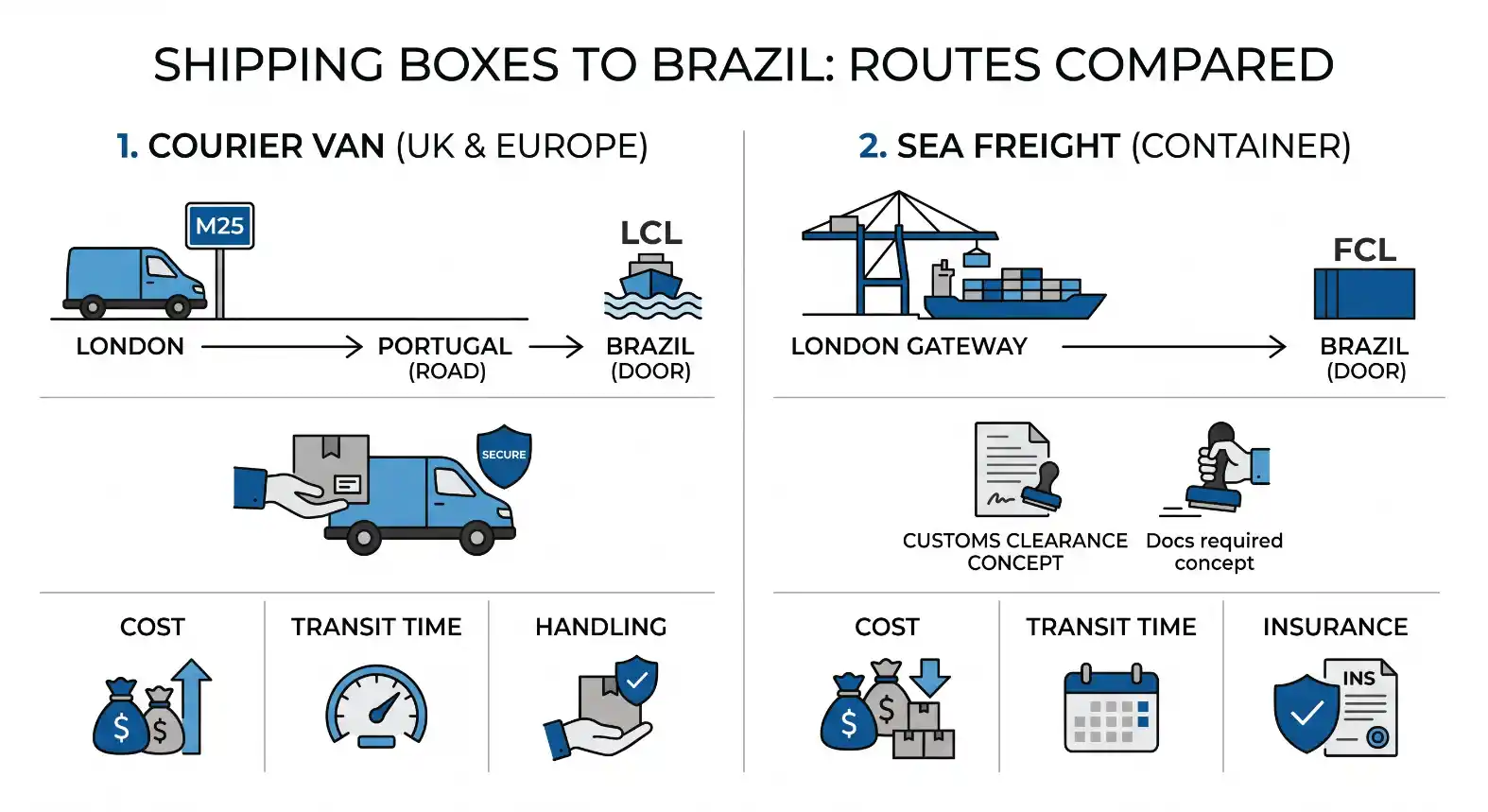
There are four realistic routes for boxes, and they differ far more in customs treatment than in headline price: post, express courier, consolidated sea freight through a removals company, and airline excess baggage. For used personal belongings in quantity, consolidated sea freight is normally both the cheapest and the least likely to be taxed.
| Route | Practical weight ceiling | Typical speed | Customs treatment of used personal items | Best for |
| Royal Mail international services | 2kg per parcel | 5 to 7 working days tracked; up to 8 weeks economy | Declared on a CN23; CPF required; small consignments only | Documents, a jumper, a book |
| Parcelforce Global Express or Priority | 30kg per parcel | From 4 days; 4 to 9 days by area | Used goods stated as prohibited and destroyed if found | New items, urgent business goods |
| Consolidated sea freight with a removals shipper | Boxes, suitcases and part-container space | Weeks to a few months | Designed for used personal effects | Clothes, household goods, a student’s belongings |
| Airline excess or extra baggage | 23kg per bag in economy | Same flight | Carried as accompanied baggage | Two or three bags travelling with you |
Those weight ceilings are not marketing distinctions. Royal Mail’s published parcel services to Brazil top out at 2kg with combined length, depth and width under 90cm, which means a single packed removal box is outside the service entirely. Parcelforce carries to 30kg and lists Brazil delivery from four days, but its own Brazil delivery guidance states that used goods are prohibited, which removes the one thing most people want to send.
Courier or freight forwarder: which suits personal belongings
Express couriers are built for new goods moving quickly in small volumes. Freight forwarders and removals shippers are built for used belongings moving in bulk, and that is where personal effects belong.
The difference is structural rather than a matter of preference:
- Couriers price by chargeable weight and move in days. They are excellent for a laptop charger, a passport document or a birthday present, and they clear cargo through the commercial import channel
- Freight forwarders and removals shippers consolidate. Several customers’ goods share a container, each paying for the space used, and the shipment is declared as personal effects
- Couriers usually require the receiver to deal with any tax assessment. A forwarder handling a personal effects shipment prepares the documentation to avoid the assessment arising in the first place
- Couriers rarely want your used sofa cushions, your worn clothes or your books. A forwarder expects them
EUROBR sits in the second group. The removals to Brazil service runs a monthly sea container departure and takes shipments down to individual boxes and suitcases as well as shared container space priced by the cubic metre, so a reader with six boxes and a reader with a three bedroom house use the same route at different scales.
Why shipping boxes usually beats paying airline excess baggage
Airline baggage is the most expensive way to move belongings by weight, and the arithmetic is easy to check against published fares. British Airways allows one checked bag in economy at “up to 23kg (50lb) per bag” with maximum dimensions of “90 x 75 x 43cm”, and charges “65 GBP / 75 EUR / 100 USD / 100 CAD per overweight bag and one-way journey” for a bag over the standard allowance.
Work that through. Two extra bags at 23kg each gives you 46kg of belongings, at a cost that varies by destination for the bags themselves, before any overweight charge. Ship the same 46kg by consolidated sea freight and you will usually pay less, you will not carry it through two airports, and you will not risk the airline refusing a bag at check-in for being 2kg over.
There is a second, less obvious advantage. Belongings in the hold are accompanied baggage and are assessed on arrival alongside you at the airport, typically at Guarulhos or Galeão. Belongings shipped separately as unaccompanied baggage go through a documentary process where the inventory has already been prepared, which is a far better position to be in than standing at a customs desk with a suitcase that has attracted attention.
- Use the flight for what you need in the first fortnight
- Ship everything you will not miss for two months
- Do not ship anything you could replace in Brazil for less than the freight cost
Building that split into the wider sequence of cancellations, notifications and collection dates is easier alongside the EUROBR moving checklist.
Understanding Brazilian customs for parcels and personal effects
Brazilian customs treats a box according to what is inside it and who is sending it to whom, not according to the carrier’s brand. There are two routes that matter to a private individual: the parcel and e-commerce import route, which is taxed, and the personal effects route for used belongings, which is not, provided the sender qualifies.
Receita Federal is the Brazilian federal revenue authority that administers both. Its rules are published in Portuguese only and there is no English-language government equivalent with the same authority, so every Brazilian rule below is stated in plain English and cross-checked against published English-language industry and legal sources rather than linked to a page the reader could not read.
Commercial goods against personal effects: why the category decides the tax
Personal effects are used goods belonging to the person moving or to the person receiving them, sent because of a relocation rather than because of a purchase. Parcels are everything else, including gifts and anything bought online.
The parcel route is taxed by design. Analysis by English-language Brazilian legal commentators describes a federal import tax of 60 per cent applying on shipments valued above US$50 and up to US$3,000, with state ICMS of roughly 17 to 20 per cent applying regardless of value. The treatment of shipments below US$50 changed more than once during 2026 and was still subject to legislative deadlines in September 2026, so it should be checked at the time of sending rather than assumed.
The personal effects route is not taxed in the same way, but it is conditional. Used household goods and personal belongings can enter free of import tax under the customs regime for unaccompanied baggage, which on Brazilian paperwork carries the Portuguese term bagagem desacompanhada. The International Association of Movers country guide for Brazil records the conditions consistently: the owner should have lived abroad for at least 12 continuous months, should not have spent more than 45 days inside Brazil during that period, should have the shipment arrive within 180 days of their own arrival in Brazil, and should start clearance within 90 days of arriving.
| Question | Parcel or courier route | Personal effects route |
| What it is for | New goods, purchases, gifts | Used belongings of a person relocating |
| Federal import tax | 60 per cent above US$50, up to US$3,000 | Exempt if conditions are met |
| State ICMS | Roughly 17 to 20 per cent, applies regardless | Not applied in the same way on exempt personal effects |
| Documentation | Customs declaration and commercial invoice | Itemised inventory in Portuguese, registered |
| Used goods accepted | Prohibited on some express services | This is exactly what the route exists for |
| Who it suits | One-off small sends, urgent new items | Returning residents, students, families relocating |
The practical consequence is that sending your own clothes to yourself through an express courier can be the worst of both worlds: the service may prohibit used goods, and if it does not, the shipment may still be assessed as an import. The full relocation version of this route is covered in the guide to removals to Brazil from the UK.
How to complete the customs declaration without creating a problem
A customs declaration is a description of what is in the box and what it is worth, and vagueness on it is the single most expensive habit in international sending. “Gift”, “personal items” and “household goods” are not descriptions.
What a declaration for a box of personal belongings should contain:
- A line for each category of contents, with quantities, for example “12 used T-shirts”, “4 used paperback books”, “1 used hairdryer”
- The word “used” against every used item, because that word is doing the legal work
- A realistic second-hand value per line, not the purchase price and not a token £1
- Brand, model and serial number for any electrical item
- Any new item listed separately and clearly identified as new
- The sender’s and the receiver’s full details, including the receiver’s tax number and a Brazilian telephone number
Undervaluing is a false economy. A box declared at £5 that clearly contains a laptop invites the inspection that an honest declaration avoids, and inspection costs time, which on a consolidated shipment costs storage.
The CPF requirement: why every receiver in Brazil needs a tax number
The CPF is the Brazilian individual taxpayer registration number, and without it a shipment to Brazil will not clear and may be returned. This applies to every carrier, not just to freight.
Royal Mail states the requirement directly for Brazil: “The Federal Revenue Department of Brazil requires the Taxpayer Identification Number (CPF) and a local telephone number on all shipments.” Parcelforce repeats it and adds that items lacking an appropriate CPF may be subject to return. For a household shipment the requirement is stricter still, because international moving guidance records that the address registered against the CPF should match the delivery address.
A UK national can obtain a CPF through the Brazilian consulate in London, and FCDO guidance on living in Brazil notes that registration with the Brazilian taxpayer registry is required to own assets subject to tax in Brazil. If you are sending boxes to a relative, use their CPF, with their consent and with their telephone number, and check that the number and the delivery address agree before the boxes are collected.
What you can and cannot put in your shipping boxes
Most ordinary contents travel without difficulty. The problems cluster around anything that burns, anything alive, anything edible, anything medicinal and anything new enough to look like stock rather than belongings.
Prohibited and restricted items: flammables, food, plants and medicines
Prohibited means the item cannot be sent at all and may be seized or destroyed. Restricted means it can be sent with the right paperwork or within a limit.
Items listed as prohibited or heavily restricted for shipments to Brazil in international moving country guidance include:
- Live plants, seeds and soil
- Narcotics, and non-prescription drugs on express services
- Flammable and corrosive materials, including aerosols, solvents, paint, lighter fuel and nail varnish remover
- Food items, including tinned and dried food
- Alcohol and tobacco beyond strict personal limits
- Prescription medicines without a doctor’s prescription and, in some cases, consular documentation
- Firearms, ammunition and replicas
- High-value coin and stamp collections
Two everyday traps deserve naming. The first is aerosols, because a can of deodorant or dry shampoo in a box of toiletries is a dangerous goods problem that can hold an entire consolidated container. The second is food, because sending a relative a box containing coffee, biscuits and a jar of something is a natural impulse and a reliable way to have the box opened.
Can you send new items, electronics or gifts without being taxed?
New items in a personal effects shipment are the most common cause of an unexpected tax bill, because a sealed box with a barcode reads to customs as an import regardless of who it is for.
The honest position is this. New goods sent to Brazil are subject to the parcel import regime described above, meaning a 60 per cent federal import tax band above US$50 plus state ICMS, with the treatment of lower values having changed during 2026. There is no trick that converts a new item into a used one, and attempting to describe a new laptop as used is the kind of misdeclaration that leads to penalties rather than savings.
What works in practice:
- Declare new items separately and honestly, and accept the tax on those lines
- Remove packaging, manuals and price labels from anything you genuinely have used, so that it presents as what it is
- Record brand, model and serial number for every electrical item, used or new
- Check voltage before shipping anything with a motor or a heating element, because Brazil runs on both 127V and 220V depending on the region
- Consider whether the item is cheaper to buy in Brazil once tax and freight are added, which for small appliances it frequently is
Parcelforce’s own Brazil guidance underlines the mirror image of this problem for the courier route: used goods are stated as prohibited and destroyed if found. New goods are welcome and taxed. Used goods are the wrong cargo for that channel entirely, which is the clearest possible signal that personal belongings belong on a freight route rather than an express one.
How to pack your boxes for a transatlantic journey
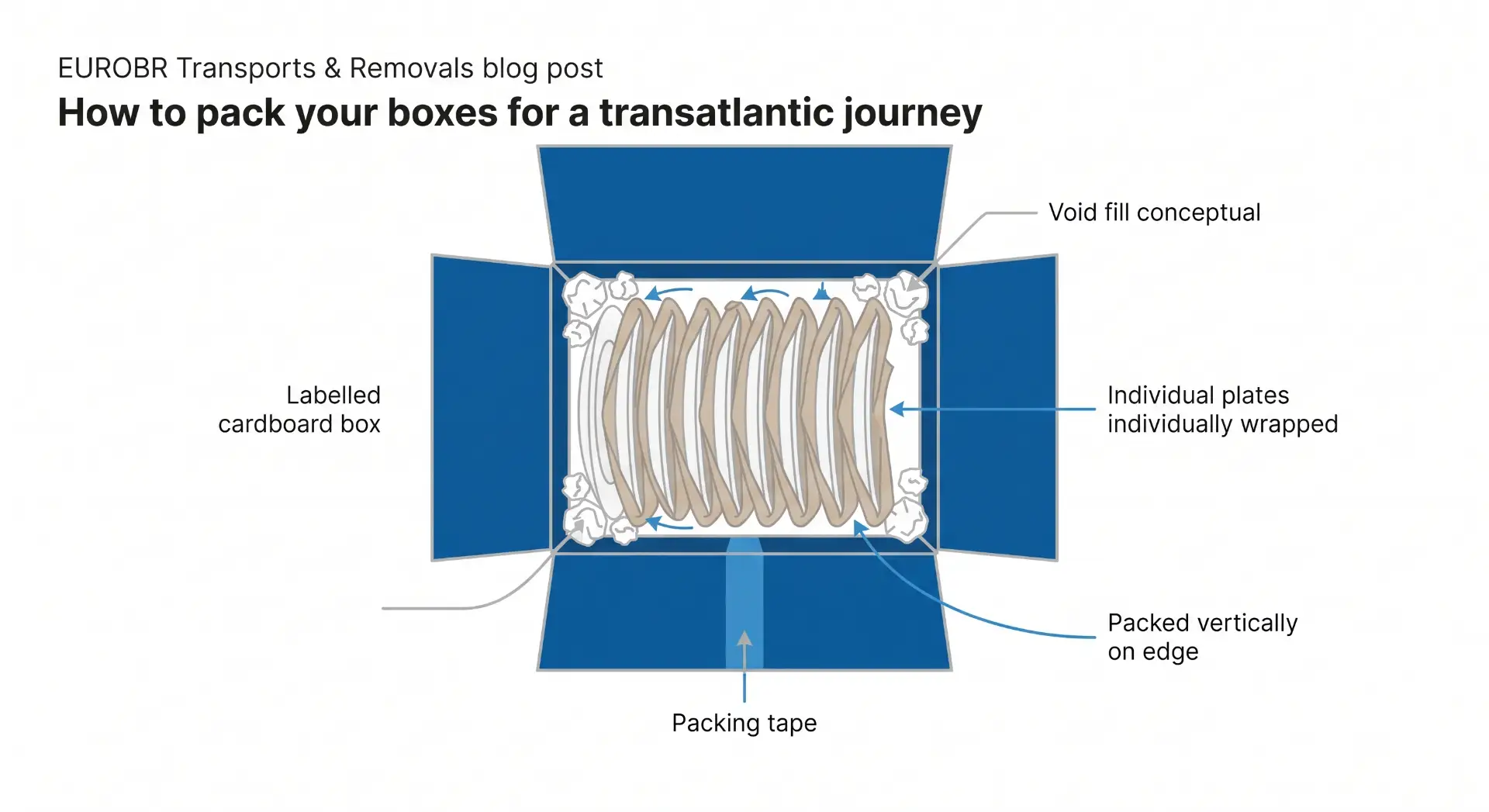
Boxes for Brazil are handled far more times than boxes for a house move across London, and they spend weeks stacked under other boxes in a container. Pack for compression and vibration, not just for carrying.
Choosing double-walled boxes and respecting weight limits
Use new double-walled cardboard boxes of a consistent size, and keep each one under 25kg. Consistency matters more than people expect, because uniform boxes stack into a stable block and odd shapes create voids that let the stack shift at sea.
The standard European removal box of 60 by 40 by 40cm is a sensible default, as set out in the EUROBR guide to packing box sizes for moving house. Two rules make the difference:
- Heavy and dense contents such as books and crockery go in small boxes, filled only two-thirds and topped with something light
- Light and bulky contents such as bedding, clothes and cushions go in large boxes, filled to the top so the box does not crush
Seal every box along the centre seam and across both edge seams, on the top and the bottom. Tape the bottom before you fill it, not after. Number every box, write the number on two sides and on the top, and keep the numbers running in a single sequence across the whole shipment so that box 14 is box 14 on the inventory, on the box and on the delivery note.
Export-grade materials are not the same as supermarket boxes. Used boxes have lost most of their compression strength, and a box that has already travelled once will not survive a container stack. Packing materials and a professional packing service exist for this, and for a shipment that is going to be inspected, professionally packed and labelled boxes present considerably better than hand-taped ones.
Protecting fragile items and writing an accurate itemised list
Fragile items need to be wrapped individually and immobilised, and the inventory needs to describe what is inside every numbered box without exception.
For fragile contents, wrap each piece in paper or bubble wrap so that no two hard surfaces touch, stand plates and glasses on their edge rather than flat, and fill every void so nothing can move when the box is tipped. A box that rattles when you shake it is not packed.
For the inventory, the principle is that a customs officer should be able to open any box and find what the list says. That means:
- One line per box, with the box number
- A description of the contents by category and quantity, in Portuguese for a Brazilian shipment
- A declared second-hand value per line and a total
- A separate section for any new items
- Brand, model and serial number for electricals
The general discipline behind a customs list is covered in the EUROBR guide to moving from the UK, packing tips and customs lists. Build the list as you pack rather than reconstructing it from memory the night before collection, because a reconstructed list is where the discrepancies that trigger inspections come from.
How much does it cost and how long does it take?
Cost depends on chargeable weight or volume, the route, and the service level, while timing depends almost entirely on whether the boxes fly or sail. Air moves in days and is priced by weight. Sea moves in weeks and is priced by volume, which is why a box of bedding costs almost nothing extra to sail and a great deal extra to fly.
| Route | Indicative timing | Priced by | Realistic use |
| Royal Mail International Tracked | 5 to 7 working days | Weight, up to 2kg | Documents and very small items |
| Royal Mail International Economy | Up to 8 weeks to South America | Weight, up to 2kg | Non-urgent small items |
| Parcelforce Global Express | From 4 days | Chargeable weight, up to 30kg | Urgent new goods |
| Parcelforce Global Priority | 4 to 9 days by area | Chargeable weight, up to 30kg | New goods, less urgent |
| Consolidated sea freight, boxes or shared container | Weeks to a few months door to door | Volume in cubic metres, or per box | Used personal belongings in quantity |
EUROBR quotes shared container space by the cubic metre above a minimum volume and also offers individual box and suitcase options on its removals to Brazil page, which is the route that fits a reader sending six to twenty boxes rather than a whole household.
Air freight against sea freight timings
Air freight to Brazil is measured in days and sea freight in weeks, and the gap on a door to door basis is wider than the gap on the transport leg alone.
Maersk states in its ocean freight guide that “sea freight shipping can range from 20-45 days” and makes the point that matters: “The time spent on water and the time shipments take from door-to-door are different.” For a consolidated shipment, add the wait for the container to fill, the clearance process in Brazil, and the inland leg from the port of entry. EUROBR publishes an estimated 60 to 120 days door to door on its Brazil service as of 2026.
Air freight and express courier remove the ocean leg but not the customs one. A courier parcel that is assessed for tax sits until the receiver pays, so “four days” describes the flight, not necessarily the doorstep. The realistic planning assumption is that urgent items fly, everything else sails, and anything you will need within the first two months travels in your suitcase.
Volumetric weight against actual weight
Volumetric weight, sometimes called dimensional weight, is a calculated figure that converts a parcel’s size into a weight so that light but bulky boxes are charged fairly. Carriers charge on whichever is greater, the actual weight or the volumetric weight.
The practical effect is that a large box of pillows can be charged as though it weighed several times what the scales say. Three responses work:
- Compress soft goods with vacuum bags before they go in the box
- Choose a box that fits the contents rather than a box with 20cm of air at the top
- Move bulky, low-value soft goods to sea freight, where volume is priced far more gently than it is in the air
For sea freight in a shared container, the equivalent measure is cubic metres of packed goods, and the same logic applies in reverse: it pays to pack densely and to be ruthless about what travels at all. The cheapest item to ship is the one you decide to leave behind.
Tracking, insurance and what happens if a box goes missing
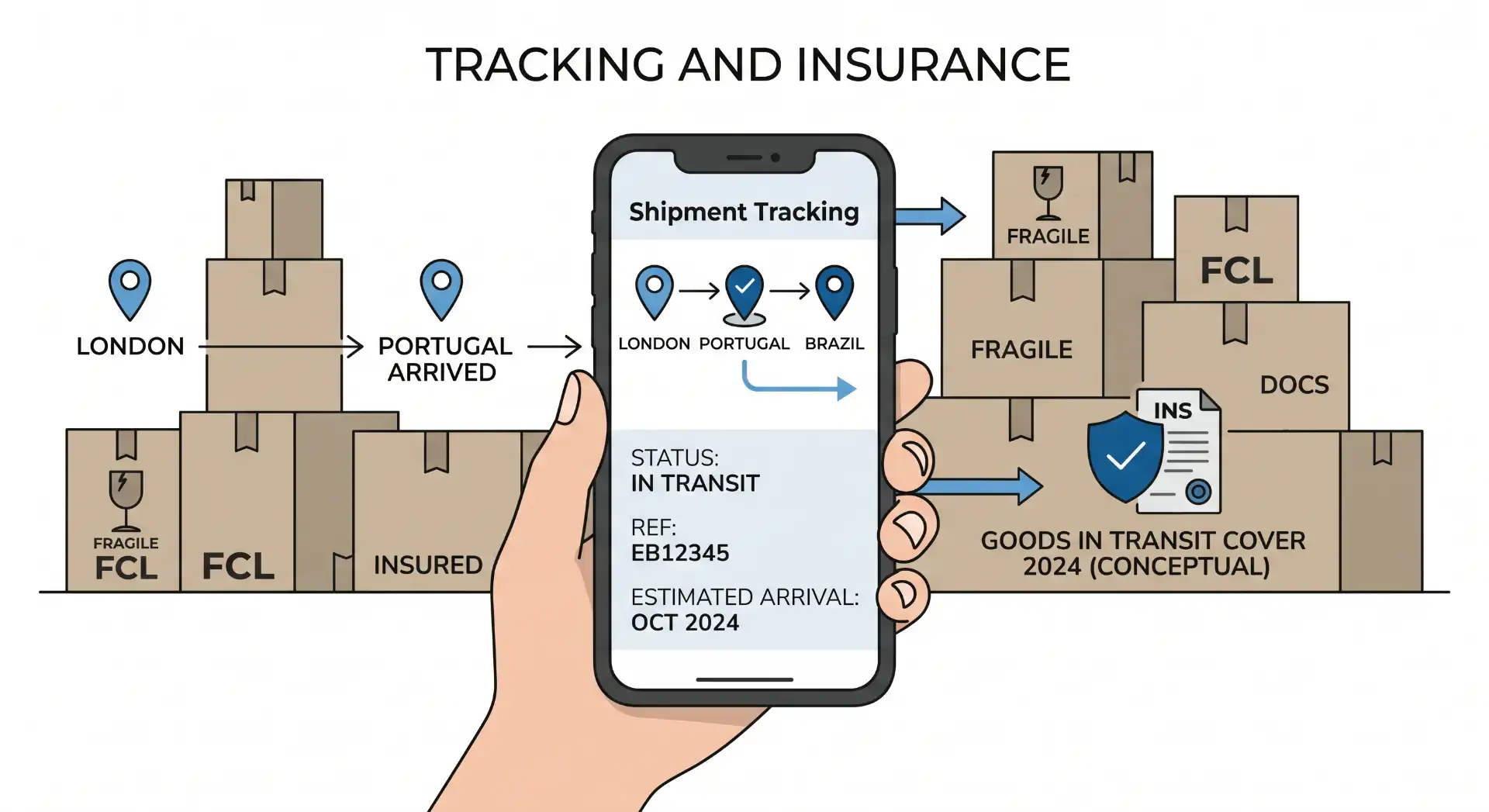
Ask three questions before you book: can the shipment be tracked, what insurance applies, and what the process is if something is lost or damaged. A cheap quote with no answer to any of the three is not cheap.
Tracking on a consolidated shipment works differently from courier tracking. There is no minute-by-minute scan history, because the shipment moves as part of a container. What you should get is a consignment number and a status at each stage: collected, consolidated, sailed, arrived, in clearance, out for delivery. EUROBR issues a consignment number that can be checked on the shipment tracking page.
On insurance, the terms matter more than the word “insured”. EUROBR carries Goods in Transit and CMR cover, and the EUROBR CMR regulations page explains CMR, the international convention governing the carriage of goods by road, in plain terms. Two questions decide whether cover is useful to you: what the limit is per item as well as in total, and how owner-packed boxes are treated, since goods you packed yourself are commonly covered on more limited terms than goods packed by the crew.
If something does go wrong with a service bought in the UK, Citizens Advice guidance on complaining about a service sets out your rights under the Consumer Rights Act 2015, which requires a service to be carried out with reasonable care and skill. The British Association of Removers also publishes what good practice looks like in the UK removals sector, including its code of practice and independent dispute resolution route, which is a fair benchmark to hold any shipper against.
In 12 years of moving London households and running a monthly container route to Brazil, the EUROBR team finds that almost every taxed or delayed box traces back to the same two lines on the paperwork: a description that said “personal items” instead of listing them, and a value that nobody believed.
Frequently asked questions about shipping boxes to Brazil from the UK
What is the cheapest way to send boxes to Brazil from the UK?
For used personal belongings in any quantity, consolidated sea freight through a removals or shipping company is normally the cheapest route, because it is priced by volume rather than by air-chargeable weight and because it is the channel designed for used goods. Postal services are ruled out by weight for anything box-sized: Royal Mail’s international parcel services to Brazil top out at 2kg with combined length, depth and width under 90cm. Express couriers carry more, with Parcelforce handling up to 30kg per parcel, but their Brazil guidance states that used goods are prohibited and will be destroyed if found, which removes the main reason most people are sending a box. Airline excess baggage is the most expensive option per kilogram once extra bag charges and overweight fees are added, with British Airways charging £65 per overweight bag on a one-way journey in 2026. Price is not the only variable either, since a shipment taxed as a commercial import can cost more in duty than it cost in freight. Options and volumes are set out on the removals to Brazil page.
How do I avoid paying customs charges on boxes sent to Brazil?
The reliable way is to qualify for the personal effects route rather than to look for an exemption inside the parcel route. Used household goods and personal belongings can enter Brazil free of import tax under the customs regime for unaccompanied baggage, provided the owner is relocating and the conditions are met. International moving country guidance for Brazil records those conditions consistently: at least 12 continuous months lived abroad, no more than 45 days spent inside Brazil during that period, arrival of the shipment within 180 days of the owner’s own arrival, and clearance started within 90 days. Goods must be used, owned by the person moving and intended for personal use, and they must appear on an itemised inventory in Portuguese with values and, for electricals, serial numbers. New items are treated as imports whatever else is in the box, so declare them separately rather than hiding them. Misdeclaring value or condition does not avoid charges, it invites inspection and penalties. The full relocation version of this process is covered in the guide to removals to Brazil from the UK.
Does the receiver in Brazil need a CPF number?
Yes, and without one a shipment can be refused, held or returned. The CPF is Brazil’s individual taxpayer registration number and it is required on inbound shipments regardless of carrier. Royal Mail states for Brazil that “The Federal Revenue Department of Brazil requires the Taxpayer Identification Number (CPF) and a local telephone number on all shipments”, and Parcelforce adds that items lacking an appropriate CPF may be subject to return. A Brazilian telephone number is required alongside it, because customs and the delivery agent need to reach the receiver directly rather than through the sender in the UK. For a personal effects shipment the requirement is stricter, since international moving guidance records that the address registered against the CPF should match the delivery address, so a shipment addressed to a relative’s new flat while their CPF still shows an old address can stall. A UK national can obtain a CPF through the Brazilian consulate in London before departure, which is considerably easier than arranging it once boxes are already in transit. Shipment status can be followed on the tracking page.
How long does it take to ship boxes from the UK to Brazil?
It depends entirely on whether the boxes fly or sail. Express courier services publish the fastest transit times, with Parcelforce listing Brazil delivery from four days and between four and nine days depending on the area, and Royal Mail listing five to seven working days on its tracked services and up to eight weeks on economy to South America. Consolidated sea freight is measured in weeks to months rather than days. Maersk puts ocean transit generally in a 20 to 45 day band and notes that time on the water and door to door time are different figures, because consolidation, clearance and inland delivery sit either side of the voyage. EUROBR publishes an estimated 60 to 120 days door to door on its Brazil route as of 2026. Customs clearance is the least predictable stage in every case: a complete, accurate declaration can clear in days, while a query, a missing tax number or a physical inspection can add weeks. Plan for the boxes you can wait for, and carry what you cannot. Volume and service options are listed on the removals to Brazil page.
What items cannot be shipped in boxes to Brazil?
Prohibited and heavily restricted contents for Brazil include live plants, seeds and soil, narcotics, flammable and corrosive materials such as aerosols, solvents, paint and lighter fuel, food items including tinned and dried food, alcohol and tobacco beyond strict personal limits, prescription medicines without documentation, firearms and ammunition, and high-value coin or stamp collections. Aerosols and food cause the most avoidable problems, because a single can of deodorant or a jar of preserves in an otherwise ordinary box can hold up a consolidated container or trigger an inspection of the whole consignment. There is a second, less obvious restriction to watch on express services: Parcelforce’s Brazil guidance states that used goods are prohibited and will be destroyed if found inside items, which makes the courier channel the wrong route for personal belongings even where the weight fits. Restricted goods such as cosmetics and beverages may travel but attract duty rather than the personal effects exemption. Packing to a standard that survives an inspection matters here, which is covered in the packing service and materials guidance.
Is it cheaper to ship boxes than to pay for extra airline baggage?
For anything beyond two or three bags, shipping is normally cheaper and always less physically demanding. British Airways allows one checked bag in economy at up to 23kg with maximum dimensions of 90 by 75 by 43cm, charges £65 per overweight bag on a one-way journey in 2026, and allows up to ten extra bags to be purchased at a cost that varies by destination. Two additional bags gives 46kg of belongings at a price that, once overweight risk is added, frequently exceeds consolidated sea freight for the same weight. There is also a customs advantage. Hold baggage is accompanied baggage, assessed alongside you at the airport on arrival, while boxes shipped separately travel as unaccompanied baggage with an inventory prepared in advance, which is a stronger position if questions are asked. The sensible split is to fly with what you need for the first fortnight and ship what you can wait two months for. Box sizes and weights that survive the journey are covered in the guide to packing box sizes.
How should I pack and label boxes going to Brazil?
Use new double-walled cardboard boxes of a consistent size, keep each under 25kg, and number every box in a single running sequence that matches the inventory. The European standard removal box of 60 by 40 by 40cm is a sensible default. Heavy and dense contents such as books and crockery go in small boxes filled about two-thirds; light and bulky contents such as bedding and clothing go in large boxes filled to the top so the box does not crush under a container stack. Tape the bottom seam before filling and seal the centre and both edge seams top and bottom. Wrap fragile items individually so no two hard surfaces touch, stand plates and glasses on edge, and fill every void so nothing moves when the box is tipped. Write the box number on two sides and the top, and add the receiver’s name, full Brazilian address, CPF and telephone number. Used boxes have lost their compression strength and should not be reused for a sea shipment. Export-grade materials and box types are set out in the packing materials guidance.
Getting your boxes to Brazil: the next step
Two numbers decide everything about a box shipment: how many cubic metres you are sending, and when you need it there. Once you know those, the route chooses itself.
EUROBR has moved London households since 2013, runs a fixed monthly sea container departure to Brazil, and takes shipments from a handful of boxes up to a full exclusive container. The team is English and Portuguese speaking, works from Croydon across Greater London and the M25, carries Goods in Transit and CMR insurance, and prepares the customs documentation at both ends so that the declaration says what it needs to say before anything sails. The company background is set out on the EUROBR about page. Delivery times depend on sailing schedules and on clearance by Receita Federal, so the quote sets out a realistic window rather than a fixed date.
Sending boxes to Brazil? Get a free, no-obligation quote from EUROBR’s insured team. Send the number of boxes and their rough dimensions on WhatsApp at +44 7878 921856, email [email protected], or request a price online.