
Removals to Europe from the UK are now export and import moves, so the inventory, customs relief and the right service type matter as much as the road journey.
Removals to Europe from the UK run door to door by road, on a shared route or in a dedicated vehicle, with an itemised inventory and customs paperwork at both ends since Brexit. EUROBR moves households from London to France, Spain, Portugal, Germany, Ireland, the Netherlands, Belgium, Italy, Switzerland, Austria and Poland, and publishes a transit range of a few days to a couple of weeks depending on destination and service, as of 2026. Used personal belongings can often enter the EU free of import duty under transfer of residence relief, if the conditions are met. The price depends on volume, service type, access and customs work, so a survey gives a firmer figure than a headline rate.
Removals to Europe from the UK used to feel like a long domestic move with a ferry in the middle. Since the UK left the EU, they are international moves in every practical sense: your belongings leave one customs territory and enter another, the destination country decides whether they enter free of duty, and the paperwork has to match what is physically on the lorry. None of that makes a European move hard, but it does change the order in which things need to happen. This guide explains how the service works in 2026, which countries are reached by road, what sets the price and the timing, the customs relief that applies to used household goods, what CMR cover means, and the checks worth making before you pay any remover a deposit.
How do removals to Europe from the UK work after Brexit?
Removals to Europe from the UK work as a door to door road service: the crew collects from your UK address, the load crosses to the continent and travels to the destination, the export and import paperwork is completed, and the belongings are delivered to your new home. What changed with Brexit is the customs layer, which now sits at the centre of every move to the EU.
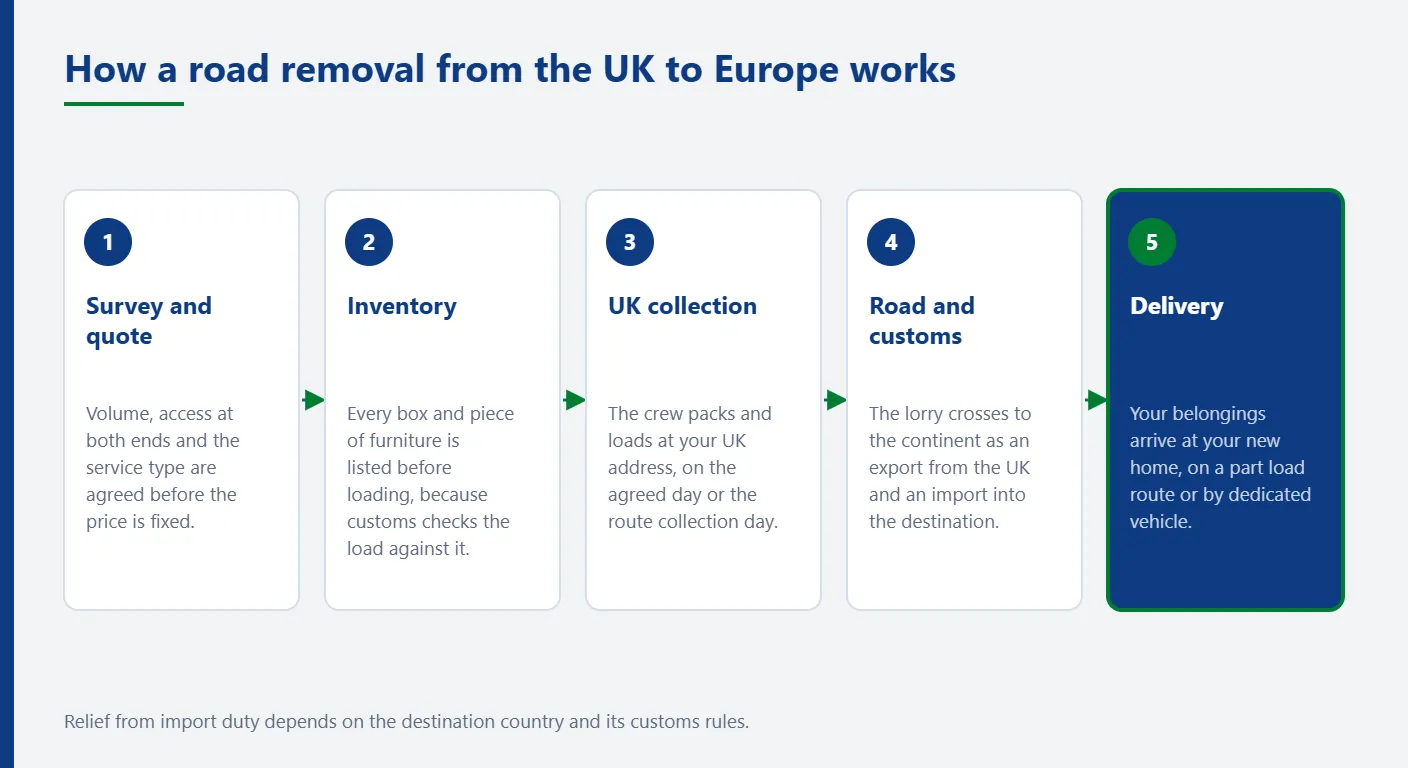
An export from the UK and an import into the EU
A European removal is now an export from the UK and an import into the EU. On the UK side, the GOV.UK guidance on declaring personal goods explains that personal goods do not normally need a formal export declaration, but it adds that anyone moving household items during a transfer of residence must check for additional requirements, including those of the destination country. The destination side is where the real paperwork sits, because the EU country you move to decides whether your used belongings enter free of duty.
In practice, this means the inventory is written before anything is loaded, and every item on the lorry has to appear on it. In 12 years moving London households, the EUROBR team finds that European moves rarely run late on the motorway. They run late when the inventory was finished in a hurry and no longer matched what was loaded.
Part load or dedicated vehicle across Europe
A part load is the cheaper option and a dedicated vehicle is the faster, more flexible one. On a part load, your belongings share a scheduled route with other customers’ shipments and you pay for the space you use. A dedicated vehicle carries only your belongings and travels more or less directly to the delivery address.
| Point of comparison | Part load on a scheduled route | Dedicated vehicle |
| What you pay for | The space your belongings occupy | The whole vehicle and the crew’s time |
| Departure | Set by the route schedule | The date you agree |
| Transit time | Longer, because the route combines several moves | Shorter, travelling more or less directly |
| Best suited to | A few boxes up to a modest flat | A full house, or a fixed key date |
| Main trade-off | Lower price for less control over timing | More control over timing for a higher price |
The right choice depends on volume and on how fixed your arrival date is. A student sending fifteen boxes from Lewisham to Madrid suits a part load. A family moving a three-bedroom house from Bromley to a rental in Lyon with a fixed start date suits a dedicated vehicle.
Which European countries can you move to by road from the UK?
EUROBR moves households by road from the UK to France, Spain, Portugal, Germany, Ireland, the Netherlands, Belgium, Italy, Switzerland, Austria and Poland, with a fixed monthly route to Portugal and Spain. All of these are EU member states except Switzerland, which has its own customs rules for household goods.
EU destinations from France and Spain to Poland
For the EU destinations, the customs logic is the same: your belongings enter the EU’s customs territory in the first member state they reach, and relief from import duty on used personal property is governed by a single EU framework, which the EU summary of the customs duty relief system explains in English. Each country applies that framework through its own customs authority and forms, so the documents differ in detail.
| Destination | Customs status in 2026 | What to expect |
| France, Spain, Germany, Italy | EU member states | EU transfer of residence relief, national forms and evidence |
| Portugal | EU member state | Baggage certificate from the Portuguese consulate in most cases |
| Ireland | EU member state | Transfer of residence relief administered by Revenue |
| Netherlands, Belgium, Austria, Poland | EU member states | EU transfer of residence relief, national forms and evidence |
| Switzerland | Not in the EU or the EU customs union | Swiss rules for removal goods, form 18.44 at the border |
Ireland is a useful example because its rules are published clearly in English. Revenue’s rules for transfer of residence relief require that you have lived outside the EU for a continuous period of at least 12 months, that you have owned and used the goods for a minimum period, and that you import them within six months before or 12 months after the date you move to live there. Portugal works through a consular baggage certificate, covered step by step in the EUROBR guide to removals to Portugal from the UK.
Switzerland and moves outside the EU
Switzerland is not part of the EU customs union, so a move there follows Swiss rules rather than the EU framework. The Swiss customs guidance on moving to Switzerland states that transferring your domicile is the key requirement for duty-free import of household goods, that items must have been in personal use for at least six months, and that the relocation file should reach the relevant customs office at least two working days before the border crossing, using form 18.44.
The practical difference is timing and routing. A Swiss move needs its paperwork filed before the lorry reaches the border, and the vehicle has to cross at the office the file was sent to. That makes Switzerland a destination where a dedicated vehicle is often the more sensible choice.
How much do removals to Europe from the UK cost in 2026?
The cost of removals to Europe from the UK depends on volume, destination, service type, packing, access at both ends and the customs work. As of 2026, EUROBR does not publish a single price for European moves and quotes each one on these variables, with quotes valid for 30 days.
For a sense of scale on the UK side alone, the HomeOwners Alliance guide to removal costs, updated in October 2026 with reallymoving data from August 2026, puts the average UK long-distance move of more than 100 miles at £900 to £1,200 for a one or two-bedroom house and £2,200 for four bedrooms or more. A European move adds the Channel crossing, the continental journey, tolls and customs work on top of that, so treat those figures as a floor for planning rather than a quote.
The variables that set a European removal price
Six variables set the price of a European removal, and most of them are within your control before the survey.
| Variable | Why it moves the price | What you can do about it |
| Volume | Space on the vehicle is the main cost driver | Sell, donate or clear what you will not use abroad |
| Service type | A dedicated vehicle costs more than a part load | Use a part load if your arrival date is flexible |
| Destination and route | Fuel, tolls and driving time grow with distance | Align your move with a scheduled route where one exists |
| Packing | Export packing adds time and materials | Pack books and clothes yourself, leave fragile items to the crew |
| Access at both ends | Stairs, long carries and parking add crew time | Arrange parking in the UK and check access abroad early |
| Customs work | Inventory and paperwork take time | Start the inventory as soon as you book |
Why distance alone does not set the price
Distance matters less than most people expect. A part load to Lisbon on a scheduled monthly route can cost less than a dedicated vehicle to a closer city in France, because the scheduled route shares the cost of the journey across several customers. Volume and service type usually outweigh mileage.
This is why EUROBR’s European removals page describes quotes as “based on time, distance, weight, and volume” and why a short survey of what you are moving is the reliable way to price it. A survey also catches the details that add hours on the day, such as a third-floor flat in Paris without a lift, which a price based on distance alone would miss.
How long does a removal from the UK to Europe take?
A road removal from the UK to Europe takes from a few days to a couple of weeks, depending on the destination and the type of service, according to EUROBR’s published range as of 2026. A dedicated vehicle sits at the faster end, a shared route at the slower end, and customs paperwork is the main source of delay.
Transit time by service type
The table below shows the stages of a typical European move. Preparation timings are practical planning guidance, not published service levels, and your quote confirms the window for your own move.
| Stage | Part load | Dedicated vehicle |
| Survey and quote | Before the route date you want | Before the date you want |
| Inventory and paperwork | Started at booking | Started at booking |
| Collection | On the route’s collection days | On the agreed day |
| Road journey and clearance | Longer, following the route itinerary | Shorter, more or less direct |
| Delivery | On the route’s delivery days | On the agreed day |
| Overall range published by EUROBR, 2026 | Towards a couple of weeks | Towards a few days |
Where the time is lost
Time on a European move is lost in three places: incomplete paperwork, access at either end, and the itinerary of a shared route. Customs assesses the shipment against the inventory, so a missing document or a mismatch stops the load until it is resolved.
EUROBR’s European removals page is candid about this: delivery times “are estimated and may experience delays”, and important items should be shipped in advance. If your move has a hard deadline, such as a job start date or the end of a UK tenancy, plan around a window rather than a single day, and choose a dedicated vehicle if the date cannot move.
What paperwork do you need to move your belongings to Europe?
Moving your belongings to Europe needs an itemised inventory and, if you want to bring used personal property in free of import duty, evidence that you are transferring your normal residence to the destination country. The exact forms depend on the country, and the EU framework sets the common conditions.
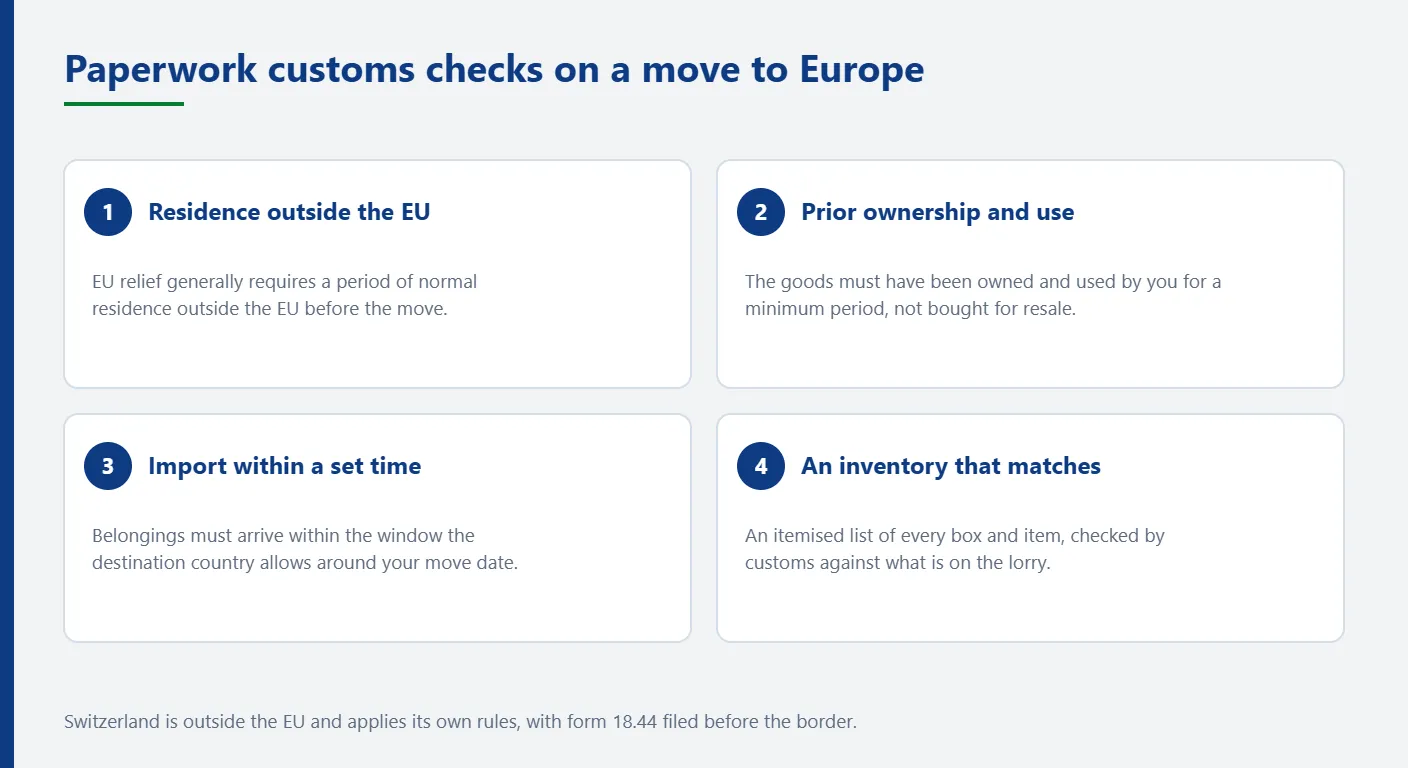
Transfer of residence relief in the EU
Transfer of residence relief is the customs rule that lets people moving their normal residence into the EU bring used personal belongings in without paying import duty, if conditions are met. The EU framework, summarised by EUR-Lex, generally requires a period of residence outside the EU, a period of prior ownership and use of the goods, and import within a set time of the move. Goods brought in under the relief cannot normally be lent, sold or hired out for a period afterwards.
Countries apply this framework with their own evidence. Ireland, for example, publishes the 12-month residence rule and the import window in English. Portugal asks for a baggage certificate from its consulate. The safest approach is to treat the destination country’s customs authority as the source of truth and to prepare your evidence before the lorry is loaded, not after.
The inventory and what you cannot ship
The inventory is an itemised list of every box and piece of furniture on the load, and customs checks the shipment against it. Number every box, describe the contents in plain terms, and list furniture and higher-value items individually. EUROBR’s European removals page lists what can travel, from clothes and kitchenware to furniture, used electronics and books, with the condition that items show signs of prior use and are not for resale.
Some categories cannot travel as household goods, including commercial goods for resale, weapons and hazardous materials, flammable liquids, loose batteries, medicines, and food and perishables. If you are unsure about an item, ask before it is packed. The guide to packing box sizes for moving house helps you keep the box count on the inventory realistic.
What is CMR and why does it matter on a European move?
CMR is the Convention on the Contract for the International Carriage of Goods by Road, the international agreement that governs road transport of goods between countries, including the consignment note that travels with the load and the carrier’s liability. On a European removal it sits alongside Goods in Transit cover.
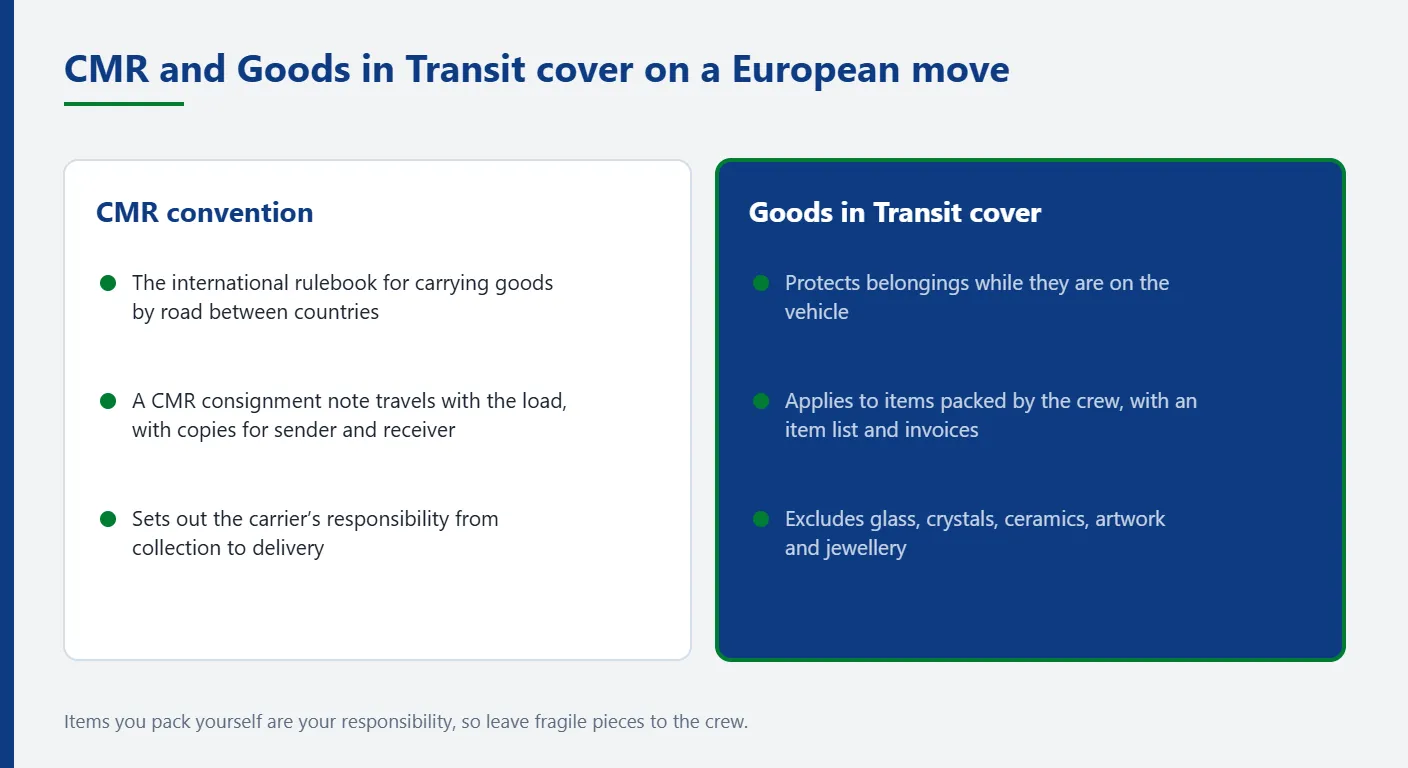
CMR in plain English
CMR is the rulebook for international road carriage. It sets out what the carrier is responsible for between collection and delivery, and it requires a consignment note, the CMR note, that records what is being carried, from where and to where. The GOV.UK guidance on international road haulage states that a CMR note is required on all international journeys carrying goods on a commercial basis, with copies for the sender, the receiver and the load itself.
For a household move, CMR matters because it is the framework a claim falls under if something goes wrong between countries. EUROBR carries CMR cover and holds the convention document on its CMR regulations page.
Goods in Transit cover and its exclusions
Goods in Transit insurance protects belongings while they are on the vehicle. EUROBR’s European removals page states that its standard goods in transit cover applies to items packed by its team, with an item list and invoices, and that cover does not extend to glass, crystals, ceramics, artwork and jewellery, or to scratches, marks and defects. It also states that items packed by the customer are the customer’s responsibility.
Those conditions shape how you pack. Leaving fragile and valuable items to the crew is not just about care, it is about cover. EUROBR’s packing services and materials include full packing, part packing and materials only, so you can split the work by risk.
How do you choose a removal company for a move to Europe?
Choose a removal company for a move to Europe by checking four things: insurance that covers international road carriage, a regular route or a clear plan for your destination, real experience with post-Brexit customs paperwork, and a written quote with its validity, payment and delivery terms spelled out.
Checks before you pay
Run these checks before you pay any deposit:
- Insurance: ask for Goods in Transit and CMR cover and for the conditions and exclusions in writing.
- Licensing and trade standards: the British Association of Removers explains what its members commit to, including an independent audit and a code of practice.
- Route: ask when the vehicle actually travels to your destination and whether that date is scheduled or depends on filling the lorry.
- Customs: ask who prepares the inventory and the destination paperwork, and what you have to provide.
- Contact: make sure there is a named person and a working phone line for the day of delivery abroad.
Reading the quote: validity, payment and delivery terms
A good European quote states how long it is valid, when payment is due, what is included and what is excluded. EUROBR’s European removals page publishes that quotes are valid for 30 days, that payment is due before shipment, and that deliveries are not made to difficult-to-access locations or areas without pavement. Reading those terms before booking avoids the most common disputes.
If something does go wrong, Citizens Advice explains your rights when a service is not carried out with reasonable care and skill.
Frequently asked questions about removals to Europe from the UK
What is the cheapest cost for removals from the UK to Spain?
The cheapest removal from the UK to Spain is usually a small part load on a scheduled route, because you pay only for the space your belongings occupy and the cost of the journey is shared with other customers. There is no reliable single figure for the cheapest price, since it depends on how much you send, where in Spain it goes, the access at both ends and the paperwork. As a scale reference for the UK side only, the HomeOwners Alliance puts the average UK long-distance move of more than 100 miles at £900 to £1,200 for a one or two-bedroom house, using reallymoving data from August 2026, and a move to Spain adds the continental journey and customs on top. EUROBR runs a fixed monthly road route between the UK, Portugal and Spain, with Madrid and Barcelona on the same corridor as Lisbon and Porto, which is designed to keep shared costs down. The most effective way to cut the price is to reduce volume before the survey. The European removals service quotes after a short survey of what you are sending.
Can I move my stuff from the UK to Europe?
Yes. You can move your household belongings from the UK to any European country, but since Brexit the move is an export from the UK and an import into the destination country, so it needs an itemised inventory and, usually, customs paperwork at the destination. If you are transferring your normal residence, used personal belongings can often enter the EU free of import duty under transfer of residence relief, provided you meet conditions on prior residence outside the EU, prior ownership and use of the goods, and the timing of the import. Each country applies those conditions with its own evidence, such as a baggage certificate for Portugal or Revenue’s forms for Ireland. Some items cannot travel as household goods, including goods for resale, hazardous materials, medicines and food. A professional remover prepares the inventory with you and handles the transport paperwork, while you provide the personal evidence of your move. The EUROBR guide to removals to Portugal from the UK shows the full paperwork for one destination step by step.
What day is the cheapest for removals?
Midweek is usually the cheapest time to book a removal, because it is quieter for removal firms. The HomeOwners Alliance notes that Tuesday is often the cheapest day to move house and that Fridays and Mondays are busy and therefore more expensive, as of 2026. For a European move, the day of the week matters less than the type of service. On a part load, the departure is set by the route schedule, so the cost saving comes from sharing the vehicle rather than from the weekday. On a dedicated vehicle, a flexible collection date gives the remover room to fit your move into a quieter slot, which can help the price. Timing within the year matters too, because the end of the month and the summer holidays are popular moving periods. The practical advice is to ask for prices on two or three dates rather than one. Use the EUROBR moving checklist to work back from your arrival date and leave enough room to choose the cheaper slot.
What are the best removal companies for moving from the UK to France?
The best removal company for a move to France is one that holds insurance covering international road carriage, has real experience with post-Brexit customs paperwork, gives you a clear written quote and can tell you when the vehicle will actually travel. Rankings and comparison sites cannot tell you which firm suits your move, because the right choice depends on your volume, your dates and your address in France. Ask every remover the same questions: what Goods in Transit and CMR cover includes and excludes, who prepares the inventory and the French customs evidence, whether the departure is scheduled or depends on filling the lorry, how long the quote is valid, and when payment is due. Trade body membership, such as the British Association of Removers, adds a code of practice and a complaints route. EUROBR is fully insured with Goods in Transit and CMR cover, has a bilingual team and moves households to France by road. The CMR regulations page holds the convention document if you want to read the framework yourself.
Can you send a few boxes to Europe instead of a full move?
Yes. You do not need a full house move to use a European removal service. EUROBR’s scheduled routes carry anything from a single suitcase or a few boxes up to the contents of a whole home, and smaller shipments travel as a part load, where you pay for the space you use rather than for a whole vehicle. This suits students, people moving into furnished accommodation and anyone sending part of their belongings ahead. The same paperwork rules apply to a small shipment as to a large one: every box needs to appear on the inventory, and the items must be used personal belongings rather than goods for resale. Use strong double-wall boxes, fill them fully so they do not crush, and number each one to match the inventory. Fragile items packed by the customer are the customer’s responsibility under EUROBR’s published terms, so consider professional packing for anything breakable. The packing services and materials range covers boxes, tape and protective wrap for a small shipment.
Do you pay import duty on used furniture moved to the EU?
Usually not, if you are transferring your normal residence to the EU and meet the conditions for transfer of residence relief. The relief lets used personal belongings, including furniture, enter without import duty, but it depends on conditions that each country checks: a period of residence outside the EU before the move, prior ownership and use of the goods, and import within a set window around the date you move. Ireland, for example, publishes a 12-month residence rule and an import window of six months before to 12 months after the move. Goods brought in under the relief generally cannot be sold, lent or hired out for a period afterwards. New items, or goods in commercial quantities, are treated differently and may attract duty and VAT. Because these rules belong to the destination country, confirm them with its customs authority before you pack. EUROBR’s removals to Portugal from the UK service shows how the relief works for one destination.
Planning removals to Europe from the UK
Removals to Europe from the UK go smoothly when the inventory, the customs evidence and the access at both ends are settled before collection day. The road journey is the predictable part. EUROBR moves households from London to eleven European countries by road, runs a fixed monthly route to Portugal and Spain, is fully insured with Goods in Transit and CMR cover, and has a bilingual English and Portuguese team with an office in Portugal. Delivery times depend on the destination, the service type and clearance, so the team gives you a realistic window with your quote.
Planning a move to Europe? EUROBR handles the customs paperwork end to end and quotes after a short survey of what you are moving. Message the team on WhatsApp at +44 7878 921856, email [email protected], or request an international quote today.