

Office removals in London are the planned relocation of a business’s furniture, files, equipment and IT infrastructure from one commercial address to another, normally carried out outside trading hours so the company keeps working.
A commercial move differs from a domestic one in four ways: it runs to an inventory rather than a van load, it involves a landlord and a lease, it carries legal duties over data and waste, and every hour of downtime has a cost attached. London adds its own constraints, with 538,000 registered businesses in the capital as of March 2025 according to the ONS, most of them in buildings with booked goods lifts, controlled loading bays and a daily emissions charge on every vehicle that turns up. The decisions that matter most are the timeline, the asset inventory and who is legally responsible for what leaves the old building.
Office removals in London are judged on one number: how long the business is unable to trade. Everything else, the crate count, the van size, the number of desks, is a means to keeping that number small. A move that runs from Friday evening to Sunday afternoon and has staff working normally on Monday morning was a good move, even if it was not the cheapest quote. A move that overruns because the goods lift was not booked, or because nobody knew which cables belonged to which desk, costs far more than the difference between two quotes. This guide sets out how to plan a commercial relocation in London, what a full service includes, what drives the price, the legal duties over data and waste that come with clearing an old office, and how to check a supplier before you sign.
Why professional office removals in London require specialist expertise
A commercial move is a project with dependencies, not a job with a van. The difference is that a household move can absorb a two-hour delay, while an office move that overruns leaves staff unable to work and customers unable to reach anyone.
Three things separate commercial work from domestic removals. The load includes equipment that cannot simply be carried, such as server racks, multifunction printers, safes and fire-rated cabinets. The building imposes rules, because most London commercial premises control access to goods lifts and loading bays and require insurance documents before a crew is admitted. And the paperwork carries legal weight, because confidential files and electronic equipment leaving a premises engage data protection and waste duties that fall on the business, not on the mover.
The hidden costs of managing an office relocation in-house
Asking staff to move the office themselves looks like a saving until the real costs are counted. Four of them are routinely missed.
- Lost productive hours. A team of fifteen spending a day and a half packing and carrying is more than twenty working days of output, charged at salary rather than at a mover’s hourly rate.
- Injury risk carried by the employer. The Manual Handling Operations Regulations 1992 require an employer to avoid hazardous manual handling where reasonably practicable, assess the risk where it cannot be avoided, and reduce it as far as possible. Handling, lifting or carrying accounted for 17% of the non-fatal injuries employers reported under RIDDOR in Great Britain in 2024/25, from 59,219 reported employee injuries in total.
- Uninsured damage. A hired van carries no Goods in Transit cover for your equipment, and a dropped monitor arm or a scratched lift interior becomes a direct cost, sometimes a dilapidations claim.
- Overrun. Untrained teams underestimate loading time by a wide margin, and the overrun lands on Monday morning rather than on Saturday night.
Minimising business downtime: moving at weekends and at night in London
The standard answer to downtime in London is to move outside trading hours, and it works because the constraint is rarely the driving. It is the building.
An out-of-hours move means the crew loads on Friday evening, transports and unloads overnight or on Saturday, and spends Sunday positioning furniture and reconnecting equipment so that Monday starts normally. It requires three things arranged in advance: written permission from both building managements for out-of-hours access, a booked and padded goods lift at each end, and security clearance for the crew where the building requires it. EUROBR’s office and IT relocation service covers out-of-hours and weekend moves with building access, security and parking coordination included, alongside a dedicated move coordinator.
How to plan an office relocation in London, step by step
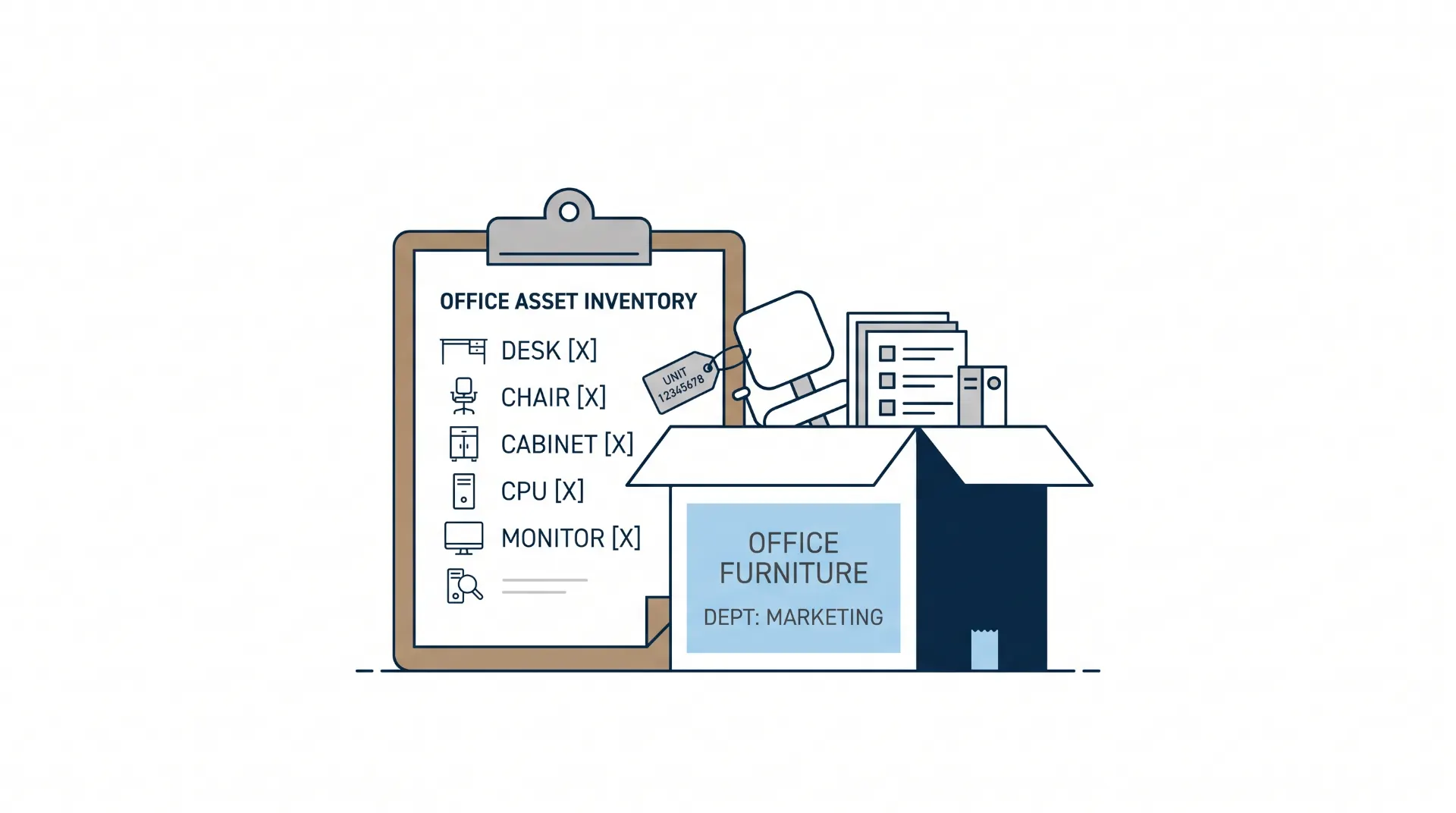
Planning a commercial move is mostly sequencing. The physical work takes a weekend; the preparation takes months, and the preparation is what determines whether the weekend is enough.
Creating a realistic timeline
Work backwards from the day the new lease starts and the day the old one ends, and accept that those two dates rarely overlap neatly. The timeline below is the planning shape used for a typical London office of 20 to 100 people.
| When | What happens |
| 6 to 9 months out | Confirm the new premises, read the exit obligations in the old lease, appoint an internal move owner |
| 4 to 6 months out | Commission a survey, request quotes, agree the fit-out and desk plan for the new site |
| 3 months out | Appoint the removals firm, book the moving weekend, notify telecoms and connectivity suppliers |
| 8 to 10 weeks out | Complete the asset inventory, agree what is moving, what is being replaced and what is being disposed of |
| 6 weeks out | Book goods lifts and loading bays at both ends, apply for parking bay suspensions, arrange security clearance |
| 4 weeks out | Brief staff, issue crate allocations and labels, confirm the IT shutdown and restart sequence |
| 2 weeks out | Confirm insurance documentation with both building managements, finalise the runbook |
| Moving weekend | Shutdown, load, transport, unload, position, reconnect, test |
| Week after | Snagging, dilapidations handover on the old site, disposal of anything left |
The two items people leave too late are the goods lift booking and the parking bay suspension. Most London councils require between three and fifteen working days’ notice for a suspension depending on the borough, and a busy building’s goods lift diary fills weeks ahead. The parking suspension guidance and the blog article on parking suspension for moving in London set out how each council handles the application.
Conducting a comprehensive IT and asset inventory
The inventory is the single document the whole move runs on, and it is worth more than any other piece of preparation.
A usable inventory records, for every item: what it is, an asset tag or serial number where one exists, which department owns it, where it sits now, where it goes at the new site, and whether it is moving, being replaced or being disposed of. Crates are numbered and mapped to a desk and a department rather than to a person, because people move desks between the plan and the day. EUROBR’s commercial service includes crate hire, labelling and inventory management, with items labelled by destination, desk and department.
Three categories need separate treatment on the inventory:
- IT hardware, which needs its own shutdown sequence and cable logging, covered in detail in the companion guide to IT relocation.
- Confidential records, which need a documented chain of custody from the old office to the new one.
- Anything being disposed of, which needs a route and a waste transfer note rather than a skip.
Managing lease obligations, dilapidations and landlord requirements
The exit from the old building is the part of an office move most likely to produce an unexpected bill months later.
A schedule of dilapidations is a formal document, normally prepared by a building surveyor, that lists the tenant’s lease obligations, the alleged breaches, the works proposed to remedy them and the cost. RICS guidance distinguishes an interim schedule, served during the lease term, from a terminal schedule, prepared at or shortly after the end of the lease and usually including yield-up obligations. Those obligations commonly cover repair, decoration, reinstatement of alterations and removal of the tenant’s own items and fixtures. Section 18(1) of the Landlord and Tenant Act 1927 caps damages for breach of a repairing covenant at the diminution in the landlord’s property value, which is a meaningful limit on a disproportionate claim.
For the move itself, three practical consequences follow. Reinstatement work, such as removing partitions or making good cabling routes, has to be scheduled after the office is cleared and before the keys go back. Anything the lease requires the tenant to remove must be on the disposal list, not left behind. And both building managements will normally ask for the removals firm’s insurance documents before granting access, so those are requested weeks ahead rather than on the Friday.
What services are included in commercial office removals?
A full commercial service covers the physical move, the equipment handling and the clearance of the old site, coordinated by one person rather than split across suppliers.
Secure packing, crate hire and heavy item handling
Commercial moves run on reusable plastic crates rather than cardboard, because crates stack safely, seal without tape, take a printed label and can be delivered a week early so staff pack their own desks in their own time. On top of the crates, a commercial crew handles the items an office cannot move itself: desks and pedestals, partitions, filing and archive, reception furniture, safes and fire cabinets. Desk, partition and furniture dismantling and reassembly is part of the standard scope.
IT disconnection, safe transport and server room relocation
Equipment is decommissioned in a controlled sequence rather than unplugged, with cabling logged so that reconnection at the new site rebuilds the same configuration. Servers, workstations, network and communications hardware are handled, transported and recommissioned. This is the highest-risk element of a commercial move and it has its own methodology, which the companion guide on IT relocation covers in full.
Furniture recycling, clearance and storage
Almost every office move leaves furniture behind, and the disposal route is regulated. EUROBR is a licensed waste carrier registered with the Environment Agency, and removal and licensed disposal of old furniture is part of the commercial service. Where the two lease dates do not meet, short-term storage between moving dates is available through the house and flat removals service, although the commercial page does not publish a separate storage offer, so confirm capacity and duration at quote stage.
| Element | What it covers | Why it matters commercially |
| Crate hire and labelling | Reusable crates delivered ahead, labelled by desk and department | Staff pack in their own time, and unloading goes to the right desk first time |
| Furniture dismantling and reassembly | Desks, pedestals, partitions, storage, reception | Large items pass through doors and lifts that a built desk cannot |
| IT decommission and recommission | Servers, workstations, network and comms, cabling logged | Rebuilds the same configuration instead of improvising on Monday |
| Confidential document handling | Secure handling with a chain of custody | Files leaving a premises engage data protection duties |
| Old furniture clearance | Removal and licensed disposal | The business remains legally responsible for its own waste |
| Out-of-hours and weekend moves | Evening, overnight and weekend working | Trading hours are protected |
| Move coordination | One named coordinator across both buildings | Building access, lifts and parking stop being the client’s problem |
How much do office removals in London cost in 2026?
Commercial removals are quoted per project after a survey, not from a price list, because the variables that drive the cost are specific to the two buildings involved. No UK public authority publishes benchmark rates for office removals, so any figure quoted online without a named source should be treated with caution.
Key factors that shape a commercial quote
- Volume and headcount. Desks, crates, storage units and IT equipment count, not floor area alone.
- Access at both ends. Goods lift or stairs, loading bay or kerbside, distance from the vehicle to the lift, and whether the building restricts vehicle size.
- Timing. Out-of-hours, overnight and weekend working carries a premium, which is normally repaid several times over in avoided downtime.
- Specialist items. Server racks, safes, large-format printers and fire cabinets need specific equipment and crew.
- Dismantling and reassembly. The number of desks, partitions and storage units to be taken apart and rebuilt.
- Clearance. Old furniture and equipment leaving the site is priced separately, because it is regulated work.
- Storage. Any gap between the two lease dates.
Three London charges are fixed and verifiable, and a compliant quote should itemise them rather than bury them.
| Charge in 2026 | Amount | Applies to |
| ULEZ | £12.50 a day | All London boroughs, 24 hours a day, every day except 25 December |
| Congestion Charge | £18 a day paid in advance or on the day, £21 if paid within three days after | Central zone, 07:00 to 18:00 Monday to Friday and 12:00 to 18:00 at weekends and on bank holidays |
| Parking bay suspension or dispensation | Set by each borough, typically tens of pounds per bay per day plus an administration fee | Controlled parking streets, with three to fifteen working days’ notice depending on the council |
Insurance and Goods in Transit cover
Insurance is where a commercial quote should be read most carefully, because the value of an office load is concentrated in a small number of items.
Goods in Transit insurance covers goods while they are carried in the vehicle. CMR insurance is the regime that applies to international road transport, explained on the CMR regulations page. EUROBR carries both on commercial work. Two questions decide whether the cover is adequate for your move. First, what is the limit per load, expressed as a figure rather than as the phrase “fully insured”, since a single rack of servers can exceed a modest ceiling. Second, are high-value or fragile categories included or excluded, since screens, glass and specialist equipment are commonly excluded from standard cover unless declared and priced.
Ask for both answers in writing before the contract is signed, and check them against your own commercial insurance so there is no gap between the two policies.
Access, parking and vehicle charges for a central London office move

Access is the constraint that most often turns a well-planned commercial move into a long night, and it is entirely solvable in advance.
Four items need to be confirmed in writing, at both buildings, several weeks before the move.
- Goods lift booking. Dimensions, weight limit, padding, and the hours it may be used. The internal depth matters as much as the door width for desks and racks.
- Loading bay or vehicle access. Height restrictions on car parks and service yards routinely exclude a 3.5 tonne or 7.5 tonne vehicle, which changes the number of trips.
- Parking bay suspension or dispensation where there is no bay, applied for through the borough with the notice period that council requires.
- Security and insurance documentation. Many managed buildings require the crew list, insurance certificates and sometimes security clearance before admitting anyone.
In 12 years moving London households and offices, the EUROBR team finds the single biggest cause of moving-day delay is access that was not arranged in advance, and in commercial work that means the goods lift far more often than the road.
Your legal duties when an office move creates waste
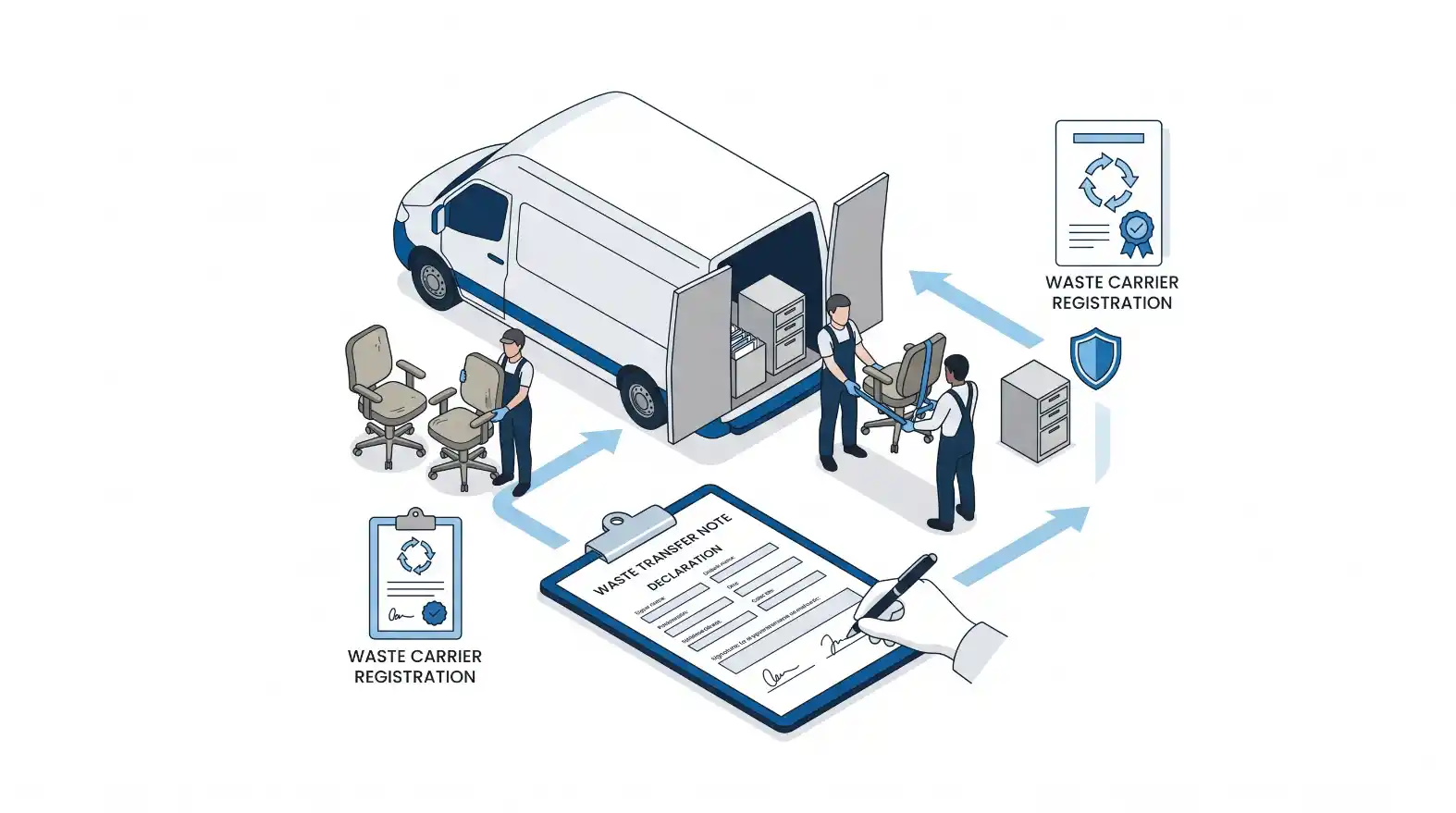
Clearing an old office generates waste, and the legal responsibility for it sits with the business, not with whoever carries it away.
Under the business waste duty of care, GOV.UK requires a company to keep waste to a minimum by preventing, reusing, recycling or recovering it in that order, to sort and store waste safely, to check that its waste carrier is registered, and to complete a waste transfer note for every load that leaves the premises. Both parties must keep a copy of the note for two years and produce it if the council or the Environment Agency asks. Upper tier waste carrier registration in England costs £191.02 for a new registration and £130.25 to renew every three years, and operating without one carries an unlimited fine.
Electrical and electronic equipment is regulated separately. GOV.UK guidance is that equipment becomes WEEE when the holder discards it, intends to discard it, or is required to discard it. Equipment passed on for genuine reuse can stay outside the waste regime, but only if all six of the conditions the Environment Agency sets are met, including that the item needs no more than minor repair, that this is established before it leaves the premises, that there is a real market for reuse and that it is not transported as though it were waste. Where equipment is prepared for reuse, records must be kept for each individual item showing the visual, safety and functionality checks that were carried out.
Confidential records carry a third set of duties. The ICO expects documented secure disposal methods such as device wiping, degaussing or hardware shredding, secure storage with restricted access for equipment awaiting destruction, logs of what is held and where, contracts with third parties that include security measures and a right to audit, and a named person checking destruction certificates against what was sent. Those expectations sit under articles 5 and 32 of the UK GDPR.
The practical consequence for an office move is simple. Anything leaving the old building needs a route, a carrier who is registered for it, and a piece of paper.
How to check a commercial removals firm before you sign
Five checks separate a supplier who can carry a project from one who can carry boxes.
- A pre-move survey, on site, at both addresses. Any firm quoting a commercial move without seeing the goods lift and the loading bay is guessing.
- Goods in Transit and CMR cover, with limits in figures, plus written confirmation of which categories are excluded.
- Waste carrier registration if the firm is clearing furniture or equipment. Search the company name on the Environment Agency’s public register of waste carriers.
- A named move coordinator and a written method statement covering the shutdown sequence, the load order and the reconnection plan.
- A complaints and escalation route. Firms in the British Association of Removers work to an Approved Code of Practice overseen by Chartered Trading Standards, which requires a complaint to be acknowledged within three working days and resolved within eight weeks, with unresolved disputes referred to the Furniture and Home Improvement Ombudsman for a binding adjudication.
Business-to-business contracts do not carry the same statutory consumer protections as domestic ones, which makes the written scope, the insurance limits and the escalation route more important rather than less.
A moving-weekend runbook for the office manager
The runbook is a one-page document that tells everyone what happens and when. It is the difference between a crew that works and a crew that waits.
- Friday, close of business. Staff clear desks into numbered crates. Personal items and valuables go home with their owners rather than into the load.
- Friday evening. IT shutdown in the agreed sequence, cabling logged and bagged, equipment packed. Furniture dismantling begins on the floors that are already clear.
- Saturday. Load, transport and unload. Large items and IT go into the new building first, while the floors are empty.
- Saturday evening or Sunday morning. Furniture reassembled and positioned to the desk plan. Crates delivered to the desk and department printed on the label.
- Sunday. Equipment reconnected and tested, network validated, and a walk round of both buildings with the coordinator to list snags.
- Sunday evening. Old site cleared, waste transfer notes collected, keys and access cards accounted for.
- Monday morning. A member of the crew or the coordinator on site for the first two hours, because that is when the small problems appear.
Two rules make the runbook work. Nothing goes in the load that is not on the inventory, and one named person at each building has authority to make decisions on the day. The moving checklist covers the administrative tasks that run alongside, and the man and van service covers smaller single-vehicle jobs such as a satellite office of three or four desks.
Frequently asked questions
How much do office removals in London cost?
Commercial removals are quoted per project after a survey rather than from a published rate, because the cost is driven by variables specific to the two buildings involved. The main factors are volume and headcount, access at both ends, whether the work runs out of hours, the number of specialist items such as server racks and safes, how much furniture needs dismantling and reassembling, and how much old equipment is being cleared. No UK public authority publishes benchmark rates for office moves, so figures quoted online without a named source are unreliable. Three London charges are fixed and should appear as separate lines on any quote: the ULEZ at £12.50 a day across all London boroughs, the Congestion Charge at £18 a day in the central zone paid in advance or on the day, and any council parking bay suspension, which is set by each borough and typically costs tens of pounds per bay per day plus an administration fee. Domestic hourly structures, which work differently, are set out in the guide to how much a man with a van costs in London.
How far in advance should an office removal company be booked in London?
Three months before the move is the practical minimum for an office of 20 to 100 people, and six months is more comfortable where a fit-out is involved. The constraint is rarely the removals firm’s diary. It is the sequence of approvals that has to happen before the crew can work. Goods lift bookings in managed London buildings fill weeks ahead and often restrict the hours a move may use them. Parking bay suspensions need between three and fifteen working days’ notice depending on the borough, and the application usually has to name the vehicle and the dates. Building managements commonly require insurance certificates, crew lists and sometimes security clearance before admitting anyone out of hours. Telecoms and connectivity at the new site have their own lead times, which are frequently longer than the removals lead time and should be ordered first. Working backwards from the lease dates is the reliable method, and the moving checklist sets out the same countdown structure for the administrative tasks.
Do removal companies dismantle and reassemble office furniture?
Yes, dismantling and reassembly is standard scope in a commercial move rather than an extra, because most office furniture cannot pass through a doorway or a goods lift assembled. The work covers desks and pedestals, screens and partitions, storage and filing units, meeting tables and reception furniture. Fixings are bagged and labelled to the item they belong to, and panels are protected before they go in the vehicle. Two points are worth agreeing in the written scope. First, whether reassembly follows the existing layout or a new desk plan, since a new plan needs to be issued to the crew in advance and drives the unloading order. Second, how items that have already been dismantled and rebuilt several times will be handled, as fixings in chipboard and MDF weaken each time they are unscrewed. Where furniture is being replaced rather than moved, the old items become waste and need a licensed route out, described on the office and IT relocation service page.
What parking and congestion charges apply to an office move in central London?
Three separate charges can apply, and they are cumulative rather than alternatives. The ULEZ is £12.50 a day, applies across all London boroughs, and runs 24 hours a day every day except 25 December, so any non-compliant vehicle pays it regardless of the hour the move runs. The Congestion Charge is separate and applies only in the central zone, at £18 a day paid in advance or on the day, or £21 if paid within three days afterwards, operating 07:00 to 18:00 Monday to Friday and 12:00 to 18:00 at weekends and on bank holidays. A weekend move in the central zone therefore still attracts the charge for part of the day. On a controlled parking street with no loading bay, the vehicle also needs a bay suspension or a dispensation from the borough, priced per bay per day with an administration fee on top and requiring notice that varies from around three to fifteen working days. Borough-level detail is set out in the guide to parking suspension for moving in London.
Can an office move be done overnight or at the weekend?
Yes, and for most London businesses it is the default rather than the exception, because the cost of an out-of-hours premium is normally far smaller than the cost of a day of lost trading. A typical sequence has staff clearing desks on Friday afternoon, IT shutdown and loading on Friday evening, transport and unloading on Saturday, furniture positioning and reconnection on Sunday, and normal working on Monday. Three approvals make it possible and all of them need arranging weeks ahead: written permission for out-of-hours access from both building managements, a booked goods lift at each end with the permitted hours confirmed, and security clearance for the crew where the building requires it. Some managed buildings prohibit moves entirely outside set hours, which is why the building rules are checked before the moving weekend is chosen rather than after. Out-of-hours and weekend working with building access, security and parking coordination is part of the commercial scope described on the office and IT relocation service page.
Who is legally responsible for the old furniture and equipment left behind?
The business that produced the waste remains responsible for it, which surprises many outgoing tenants. Under the business waste duty of care, GOV.UK requires a company to prevent, reuse, recycle or recover waste in that order, to sort and store it safely, to check that its waste carrier is registered, and to complete a waste transfer note for every load leaving the premises, with both parties keeping a copy for two years and producing it on request from the council or the Environment Agency. Upper tier waste carrier registration in England costs £191.02 for a new registration and £130.25 to renew every three years, and operating unregistered carries an unlimited fine. Electrical equipment is regulated separately: it becomes WEEE when the holder discards it or intends to, and passing it on for genuine reuse only stays outside the waste regime if the Environment Agency’s six conditions are all met. The lease adds a further layer, since terminal dilapidations obligations commonly require removal of the tenant’s own items and fixtures, a point covered in the section on lease obligations and in the survey a commercial mover carries out before quoting.
What insurance should a commercial removals firm carry?
Two policies matter for the move itself and both should be evidenced in writing before a contract is signed. Goods in Transit insurance covers goods while they are being carried in the vehicle, and CMR cover is the separate regime governing international road transport. The question that decides whether the cover is adequate is the limit per load, expressed as a figure rather than as the phrase “fully insured”, because the value of an office load concentrates in a few items and a single rack of servers or a room of workstations can exceed a modest ceiling. The second question is which categories are excluded, since screens, glass and specialist equipment are commonly outside standard cover unless declared and priced separately. Building managements frequently require sight of the certificates before admitting a crew, so requesting them early serves two purposes. It is also worth checking the mover’s cover against the company’s own commercial policy so there is no gap between them. The regime for cross-border road transport is explained on the CMR regulations page.
Ready to move your London office without losing a trading day
An office move is won or lost in the preparation. The inventory decides whether the crew knows where things go, the lift and parking bookings decide whether the crew can work at all, and the disposal plan decides whether a bill arrives three months later. The physical work is the easy part.
EUROBR has been moving London businesses and households since 2013, carries Goods in Transit and CMR insurance, holds waste carrier registration with the Environment Agency and holds a 5.0 Google rating. Commercial work across Greater London and the M25 covers furniture and partition dismantling and reassembly, crate hire and inventory management, IT and server relocation, secure handling of confidential documents, licensed disposal of old furniture, and out-of-hours and weekend moves with a dedicated coordinator. Packing services and materials and furniture assembly and delivery can be added to the same project.
Request a free, no-obligation commercial removal quote from EUROBR’s insured team. Message on WhatsApp at +44 7878 921856 or contact the office online with your headcount, both addresses and your target moving weekend, and the team will arrange a survey and give you an itemised price.