

Man and van vs removal company: choose a man and van for small, simple moves and a removal company for family homes, packing and long distances.
Man and van vs removal company comes down to the size of the move and how much of the work you want handed over. A man and van suits studios, one-bedroom flats, single items and short-notice jobs: you pay by the hour, usually from around £64 an hour for one mover and £78 for two (Checkatrade, August 2026), and you often help with the lifting. A full removal company suits homes of two or three bedrooms and above, moves with packing and dismantling, and long distances: a local three-bedroom move averages £792 (HomeOwners Alliance, August 2026 data). The practical differences are planning, crew size, insurance and accountability. Whichever you choose, check for Goods in Transit cover in writing, a clear price basis and someone who arranges parking before the day.
Choosing between a man and van vs removal company is one of the first decisions of any London move, and it shapes the price, the timing and how tired you are by the evening. Both options put a van and at least one person outside your door. What changes is how the job is planned, who carries the risk and how many hands are on the stairs. This guide sets out what each service includes, what each costs in 2026, when the smaller option is the sensible one and when it becomes a false economy. It is written for people moving within Greater London, from a student room in Lambeth to a family house in Bromley. EUROBR runs both a man and van service in London and full house removals, so the aim here is to help you pick the format that fits, not to sell the bigger job.
Man and van vs removal company: what is the difference?
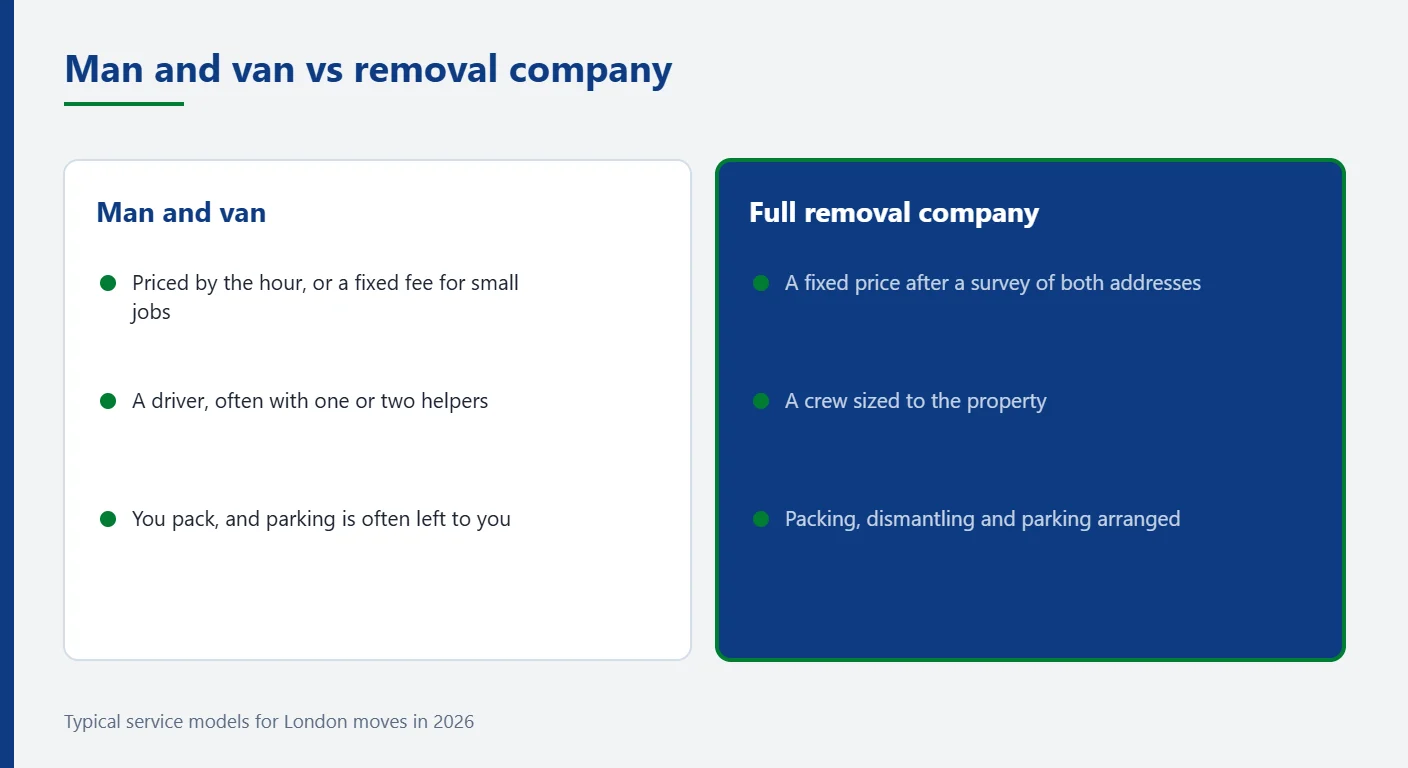
A man and van is a van, a driver and usually one or two helpers, paid by the hour or by a fixed fee for a simple job. A removal company is a planned, managed move with a surveyed price, a larger crew, packing and dismantling options and insurance that covers the whole job.
What a man and van service includes
A man and van service is transport plus loading labour. The driver brings the van, blankets and straps, and loads and unloads what you have already packed. Most operators charge by the hour from arrival, with travel time sometimes added, and some quote a fixed fee for a single item or a studio. It matters because the hourly model rewards preparation: boxes sealed, furniture empty and a clear path to the door keep the charges down. In practice, a man and van works best when the volume fits in one van load and the access is simple. EUROBR publishes starting prices for this format of £50 for a single item, £125 for a studio and £165 for a one-bedroom move, plus VAT, as of 2026, with a quote required for offices.
What a full removal company includes
A full removal company sells a managed outcome rather than hours of labour. The job starts with a survey of volume, floors and parking at both addresses, followed by a fixed price, a crew sized to the property and options for professional packing, dismantling, reassembly and short-term storage between dates. It matters because the risk moves from you to the mover: if the job takes longer than planned, a fixed price does not change on the day. In practice, a removal company plans parking suspensions, protects floors and doorways and brings materials. EUROBR’s house and flat removals in London follow exactly this model, with Goods in Transit and CMR cover on every move.
| Feature | Man and van | Full removal company |
| Typical pricing | Hourly, or fixed fee for small jobs | Fixed price after a survey |
| Crew | Driver, often with one or two helpers | Crew sized to the property |
| Packing | Usually done by you | Optional full or part packing |
| Dismantling and reassembly | Sometimes, for an extra fee | Standard option |
| Parking and permits | Often left to you | Usually arranged by the mover |
| Best for | Studios, one-bedroom flats, single items | Two bedrooms and above, complex access |
Is it cheaper to hire a van, a man and van or a removal company?
For a small move, a man and van is usually the lowest-cost way to get professional help, and self-drive hire costs less again only if you have friends to lift and time to spare. For a family home, a removal company often costs less than the hours a small crew would need.
Man and van hourly rates in 2026
Man and van rates are set by the hour and by crew size. Checkatrade’s man and van price guide, last updated in August 2026, puts the national averages at:
- one man with a van: £64 an hour (range £35 to £93)
- two men with one van: £78 an hour (range £50 to £105)
- three men with one van: £94 an hour (range £68 to £120)
The same guide notes that prices are often higher in London and the South East, and that a small flat move typically takes three to five hours. Applying the two-mover range of £78 to roughly £93 an hour to three to five hours gives about £230 to £470 for a one-bedroom flat, before congestion, ULEZ or parking costs, and London jobs tend to land in the upper half. For a deeper look at those extras, see the EUROBR guide on how much a man with a van costs in London.
Average removal company costs by property size
Removal company prices are quoted per job rather than per hour. The HomeOwners Alliance removal cost guide, updated in October 2026 with reallymoving data from August 2026, gives these local averages including VAT:
| Property size | Average local removal cost (2026) | Long distance, over 100 miles (2026) |
| One bedroom | £330 | £900 to £1,200 (one to two bedrooms) |
| Two bedrooms | £543 | £900 to £1,200 (one to two bedrooms) |
| Three bedrooms | £792 | £1,600 |
| Four bedrooms | £1,169 | £2,200 or more |
| Five bedrooms | £1,590 | Not published |
A packing service adds around £400 to £500 for a three-bedroom house and dismantling and reassembly around £125, according to the same source. The comparison that matters is the crossover: once a man and van would need a full day with three people, the hourly bill approaches the fixed price of a removal company that also brings materials and insurance for the whole job.
Self-drive van hire and where the saving goes
Self-drive hire has the lowest headline figure and the highest cost in effort. You pay for the van, fuel, insurance excess and any ULEZ charge, and you supply the labour. Transport for London’s ULEZ charge is £12.50 a day for non-compliant vans as of 2026, across all London boroughs, around the clock. The saving disappears quickly when friends drop out, when a sofa will not turn on a staircase or when the hire has to be extended by a day. There is also a safety cost: the HSE injury statistics show that handling, lifting or carrying caused 17% of the 59,219 non-fatal workplace injuries reported in 2024/25, which is why trained crews lift in pairs and use straps and trolleys.
When does a man and van make more sense?
A man and van makes more sense when the load fits in one van, the access is straightforward and you are happy to pack and help. It is also the natural choice for urgent or one-off jobs.
Studio and one-bedroom flat moves
Studio and one-bedroom moves are the core of the man and van market in London. The ONS Census 2021 housing data shows that 54.0% of London households live in a flat or maisonette, against 21.7% across England and Wales, and that 30.0% rent privately. Many of those moves are small, quick and tied to a tenancy end date. In practice, a Luton-style van with two movers can usually clear a furnished one-bedroom flat in a morning when everything is boxed. The warning sign is volume: if you are unsure whether it fits, describe every large item when you ask for a price, so the operator sends the right van rather than making two trips on the clock.
Single items, student moves and short-notice jobs
Single items, student moves and last-minute bookings suit the flexibility of a man and van. Collecting a sofa from a shop, moving a student’s belongings from halls to a shared house or clearing a room before a deadline rarely justifies a survey and a fixed-price contract. Short notice is the other strength: EUROBR offers same-day and next-day availability, including late hours, weekends and bank holidays, subject to the crew’s diary. For students, timing around term dates and halls access matters more than the van, so book early in September and June.
When is a removal company the better choice?
A removal company is the better choice when the home has two or three bedrooms or more, when you want packing and dismantling handled, or when the move crosses a long distance. In those cases the managed model costs similar money and removes most of the risk.
Family homes of three bedrooms or more
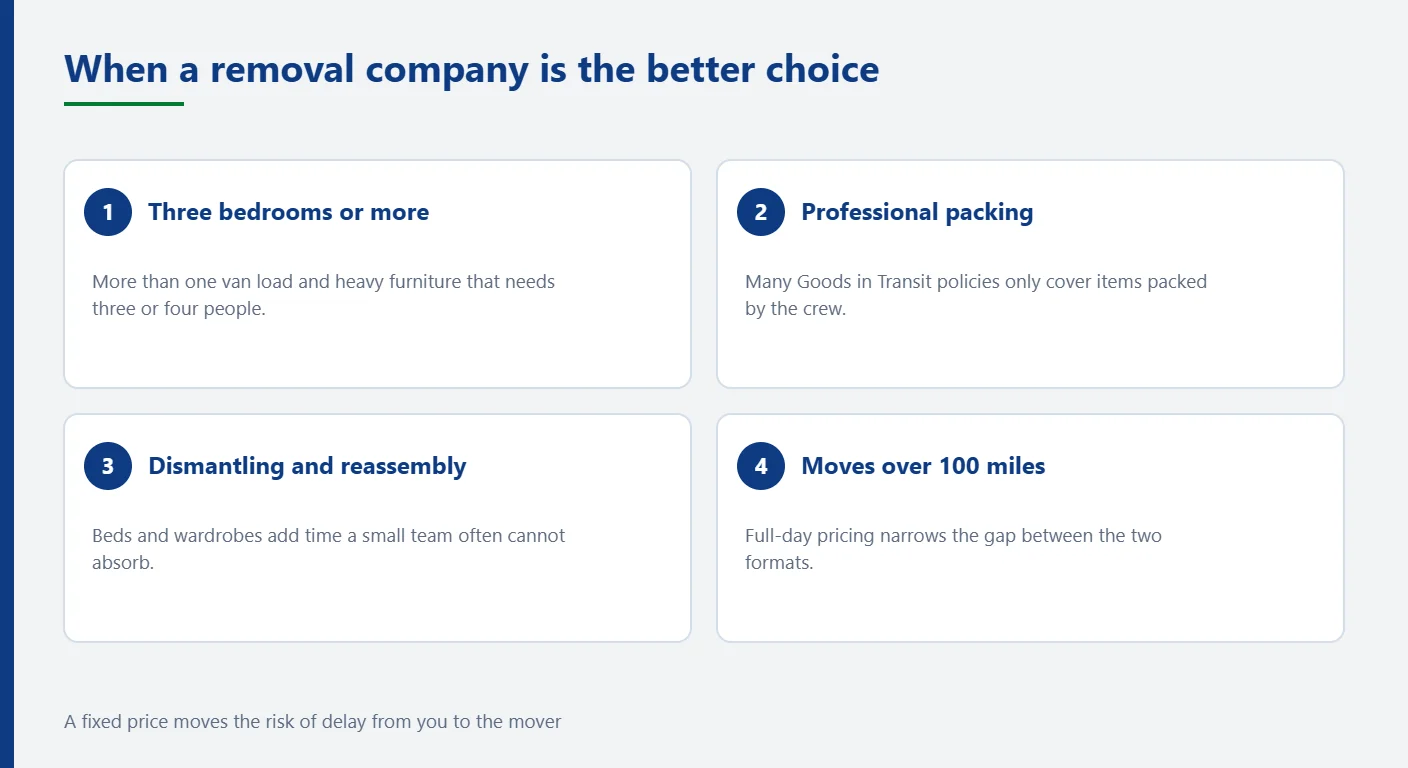
Family homes are where the hourly model stops working in your favour. A three-bedroom house can hold more than one van load, with wardrobes, beds and white goods that need three or four people and careful sequencing. A removal company surveys the volume, sends the right vehicles and crew and quotes a fixed price, so a slow staircase or a late key release does not push the bill up. In 12 years moving London households, the EUROBR team finds that the most expensive mismatch is booking a small crew for a large home: the job runs into the evening, the charges keep rising and fragile items get rushed at the end.
Packing, dismantling and long-distance moves
Packing, dismantling and distance all favour a full service. Professional packing protects fragile items and matters for insurance, because many Goods in Transit policies only cover items packed by the crew. Dismantling and reassembly of beds and wardrobes adds time that a small team often cannot absorb within a fixed window. EUROBR offers packing services and materials and furniture dismantling and assembly as part of a managed move. For long distances, the HomeOwners Alliance figures above show that one van making a 100-mile round trip is priced as a full day or more, which narrows the gap between the two formats further.
How do you check a mover is insured and accountable?
Ask for insurance, licensing and the price basis in writing before you book. A reliable operator, whether a man and van or a removal company, will show Goods in Transit cover, explain the exclusions and give you a written quote.
Goods in Transit and CMR cover explained
Goods in Transit insurance is a policy that covers your belongings against loss or damage while they are being loaded, carried and unloaded. It matters because informal operators sometimes carry no cover at all, which leaves you with no claim if a television is dropped. In practice, ask what the policy limit is, whether items you packed yourself are covered and what is excluded: glass, jewellery, artwork and plants are common exclusions. CMR is the international convention for carrying goods by road, and the term appears on many mover websites because it sets the carrier’s liability on cross-border journeys. EUROBR carries Goods in Transit and CMR cover on every move, from a studio to a house, and explains the background on its CMR regulations page.
Waste carrier licence, trade bodies and your consumer rights
A waste carrier licence is a registration with the Environment Agency that any mover who takes away furniture or rubbish must hold. You can check a company on the public register of waste carriers in a minute, and EUROBR is a licensed waste carrier. Trade membership adds another layer: the British Association of Removers requires members to pass an extensive external audit each year, follow a code approved by the Chartered Trading Standards Institute and offer free independent dispute resolution. Whatever the format, the Consumer Rights Act 2015 says services must be carried out with reasonable care and skill, and Citizens Advice explains how to complain about a service, including the right to ask for a redo or a price reduction.
How London access changes the decision
London access often decides the format before property size does. Parking, stairs and lifts set how long loading takes, and time is what you pay for on an hourly booking.
Parking suspensions and loading time
A parking suspension is a temporary reservation of controlled bays outside your address, arranged through the local council. It matters because on many London streets a van has nowhere legal to stop, and without one the crew may carry everything a long distance or risk a penalty charge notice. In practice, most councils need five to ten working days’ notice. In 12 years moving London households, the EUROBR team finds the single biggest cause of moving-day delay is parking access that was not arranged in advance. Removal companies usually book this as part of the job; many man and van operators leave it to you. The EUROBR parking suspension guide explains the permit types and timings.
Stairs, lifts and crew size
Stairs and lifts change the maths of crew size. A fourth-floor flat with no lift can double the loading time of a ground-floor flat with the same contents, and a narrow Victorian staircase may need furniture dismantled before it moves. A single mover on an hourly rate is cheap per hour but slow on stairs, while two or three movers cost more per hour and finish sooner. In practice:
- ground floor or lift access with a small load: one or two movers is usually enough
- upper floors without a lift: plan for at least two movers and add time for each flight
- large furniture or a tight staircase: book dismantling and a crew of three
Man and van vs removal company: a side-by-side decision table
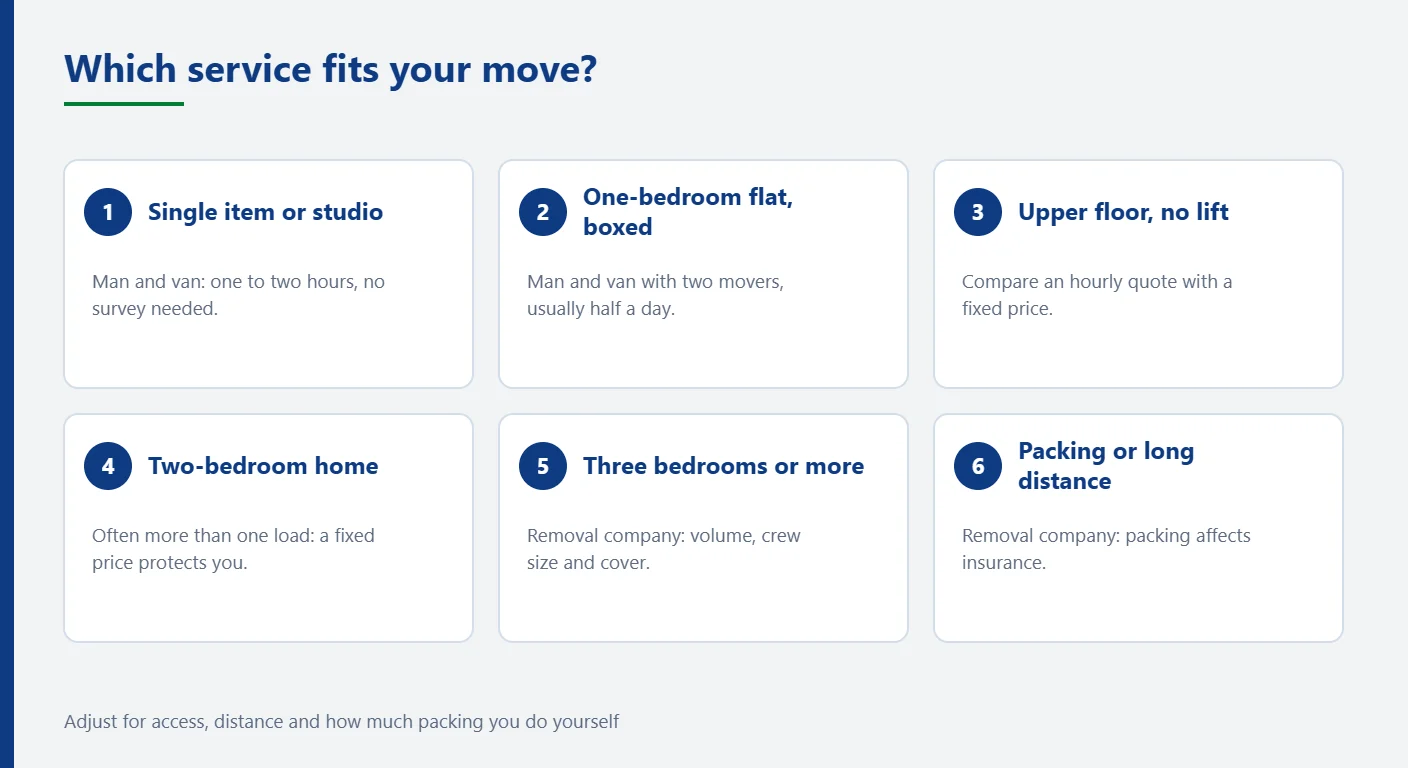
The table below matches the most common London moves to the format that usually fits best. Use it as a starting point and adjust for access, distance and how much packing you want to do yourself.
A quick decision guide by move type
| Move type | Usually the better fit | Why |
| Single item or furniture collection | Man and van | One to two hours, no survey needed |
| Student room or studio | Man and van | One van load, simple access |
| One-bedroom flat, boxed and ready | Man and van with two movers | Half a day, hourly rate stays low |
| One-bedroom flat, upper floor, no lift | Either; compare a fixed price | Stairs add time on an hourly rate |
| Two-bedroom flat or house | Removal company, or a well-sized man and van | Often more than one load; fixed price protects you |
| Three bedrooms or more | Removal company | Volume, crew size and insurance for the whole job |
| Move with packing and dismantling | Removal company | Packing affects insurance cover |
| Move over 100 miles | Removal company | Full-day pricing narrows the gap |
How do you compare quotes like for like?
Compare quotes on the same basis: total expected cost, what is included and who carries the risk if the job overruns. A cheap hourly rate and a higher fixed price can end up at the same figure.
Hourly rate or fixed price
An hourly rate is a price per hour of labour and van time, while a fixed price is an agreed total for a defined job. An hourly quote is fair when the job is small and predictable. A fixed price is safer when the volume or access is uncertain, because the mover carries the risk of delay. To compare them, multiply the hourly rate by a realistic number of hours, add travel time, congestion or ULEZ charges and any parking fee, then set the total against the fixed price and what it includes.
Questions to ask before you book
Ask the same questions of every operator, whichever format you are leaning towards:
- Is the price hourly or fixed, and does the clock start at arrival or departure?
- Is Goods in Transit cover included, what is the limit and what is excluded?
- Who arranges the parking suspension or dispensation?
- Are blankets, straps, a trolley and boxes included?
- Is dismantling and reassembly included, or charged extra?
- What happens if the job takes longer than planned?
The EUROBR moving checklist helps you prepare the answers on your side, from defrosting the freezer to labelling boxes by room.
Frequently asked questions
Is it cheaper to hire a van or a man with a van?
Hiring a self-drive van is usually cheaper on paper, but a man with a van is often cheaper once the full cost of the day is counted. Self-drive hire covers the vehicle only, so the customer adds fuel, insurance excess, any daily ULEZ charge of £12.50 for a non-compliant vehicle in London as of 2026, and the risk of extending the hire if loading runs late. All lifting is unpaid but not free: friends need to be available, stairs and large furniture slow an inexperienced team, and injuries from handling are common enough that the HSE attributes 17% of reported workplace injuries in 2024/25 to lifting and carrying. A man with a van includes the driver, loading equipment and, with professional operators, Goods in Transit insurance. For a studio or one-bedroom flat with two movers, the gap between the two options is often smaller than expected, and the paid option usually finishes faster. Self-drive hire makes the most sense for very small loads with helpers on hand and simple ground-floor access. A breakdown of typical charges is set out in the guide to man with a van costs in London.
How much is 2 men and a van?
Two men and a van cost around £78 an hour on average in the UK, within a range of roughly £50 to £105, according to Checkatrade’s price guide updated in August 2026. London rates sit towards the upper end of that range because of higher operating costs, congestion and parking. Most operators charge from arrival at the first address and some add travel time, so the hourly figure is only part of the total. A boxed one-bedroom flat with straightforward access typically takes three to five hours, while upper floors without a lift, large wardrobes or a long carry from the van add time. Extras to include in any comparison are the Congestion Charge in central London, the ULEZ charge for non-compliant vans, parking suspension fees set by the local council and any charge for dismantling furniture. Some providers quote a fixed fee for small, well-defined jobs, which removes the risk of the job running over. Published starting prices for London moves, from single items to one-bedroom flats, are listed on the man and van service page, with the final figure confirmed by a quote for the specific move.
What is the average cost of a removal company in the UK?
The average cost of a local removal in the UK ranges from about £330 for a one-bedroom home to £1,169 for four bedrooms, based on reallymoving data from August 2026 published by the HomeOwners Alliance. A two-bedroom home averages £543 and a three-bedroom home £792, with five bedrooms at around £1,590. Long-distance moves of more than 100 miles cost considerably more: around £900 to £1,200 for one to two bedrooms, £1,600 for three bedrooms and £2,200 or more for four bedrooms and above. Optional services add to these figures, with full packing for a three-bedroom house at around £400 to £500 and furniture dismantling and reassembly at roughly £125. London prices tend to sit above national averages because of access, parking restrictions and the time needed to load in busy streets. The final price depends on volume, distance, floor levels, lift access, parking at both addresses and the date, with Fridays and month ends in higher demand. How a fixed price is built for a home move in the capital is explained on the page for house and flat removals in London.
How much should a removal van cost?
The cost of a removal van depends on whether it comes with a crew and on the size of the vehicle. A van with a driver and one helper is usually priced by the hour, with UK averages of £64 an hour for one mover, £78 for two and £94 for three, according to Checkatrade in August 2026. A full removal company prices the whole job instead, typically from around £330 for a local one-bedroom move to well over £1,000 for four bedrooms, using the HomeOwners Alliance figures for 2026. Vehicle size matters because a standard panel van suits single items and small studios, while a larger Luton-style van is normally needed for a one or two-bedroom home. Choosing a van that is too small leads to a second trip, and on an hourly rate the second trip is paid for. In London, the ULEZ charge of £12.50 a day applies to non-compliant vans, and the Congestion Charge applies inside the central zone. A fair comparison sets the expected total for the whole move against the inclusions. Typical charges and extras for same-day bookings are covered in the guide to same day man and van in London.
Is man with a van reliable?
A man with a van can be very reliable, but reliability varies widely across the market because the format has a low barrier to entry. Professional operators hold Goods in Transit insurance, give written quotes, arrive with blankets, straps and trolleys, and can show a registration as a waste carrier with the Environment Agency if they take anything away. Informal operators may carry no insurance, which leaves the customer without a claim if an item is damaged or lost. Useful checks before booking include written confirmation of insurance and its limits, a business address and landline or WhatsApp contact, recent reviews on an independent platform, a clear explanation of how the price is calculated and an answer on who arranges parking. Searching the public register of waste carriers takes less than a minute. Under the Consumer Rights Act 2015, any service must be carried out with reasonable care and skill, and Citizens Advice sets out the steps to take if it is not. The background to transit insurance and liability on road journeys is summarised on the CMR regulations page.
What is the most trusted moving company?
The most trusted moving company for any household is the one that can prove its standards, rather than a single name that suits every move. Trust in the removals sector rests on evidence that can be checked: Goods in Transit insurance confirmed in writing, a waste carrier registration visible on the Environment Agency’s public register, a written quote that explains what is and is not included, and a consistent track record in independent reviews. Trade association membership adds an external check. Members of the British Association of Removers, for example, must pass an annual external audit, follow a code of practice approved by the Chartered Trading Standards Institute and offer free independent dispute resolution, and their prepayments for UK home moves are protected by a payment guarantee scheme. Years in operation, a fixed business address and clear contact channels also signal accountability. A dependable mover explains the exclusions in its insurance, such as fragile items packed by the customer, instead of promising unlimited cover. The questions worth asking every provider, and the preparation that makes any move run on time, are listed in the moving checklist.
Choosing the right service for your London move
The right choice in the man and van vs removal company decision is the smallest service that can do the job safely and on time. For a studio, a single item or a short-notice student move, a man and van is usually enough and costs less. For a family home, a move with packing and dismantling or a long distance, a full removal company with a fixed price protects your budget and your belongings. EUROBR has run both formats across Greater London and the M25 since 2013, fully insured with Goods in Transit and CMR cover, licensed as a waste carrier and rated 5.0 on Google. Tell the team what you are moving and where, and they will recommend the format that fits rather than the biggest job.
Get a free, no-obligation quote from EUROBR’s insured team: message on WhatsApp at +44 7878 921856 or request a price online.