
Removals to Lisbon from London run by road, door to door, with customs paperwork at the centre of the job and a delivery day shaped by Lisbon’s hills, narrow streets and parking rules.
Your belongings are inventoried and packed in London, travel on a shared monthly route or in a dedicated vehicle, clear customs as a post-Brexit export and import, and are delivered to your Lisbon address. EUROBR publishes a transit range of several days to around two weeks for its UK to Portugal route as of 2026. The price depends on volume, service type and access, so a short survey gives a firmer figure than any headline rate. At the Lisbon end, occupying parking bays needs a licence from the city council.
Removals to Lisbon from London look simple on a map and become detailed the moment you plan the delivery. The road journey is the easy part. What decides whether the day goes smoothly is everything around it: the inventory customs will check, the choice between a shared part load and a dedicated vehicle, the parking at your London address, and the very different streets at the Lisbon end, where cobbles, steep inclines and buildings without a lift change how a crew works. This guide is written for the London household relocating to Portugal’s capital and for the Portuguese or Brazilian resident of London heading home or to a new life in Lisbon. It covers how the service works, what sets the cost in 2026, how long it takes, the paperwork in brief, and the Lisbon details that rarely appear in a quote.
How do removals to Lisbon from London work?
Removals to Lisbon from London work as a scheduled road service: the crew collects from your London address, the load travels by road through mainland Europe, customs paperwork is completed for the export and the import, and the belongings are delivered to your Lisbon address. EUROBR runs a fixed monthly road route between the UK, Portugal and Spain, with Lisbon among its named destinations.
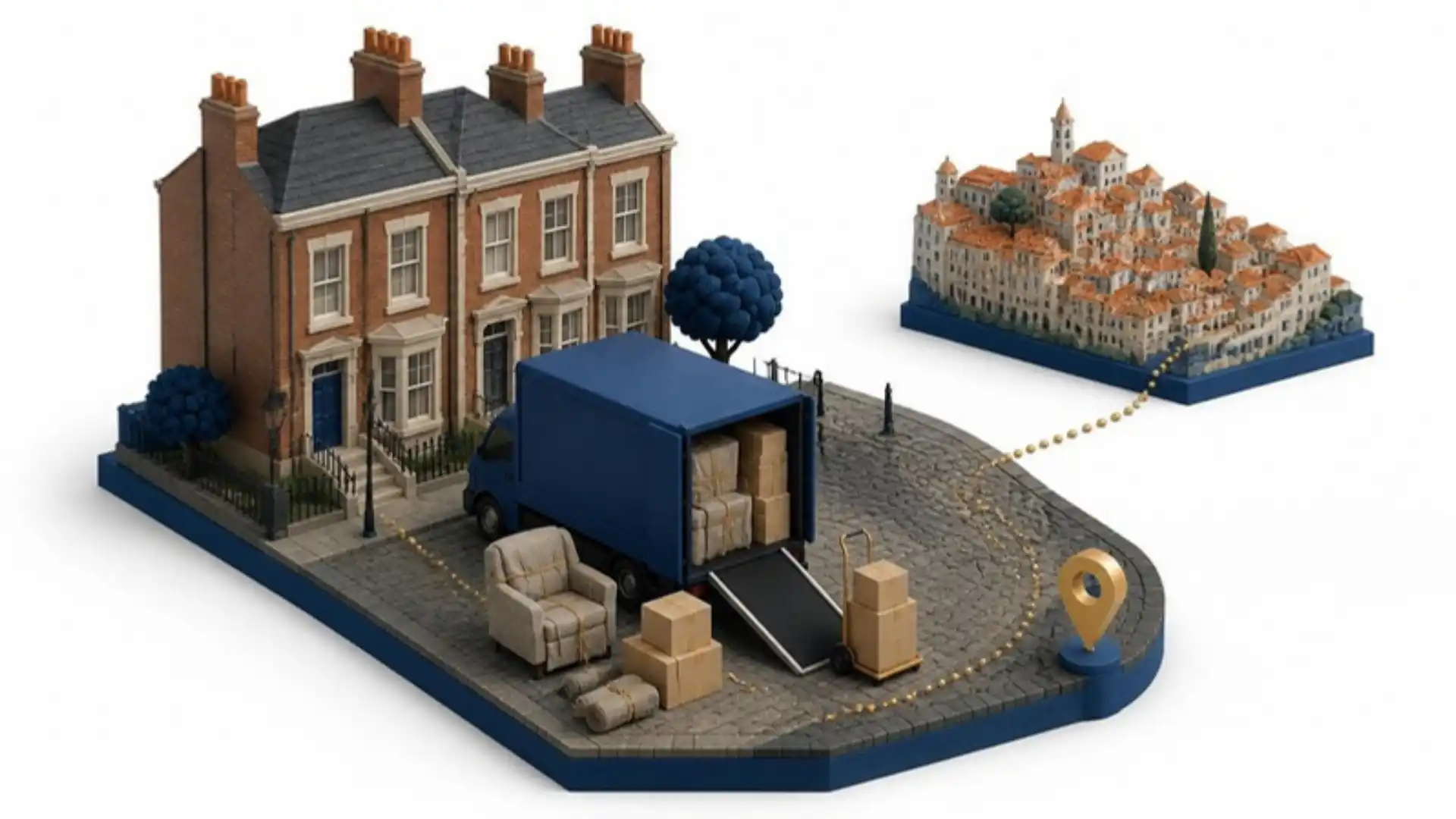
A removal to Lisbon is an international move, not a long domestic one, and that changes the order of work. The inventory comes first, because it is the document customs assesses the shipment against. Packing follows, then collection, then the road journey, then clearance and delivery. The removals to Portugal from the UK service describes this as a door to door service with customs documentation handled by the team, packing materials supplied, and optional services such as packing and furniture dismantling. In 12 years moving London households, the EUROBR team finds that the moves which run late are rarely late on the road. They are late because the inventory was unfinished or the access at one end had not been arranged.
The road route from London to Lisbon
The road route is the backbone of the service. A removal lorry leaves London, crosses to the continent and drives through France and Spain to Portugal, with Lisbon, Porto and the Algarve served on the same corridor as Madrid and Barcelona. Because EUROBR’s route departs on a regular monthly schedule rather than waiting for enough bookings, you know in advance when your belongings can travel and can plan your tenancy end and your arrival around it.
Part load on the monthly route or a dedicated vehicle
Part load is the cheaper option and a dedicated vehicle is the faster and more flexible one. On a part load, your belongings share the monthly route with other customers’ shipments and you pay for the space you use. With a dedicated vehicle, the lorry carries only your belongings and travels more or less directly, outside the shared schedule.
| Point of comparison | Part load on the monthly route | Dedicated vehicle |
| What you pay for | The space your belongings occupy | The whole vehicle and the crew’s time |
| Departure | Fixed monthly date | The date you agree |
| Transit time | Longer, because the route combines several moves | Shorter, travelling more or less directly |
| Best suited to | A few boxes up to a modest flat | A full house, or a fixed key date in Lisbon |
| Flexibility on the Lisbon delivery day | Follows the route itinerary | Agreed around your arrival |
The right choice depends on how much you are moving and how fixed your Lisbon date is. A couple moving the contents of a one-bedroom flat in Hackney into furnished accommodation in Lisbon usually suits a part load. A family with a three-bedroom house in Croydon and a signed lease starting on a set day usually suits a dedicated vehicle.
How much do removals to Lisbon from London cost in 2026?
The cost of removals to Lisbon from London depends on volume, service type, packing, access at both ends and the customs work, so no reputable remover can give a reliable price without understanding the move. As of 2026, EUROBR does not publish a single price for the route and quotes each move on these variables.
That is not evasion. Two moves to the same Lisbon postcode can differ by thousands of pounds because one is fifteen boxes on a part load and the other is a four-bedroom house in a dedicated vehicle with full packing. For a sense of scale on the UK side alone, the HomeOwners Alliance guide to removal costs, updated in October 2026 with reallymoving data from August 2026, puts the average UK long-distance move of more than 100 miles at £900 to £1,200 for a one or two-bedroom house and £2,200 for four bedrooms or more. An international move to Lisbon adds the continental journey, the Channel crossing and customs work on top of that domestic picture, so treat those figures as a floor for planning, not as a quote.
What sets the price of a London to Lisbon move
Five variables set the price of a London to Lisbon move, and each one is something you can influence before the survey.
| Variable | Why it moves the price | What you can do about it |
| Volume | Space on the vehicle is the main cost driver | Sell, donate or clear what you will not use in Lisbon |
| Service type | A dedicated vehicle costs more than a part load | Use a part load if your Lisbon date is flexible |
| Packing | Full export packing adds time and materials | Pack books and clothes yourself, leave fragile items to the crew |
| Access at both ends | Stairs, long carries and parking add crew time | Arrange parking in London and check access in Lisbon early |
| Customs work | An itemised inventory and the paperwork take time | Start the inventory as soon as you book |
The order of that list matters. Volume is the variable that moves the price most, which is why the most effective saving on any move to Portugal is deciding what not to take. Furniture that fits a London flat often does not suit a Lisbon one, and mains appliances are rarely worth the space.
Why a survey gives a firmer figure than a headline price
A survey is a short assessment of what you are moving and how the crew will reach it at both ends, done before the price is fixed. EUROBR’s Portugal service page puts it plainly: “a reliable figure comes from a short survey rather than a headline number”. The survey turns guesses into measurable facts, such as the number of wardrobes, whether the piano stays, how many flights of stairs there are in Lisbon, and whether the street outside allows a lorry to stop.
EUROBR’s European removals page also publishes that quotes are valid for 30 days and that payment is due before shipping, so book the survey once your Lisbon dates are firm rather than months ahead.
How long does a removal from London to Lisbon take?
A removal from London to Lisbon takes from several days to around two weeks door to door, according to EUROBR’s published range for its UK to Portugal route as of 2026. A dedicated vehicle sits at the faster end and a part load on the shared monthly route at the slower end, with customs clearance as the main source of delay.
From collection in London to delivery in Lisbon
The timeline below shows the stages of a typical move. The durations for preparation are practical guidance from the planning side, not published service levels, and your quote confirms the window for your own move.
| Stage | What happens | When to start |
| Survey and quote | Volume, access and service type agreed | Once your Lisbon dates are firm |
| Inventory | Itemised list of everything travelling | Straight after booking |
| Consulate paperwork | Baggage certificate application, where it applies | As early as the documents allow |
| London parking | Council suspension or dispensation booked | At least two weeks before collection |
| Packing and collection | Export packing, loading, departure | Collection day |
| Road journey and clearance | Transit through Europe and customs | Several days to around two weeks |
| Lisbon delivery | Access, parking licence, unloading | Day agreed with the crew |
What can slow the delivery down
Three things slow a London to Lisbon delivery more than distance does. The first is incomplete paperwork, because customs assesses the shipment against the inventory and a missing document stops the load until it arrives. The second is access at the Lisbon end: if the lorry cannot stop near the building, the delivery needs extra planning and more time on the day. The third is the shared route itself, which follows a set itinerary and combines several deliveries. Each can be removed in advance: finish the inventory early, describe the Lisbon street before the survey, and choose a dedicated vehicle if your date cannot move.
What paperwork do you need to move your belongings to Lisbon?
Moving your belongings to Lisbon needs an itemised inventory and, for most people relocating their main residence, a baggage certificate from the Portuguese Consulate General in London, which supports relief from import duty on used personal belongings. Since the UK left the EU, the move is an export from the UK and an import into the EU.
The full customs picture is covered in the EUROBR guide to removals to Portugal from the UK; the short version follows.
The baggage certificate in brief
The baggage certificate is a document issued by the Portuguese consulate that confirms you are transferring your residence to Portugal and that the goods listed are your used personal belongings. The Portuguese Consulate General in London’s baggage certificate requirements, published in English, list the application form, a list of the belongings being moved, proof of residence in the UK for more than one year, proof that you have cancelled that residence, and a declaration that the goods were acquired more than six months before the cancellation and used at that residence.
The certificate matters because the EU relief from import duty on a transfer of residence depends on conditions being met, and the EU summary of the customs duty relief system sets out that framework in English. The GOV.UK guidance on living in Portugal confirms that you may need a baggage certificate for household and personal goods and directs British nationals to the consulate.
The inventory that travels with your belongings
The inventory is an itemised list of every box and piece of furniture on the load, and it is the document customs checks the shipment against. A good inventory numbers each box, describes the contents in plain terms, and lists furniture and higher-value items individually. Vague entries such as “kitchen stuff” invite questions at the border.
EUROBR’s packing crew labels and lists items as they pack, which keeps the inventory consistent with what is physically on the vehicle. If you pack some boxes yourself, list them as you seal them rather than at the end, and use the box sizes in the guide to packing box sizes for moving house so the volume on the survey matches the volume on the day.
Why is delivery in Lisbon different from a London move?
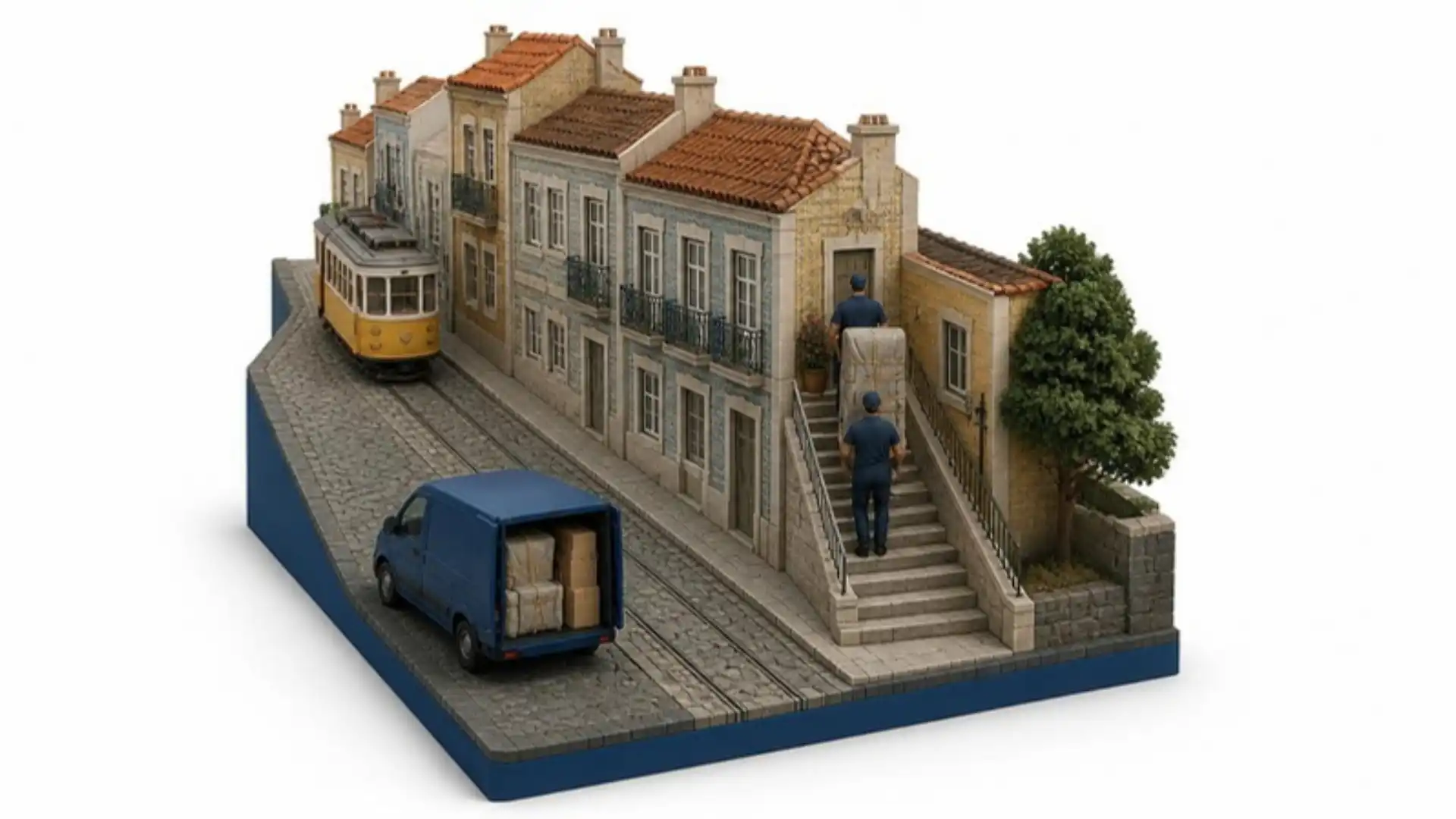
Delivery in Lisbon is different because the oldest parts of the city were built on steep hills, with cobbled lanes, stairways and narrow streets that a removal lorry cannot always enter. A London crew used to terraced streets and mansion blocks has to plan the Lisbon end around the street, not the vehicle.
Hills, cobbles and narrow streets in the historic centre
Lisbon’s historic neighbourhoods are compact and steep. Visit Lisboa’s guide to Alfama describes the city’s oldest neighbourhood as a place of “cobbled lanes and alleys and steep, gruelling inclines”, with tram rails running through the tangle of streets. Graça, Mouraria and parts of Bairro Alto share the same character, while newer districts such as Campo de Ourique or Avenidas Novas have wider streets.
What this means in practice is that the vehicle that left London may not reach your door, and the delivery has to be planned around the nearest point where it can legally stop. EUROBR’s published terms for European deliveries exclude locations that are difficult to access, so the street matters before the price is agreed, not on the day. Give the exact Lisbon address at the survey stage, ideally with photos of the street and the entrance, so the team can confirm how the delivery will work.
Buildings without a lift and tight stairwells
Many older Lisbon buildings have no lift, and those that do often have a lift too small for furniture. Narrow, turning staircases are common. A sofa that went into a London flat through a wide hallway may not turn the corner of a Lisbon stairwell, so measure the largest pieces and the stairwell before the move.
Furniture that is dismantled travels and climbs far more easily. EUROBR offers furniture dismantling and assembly as part of its additional services, which suits wardrobes, beds and modular sofas. Ask at the quote stage who carries at the Lisbon end: EUROBR’s Portugal service page describes the standard route as the driver securing items for transit, with you or your representative unloading on arrival, so a crew for the unloading in Lisbon is something to agree explicitly if your new home is up three flights of stairs.
Do you need permission to park a removal lorry in Lisbon?
Yes, in most of central Lisbon. Occupying parking spaces on the public road for a removal needs a licence from Lisbon City Council (Câmara Municipal de Lisboa), and where the bays are in a paid parking zone run by EMEL, the city’s parking company, a compensation charge applies for the hours the spaces are occupied.
The licence to occupy the public road
The licence to occupy the public road is a permit that reserves parking spaces outside the building for the duration of the removal. According to EMEL’s guidance, published only in Portuguese, the licence is issued by Lisbon City Council rather than by EMEL, the request must be made before the occupation starts, the number of spaces must be stated, and the occupation document has to be displayed visibly next to the reserved spaces until the end of the occupation. Police presence, where needed, is requested separately.
The licence is the Lisbon equivalent of a London parking suspension, and because the paperwork is in Portuguese, a bilingual team with an office in Portugal saves real time here.
EMEL parking zones and what they mean on moving day
EMEL manages paid street parking across Lisbon in colour-coded tariff zones, with shorter permitted stays in the busier zones. EMEL’s guidance lists a compensation charge per hour for occupying paid bays, for example €3.00 an hour in the black tariff area, and €8.00 on weekdays in the conditional access zones, with payment due before the occupation begins, as of 2026. The amounts are small, but a licence covering too few hours can leave the crew without a legal place to unload halfway through the day, so allow a margin.
How do you prepare your London home for an international collection?
Preparing your London home means arranging parking for the lorry, finishing the inventory and packing for a long road journey before collection day. These three steps decide whether the London end of the move takes a morning or a whole day.
Parking at the London end
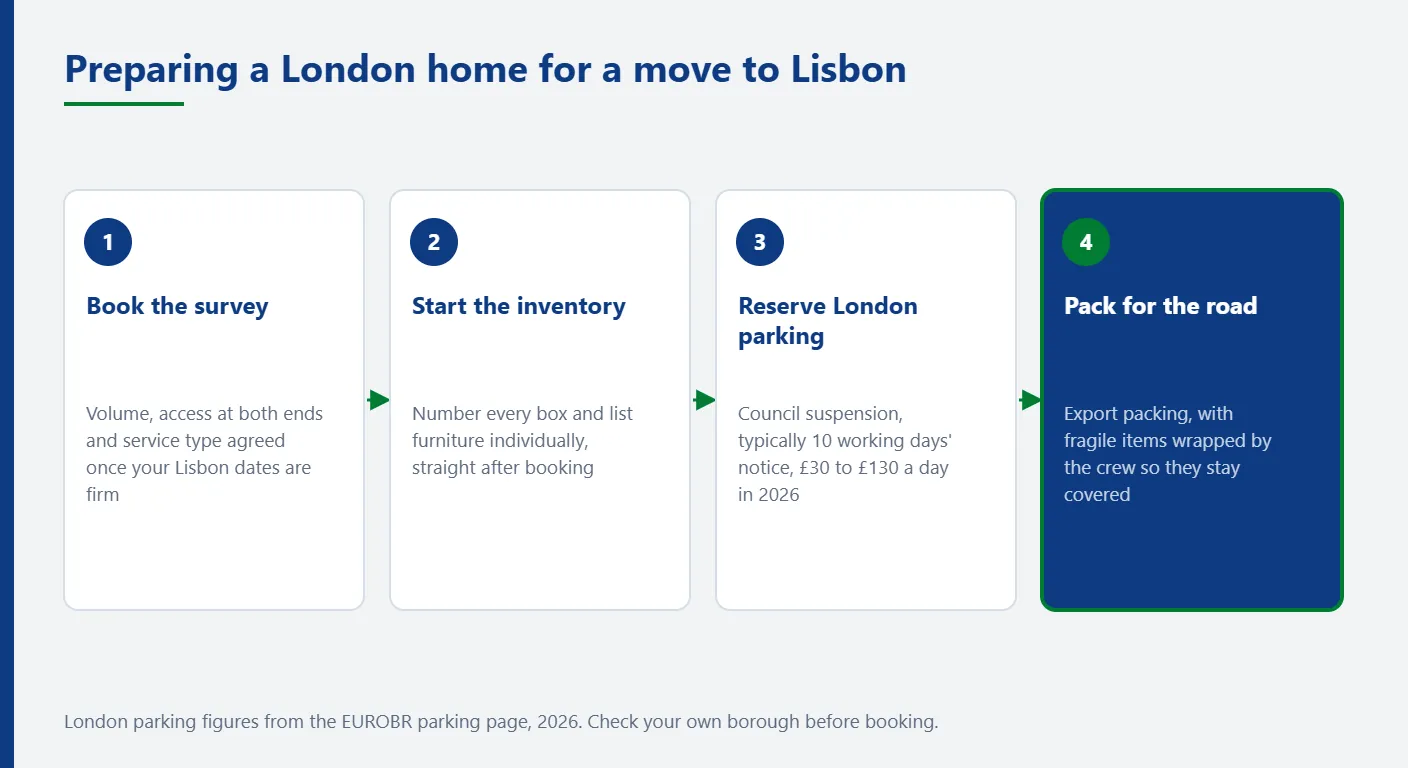
On many London streets a removal lorry has nowhere legal to stop without a council parking suspension or dispensation. EUROBR’s parking information page links the application pages for all 32 London boroughs and lists daily fees from £30 to £130 depending on the borough, with a typical notice period of 10 working days for a suspension, as of 2026. The guide to parking suspensions for moving in London explains the difference between a suspension and a dispensation.
Collection days also run inside London’s emission rules. The Ultra Low Emission Zone covers all London boroughs, operates 24 hours a day every day except Christmas Day, and charges £12.50 a day for vehicles that do not meet the standards, as of 2026.
Packing for a long road journey
Packing for Lisbon is export packing: stronger boxes, more padding and tighter sealing than a local move, because the load travels for days and is handled at more points. Fragile items need individual wrapping, furniture needs blankets and corner protection, and every box needs a number that matches the inventory.
EUROBR’s packing services and materials cover full packing, part packing and materials only. A common split is to pack books, clothes and linen yourself and leave glass, ceramics, artwork and mirrors to the crew. EUROBR’s European removals page publishes that items packed by the customer are the customer’s responsibility, and its insurance excludes glass, crystals, ceramics, artwork and jewellery, so how fragile items are packed and declared affects how they are covered.
Frequently asked questions about removals to Lisbon from London
How much does it cost to move from the UK to Portugal?
The cost of moving from the UK to Portugal depends on how much you move, whether you use a shared part load or a dedicated vehicle, how much packing you need, the access at both addresses and the customs work. There is no single reliable price, because these variables differ from one move to the next. As a scale reference for the UK side only, the HomeOwners Alliance puts the average UK long-distance move of more than 100 miles at £900 to £1,200 for a one or two-bedroom house and £2,200 for four bedrooms or more, using reallymoving data from August 2026. A move to Lisbon adds the continental road journey, the Channel crossing and customs on top of that domestic picture, so a London to Lisbon move sits above those figures. The most effective way to lower the total is to reduce volume, since space on the vehicle is the main cost driver. A part load on the shared monthly route suits smaller moves with flexible dates. For an exact figure, the EUROBR Portugal removals service quotes after a short survey of what you are moving and how the crew will reach it at both ends.
What moving company can I use to move from the UK to Portugal?
You can use any removals company that runs a regular route to Portugal, holds the right insurance for international road transport and handles the customs paperwork for an export from the UK and an import into the EU. Four checks separate a reliable remover from a risky one. First, insurance: Goods in Transit cover protects your belongings on the vehicle, and CMR cover applies to international carriage of goods by road under the CMR Convention. Second, a scheduled route, because a remover with fixed departures can tell you when your belongings will travel instead of waiting to fill a lorry. Third, customs experience, since post-Brexit paperwork is now the most common cause of delay. Fourth, a clear written quote with its validity period and payment terms. EUROBR is fully insured with Goods in Transit and CMR cover, runs a fixed monthly route between the UK, Portugal and Spain, has a bilingual English and Portuguese team and an office in Portugal. The CMR convention page holds the convention document if you want to read the framework yourself.
Is it difficult to move to Portugal from the UK?
Moving to Portugal from the UK is manageable, but it involves more paperwork than it did before Brexit, and the paperwork is where most of the difficulty sits. The physical move is a road journey that removal firms run every month. The harder part is administrative: residence permissions, the Portuguese tax number, and for your belongings, the inventory and the baggage certificate that supports relief from import duty. The GOV.UK guidance on living in Portugal covers residence and practical steps for British nationals, and the Portuguese Consulate General in London publishes the baggage certificate requirements in English. For Lisbon specifically, the practical difficulty is the delivery itself, because the historic neighbourhoods have steep, narrow streets and many buildings have no lift. The move becomes much easier when each task starts early, in the right order: dates first, then the survey and inventory, then the consulate paperwork, then parking at both ends. The EUROBR guide to removals to Portugal from the UK walks through the customs side step by step.
Can I move from the UK to Portugal?
Yes, British nationals can move to Portugal, but since the UK left the EU they need the right residence permission for their situation, and their belongings move as an export and import rather than within a single market. The residence side is a matter for the Portuguese authorities, and the GOV.UK guidance on living in Portugal is the clearest English starting point for visas, residence cards and the tax number. The removal side depends on that status, because relief from import duty on used personal belongings is linked to transferring your normal place of residence. Portuguese and Brazilian residents of London moving to Lisbon follow their own nationality’s rules for residence, but the inventory and customs logic for the belongings is the same. Many people move in stages, sending part of their belongings first and the rest once they are settled. EUROBR’s monthly route carries anything from a few boxes to the contents of a whole home, and the European removals service explains how the shared and dedicated options work across the continent. This is general guidance, not immigration advice, so confirm your own status with the relevant authority.
How can you keep the cost of a move to Lisbon down?
You can keep the cost of a move to Lisbon down by reducing volume, choosing a part load if your dates are flexible, doing some of the packing yourself and arranging access at both ends in advance. Volume is the strongest lever, because space on the vehicle is what you pay for. Sell or donate furniture that will not suit a Lisbon flat, and think twice about large appliances, which take space and may not suit Portuguese kitchens. A part load on the shared monthly route costs less than a dedicated vehicle, at the price of a longer transit and a delivery day that follows the route. Packing books, clothes and linen yourself saves crew time, while leaving fragile items to professionals protects your insurance position. Finally, access costs money when it goes wrong: a missing London parking suspension or a Lisbon street the lorry cannot enter means extra hours on the day. Start with the EUROBR moving checklist, which puts these preparation steps in order so nothing is left to the last week.
Can you send a few boxes to Lisbon instead of a full house move?
Yes. You do not need a full house move to send belongings to Lisbon. EUROBR’s monthly route carries anything from a single suitcase or a few boxes up to the contents of a whole home, and smaller shipments travel on the shared route, where you pay for the space you use rather than for a whole vehicle. This suits students, people moving into furnished accommodation in Lisbon, and anyone sending part of their belongings ahead while they find a permanent home. The same rules on paperwork apply to a small shipment as to a large one: every box needs to appear on the inventory, both for customs and so the shipment is tracked correctly. Use strong double-wall boxes, fill them fully so they do not crush, and number each one. If you would rather not source materials yourself, EUROBR supplies boxes, tape and protective wrap through its packing services and materials, and the crew can pack fragile items so they travel safely alongside other loads on the route.
Planning removals to Lisbon from London
Removals to Lisbon from London go well when the planning starts at both ends at once: the inventory and parking in London, and the access, the parking licence and the unloading plan in Lisbon. The road journey itself is the predictable part. EUROBR runs a fixed monthly route to Portugal, handles the customs paperwork end to end, and has a bilingual team and an office in Portugal, which helps with the Lisbon details that arrive in Portuguese. Transit times depend on the service type and on clearance, so the team gives you a realistic window with your quote rather than a promise it cannot keep.
Planning a move to Lisbon? EUROBR runs monthly departures to Portugal and handles the customs paperwork end to end. Message the team on WhatsApp at +44 7878 921856, email [email protected], or request an international quote today.