
Removals to Portugal from the UK are now an export and import movement rather than an internal European one, which means customs paperwork sits at the centre of the job rather than at the edge of it.
EUROBR runs a fixed monthly road route between the UK, Portugal and Spain, with dedicated vehicles and shared part loads, and publishes a transit range of several days to around two weeks depending on which you choose, as of 2026. The document that decides whether your belongings enter duty free is the baggage certificate, issued by the Portuguese Consulate General in London, and it requires proof of more than a year’s residence in the UK, proof that you have cancelled that residence, and an itemised list of what you are moving. The inventory is not optional paperwork. It is the shipment.
Removals to Portugal from the UK changed character on the day the UK left the EU customs union, and the part that changed is not the driving. A lorry still leaves London and reaches Lisbon or the Algarve in days. What changed is that your sofa and your saucepans now cross a customs border, and they need a declaration, an inventory and, in most cases, a certificate issued by a consulate before they are allowed through without duty. This guide covers what a professional removals service to Portugal actually includes, the paperwork the Portuguese authorities expect, what sets the price, how long the journey takes door to door, and the specific checks worth making before you hand anyone a deposit. It is written for both readers who make this move: the British household relocating south, and the Portuguese or Brazilian resident of the UK heading to Portugal.
What does a removals service to Portugal from the UK include?
A full removals service to Portugal covers collection at your UK address, export packing and inventory, the road journey, customs documentation at both ends, and delivery into the room at your Portuguese address. EUROBR publishes this as a door to door service on a fixed monthly route between the UK, Portugal and Spain.
The published scope on the removals to Portugal from the UK service page covers Lisbon, Porto and the Algarve, along with Madrid and Barcelona on the same route, and includes full or shared load options, full or partial packing, furniture assembly and disassembly, end of tenancy cleaning, furniture disposal and home clearance, and handling of the customs documentation. Insurance is published as standard goods in transit cover on professionally packed items.
What a removals service does not do is make the customs rules go away. It absorbs them. The difference between a competent international remover and a van hired off a marketplace is almost entirely in the paperwork, the inventory discipline and what happens when a border official asks a question nobody prepared for.
Part load against a dedicated vehicle
This is the first real decision, and it is a trade between money and control.
A dedicated vehicle carries only your consignment. It leaves when you are ready, drives the direct route and delivers on a date you can plan around, which matters enormously if you have a tenancy ending on a fixed day or a completion date at the Portuguese end. A part load, sometimes called a shared load or groupage, puts your belongings on a vehicle with other customers’ consignments on the monthly scheduled route. You pay for the space you use rather than for the lorry, which is considerably cheaper for a flat’s worth of furniture, and in exchange you accept the route’s itinerary and a wider delivery window.
| Point of comparison | Part load on the monthly route | Dedicated vehicle |
| What you pay for | The volume you occupy | The whole vehicle and the driver’s time |
| Best suited to | Studio, one bedroom and two bedroom moves | Three bedrooms and above, or a fixed completion date |
| Departure | The scheduled monthly route | A date agreed with you |
| Transit, EUROBR published range 2026 | Towards the longer end, up to around two weeks | Towards the shorter end, several days |
| Delivery date | A window, set by the route itinerary | A planned day |
| Handling | Loaded and unloaded alongside other consignments | Loaded once, unloaded once |
| Relative cost | Lower | Higher |
Why a hired van is the wrong tool for this particular journey
Driving your own hired van to Portugal looks cheaper until you price the whole exercise honestly. You are responsible for the export declaration, the import formalities, the inventory, the fuel across France and Spain, the tolls, two or three nights of accommodation, the return leg of the hire, and every risk in between. You carry no goods in transit insurance on your own belongings, because hire insurance covers the vehicle rather than the load. If a border query arises you resolve it yourself, in a language you may not speak, with a van full of furniture parked somewhere inconvenient.
There is a physical cost too. The Health and Safety Executive recorded 59,219 non-fatal injuries reported by employers under RIDDOR in 2024/25, with 17 per cent of them arising from handling, lifting or carrying, and its guidance on the law on manual handling sets out the duty to avoid, assess and reduce exactly these risks. A three bedroom house carried down a London staircase by two friends on a Saturday is that statistic waiting to happen.
The honest comparison is not van hire against a removals firm. It is van hire plus your own labour, your own risk and your own customs competence, against a priced service that includes all three.
What customs paperwork does Portugal require after Brexit?
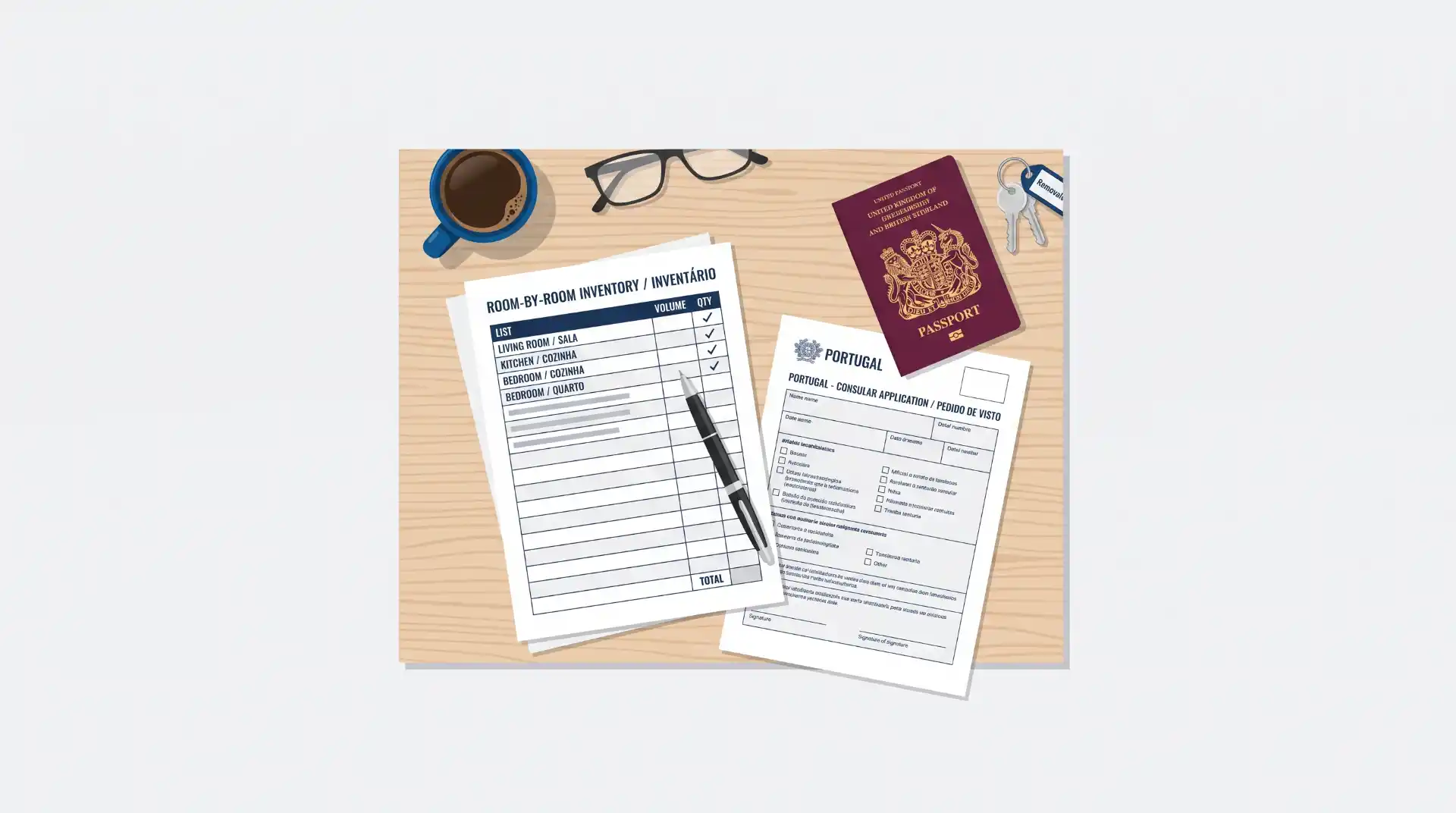
Portugal requires a declaration and an itemised inventory for household goods arriving from the UK, and duty-free entry depends on qualifying for the EU’s relief for people transferring their normal place of residence. For UK residents that normally means obtaining a baggage certificate from the Portuguese Consulate General in London before the move.
The UK government’s own guidance is explicit about this. The living in Portugal page on GOV.UK states that for household goods and personal items “you may need a baggage certificate”, and directs readers to request one from the Portuguese Consulate General in London. That is the starting point, not an optional extra.
The baggage certificate, and how to apply from London
The Portuguese Consulate General in London publishes its requirements in English, which is unusually helpful on this route. Its baggage certificate requirements sheet lists the mandatory documents.
| Document required | What it has to show |
| Completed application form for the issue of a baggage certificate | The form is attached to the consulate’s own requirements sheet |
| List of personal belongings to be transported and imported into Portugal | The inventory, which becomes the customs document |
| Proof of residence in the UK for more than one year | Payslips, GP registration, utility bills |
| Proof of cancellation of residence in the UK | GP deregistration, closed utility accounts |
| Declaration confirming cancellation of UK residence and transfer to Portugal | Signed by the applicant |
| Declaration about the goods themselves | That they “were acquired more than 6 months prior to the date of cancellation of the UK residence, were used at that residence and are intended to be used at the new habitual residence in Portugal” |
| Copy of identity card or passport | Identity |
| Copy of residence permit in Portugal | Foreign nationals only |
| Payment | By postal order from the Post Office, at the amount in the consular fees table, plus £5 for postage |
Two things in that list catch people out. The proof of cancellation of UK residence is a document most people have never thought about collecting, and it is easiest to assemble while you are still here rather than after you have gone. And the six month ownership declaration means a sofa bought in the week before you leave is not treated the same way as the sofa you have been sitting on for three years.
The inventory the Portuguese customs authority expects
The inventory is the single document that determines how smoothly your goods cross the border, and the consulate’s requirement for a “list of personal belongings to be transported and imported into Portugal” understates how detailed it should be. Build it room by room, number every carton, and describe contents in terms a customs officer can match against what is in the vehicle. “Box 14, kitchen, 6 dinner plates, 4 bowls, 1 kettle, used” is a usable line. “Box 14, kitchen stuff” is an invitation to open the box.
Three practical rules apply. Keep new and unused items on separate lines, because they are assessed differently from used household goods. Note serial numbers for televisions, computers and other high-value electronics. And make sure the inventory you give the consulate, the inventory the remover works from and the inventory presented at the border are the same document, because inconsistencies between the three are the most common cause of a query. Our UK customs list and packing checklist sets out how to build one that survives inspection.
The EU relief conditions behind a duty-free move
The legal basis for duty-free entry is EU-wide rather than Portuguese, and knowing the conditions tells you whether you qualify before you spend anything. Council Regulation (EC) No 1186/2009 governs relief from import duty on personal property belonging to people moving their normal place of residence into the EU. The conditions that matter to a UK household are these:
- The person must have had their normal place of residence outside the EU for at least 12 consecutive months, which the EUR-Lex summary of the EU customs duty relief system confirms
- The goods must have been in the possession of the person concerned for at least 12 months before the transfer
- The goods must be entered for free circulation within 12 months after the person establishes their normal place of residence in the EU
- Relief does not apply to alcohol, tobacco, commercial means of transport, or “articles intended for a trade or business or professional activity”
- For 12 months after import, relieved goods cannot be “lent, pledged, hired out or transferred to third parties”
Note the gap between the consulate’s six month ownership declaration and the regulation’s 12 month possession condition. They are measuring from different dates, which is precisely why the certificate is issued by the consulate rather than assembled by you. Where the two do not align for a particular item, the safe course is to declare it accurately and let the consulate and the remover resolve the treatment, rather than to guess.
One asymmetry is worth naming plainly. GOV.UK publishes detailed guidance for bringing belongings into the UK under transfer of residence, but there is no equivalent GOV.UK page for taking household belongings out to the EU, because the relief sits with the destination country. The UK side is an export declaration handled by the remover. The relief you care about is Portuguese.
How much do removals to Portugal from the UK cost?
The price of removals to Portugal is built from volume, service type, access at both ends and distance to the final address, and no UK consumer authority publishes average UK to Portugal prices. EUROBR’s published position is that “a reliable figure comes from a short survey rather than a headline number”, which is an honest description of how international removal pricing actually works.
That is an unsatisfying answer if you want a number today, so here is what can be stated with evidence and what cannot.
The variables that set the price
Five factors do nearly all the work, and four of them are at least partly under your control.
- Volume. Measured in cubic metres once packed and stacked, not as bare furniture. This is the dominant variable in any part load price, because you are literally buying space on a vehicle.
- Service type. A dedicated vehicle costs materially more than space on the monthly route, because you are paying for the lorry and the driver’s time rather than for your share of them.
- Access at both ends. Stairs without a lift, a narrow street a lorry cannot enter, a shuttle vehicle needed for the last stretch in an Algarve development. Each adds crew time.
- Distance from the route. Lisbon, Porto and the Algarve sit on EUROBR’s published route. An address a long way inland adds a leg.
- Packing. Full packing, part packing or materials only, as set out on the packing services and materials page. Export-grade wrapping for a long road journey is not the same specification as wrapping for a move across London.
What the UK side of the job costs on its own
The one part of this move with reliable published UK figures is the domestic removal work, which is useful as a floor rather than as a total. The HomeOwners Alliance publishes removal cost figures drawn from August 2026 reallymoving data, last updated on 1 October 2026.
| Property size | Local UK removal, 2026 | Long distance within the UK, over 100 miles, 2026 |
| One bedroom | £330 | £900 to £1,200 |
| Two bedrooms | £543 | £900 to £1,200 |
| Three bedrooms | £792 | £1,600 |
| Four bedrooms | £1,169 | £2,200 |
| Five bedrooms | £1,590 | Quoted individually |
The same source puts a full packing service for a three bedroom house at around £400 to £500, unpacking at approximately £200 more, and dismantling and reassembly at an extra £125 on average. A move to Portugal adds the international road leg, the customs documentation, export-grade packing and delivery at the Portuguese end on top of figures of this order, which is why a survey rather than a table produces the real number.
As a rough volume reference before any survey, a studio or one bedroom property usually produces 10m³ to 15m³ of packed goods, a two bedroom home 18m³ to 25m³, a three bedroom home 28m³ to 35m³, and a four bedroom home 38m³ to 45m³. Those bands are an industry reference and not a quotation, but they let you work out immediately whether you are asking about a part load or a dedicated vehicle.
Costs that appear after the headline figure
Ask for each of these to be confirmed in writing as included or excluded before you accept a quote:
- Consular fee for the baggage certificate, plus the £5 postage the consulate specifies
- Any translation or notarisation of documents
- Parking suspension or dispensation at the UK address, which ranges from £30 to £130 a day depending on the borough, according to EUROBR’s parking guide
- ULEZ and Congestion Charge on the collection day, where applicable
- A shuttle vehicle if a lorry cannot reach either address
- Storage at either end if your dates do not align
- Waiting time if the property is not ready on the delivery day
EUROBR’s published European terms state that quotes are valid for 30 days and that payment is required before shipment, which is normal on this route and worth budgeting for rather than discovering late.
How long do removals to Portugal from the UK take?
EUROBR publishes a transit range of several days to around two weeks for the UK to Portugal, as of 2026, with a dedicated vehicle at the short end and the shared monthly route at the long end. Customs clearance can add to either.
The driving itself is the predictable part. A lorry from London to Lisbon is a journey of a few days including the legally required driver rest periods, the Channel crossing and the run down through France and Spain. The variability comes from three other places: when the monthly route departs relative to when you are ready, how long border formalities take, and how far your final address sits from the route.
| Stage | What happens | What governs the time |
| UK side | Survey, packing, inventory, loading, export declaration | Your readiness and, on a part load, the route schedule |
| Road leg | Channel crossing, France, Spain, arrival in Portugal | Distance, driver rest rules, the route itinerary |
| Border and clearance | Import formalities, inventory check, release | Document quality, and whether the consignment is selected for inspection |
| Portuguese side | Inland delivery, unloading, reassembly | Access at the delivery address and your availability |
Why clearance and the final leg add the days people do not budget for
Two scenarios account for most delayed deliveries on this route, and both are avoidable. The first is an inventory that does not match the load, which turns a routine border formality into an inspection. The second is a delivery address nobody assessed: a lorry that cannot turn into the street, a lift too small for a wardrobe, a development with restricted access hours, a property whose keys are not available on the agreed day. The remedy for both is the same survey that produces the price.
In 12 years running London removals and the monthly road route to Portugal and Spain, the EUROBR team finds the single biggest cause of delay on international road moves is not the border. It is access that was never checked at one of the two addresses. The team arranges a parking suspension in London in advance for exactly that reason, and the same assessment at the Portuguese end is what keeps a delivery to one day instead of two.
What happens on the day, door to door?
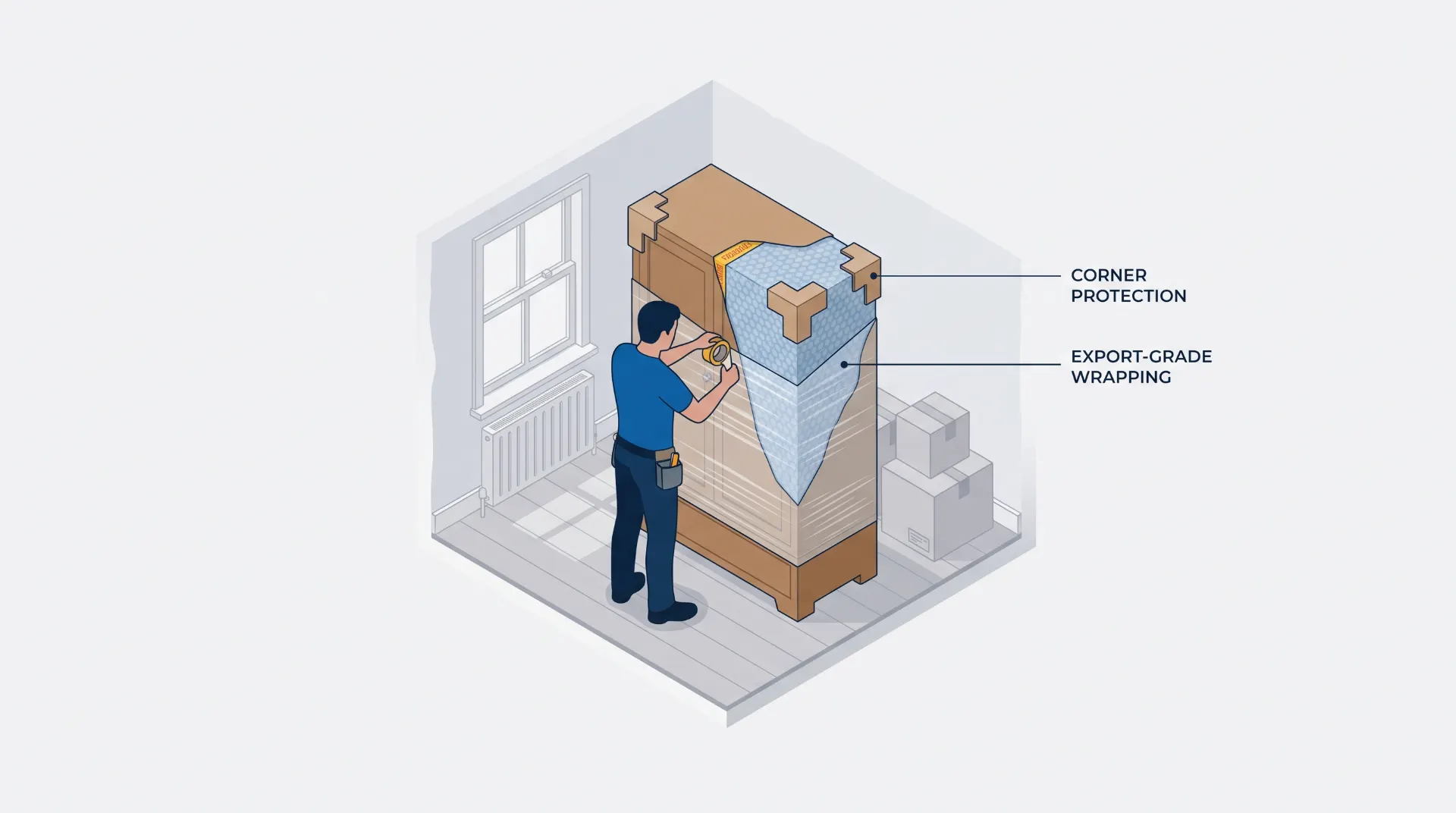
A door to door removal to Portugal runs as a sequence: survey, packing, inventory, loading, export declaration, road transit, import clearance, delivery and reassembly. The customer’s main job is finished before the lorry arrives.
Export packing for a long road journey
Export packing is a higher specification than domestic packing, and the reason is mechanical. A consignment travelling 2,000 kilometres by road is subjected to days of vibration, repeated braking and, on a part load, being unloaded and reloaded as other consignments come off. EUROBR’s published scope covers full or partial packing with materials supplied, and its published insurance position is that standard goods in transit cover applies to items professionally packed by its team, while items packed by the customer remain the customer’s responsibility.
The published exclusions on the European route are worth reading before you decide what to pack yourself: fragile items such as glass, crystals, ceramics, artwork and jewellery, along with scratches, marks and defects. Anything in those categories either travels professionally packed or travels at your risk. Our guide to packing box sizes covers how carton choice affects both protection and the final cube, and the professional packing service guide explains what each packing level includes.
Furniture is the other decision. Dismantling a wardrobe, a bed frame or a dining table reduces both volume and risk, and reassembly at the other end is a published service on the furniture assembly and delivery page.
Access, parking and charges on the London loading day
Loading day in London carries its own costs and rules, and they are the ones most often left out of a quote comparison.
Transport for London’s Ultra Low Emission Zone applies a £12.50 daily charge to non-compliant vehicles, and the zone “operates across all London boroughs, and does not include the M25”, running 24 hours a day every day except Christmas Day. The Congestion Charge is separate: the RAC reported that the London Congestion Charge rose from £15 to £18 from 2 January 2026, with a £180 penalty for non-payment reduced to £90 if paid within 14 days.
Parking is the item that actually delays loading. A parking suspension is a temporary reservation of controlled parking bays outside your address, arranged through the local council. It matters because on many London streets a removal lorry has nowhere legal to stop, and without a suspension the crew carries your belongings a long distance or risks a penalty charge notice. In practice most councils need between five and fifteen working days’ notice, with suspensions typically requiring around ten working days, dispensations five and temporary permits seven, at £30 to £130 a day depending on the borough. Our guide to parking suspensions for moving in London explains how to apply, and the moving checklist sets the deadlines against the rest of the move.
What insurance covers your belongings on the road to Portugal?
EUROBR publishes fully insured door to door transport with standard goods in transit cover on professionally packed items, plus CMR cover, which is the convention governing a road carrier’s liability on international journeys. Cover is tied to who packed the goods and what they are.
Two terms need defining once, because quotes use both without explanation.
Goods in transit insurance covers your belongings while they are in the carrier’s custody, subject to the policy’s limits and exclusions. It is what responds if a carton is crushed or a consignment is lost.
CMR is the Convention on the Contract for the International Carriage of Goods by Road, an international treaty that sets out the liability of a road carrier moving goods across borders, including the carrier’s obligations around the consignment note and the circumstances in which liability is limited or excluded. It is the legal framework underneath an international road move rather than a product you buy, and EUROBR publishes the convention text on its CMR regulations page.
What is excluded, and what that means for you
The published exclusions on EUROBR’s European route are specific: fragile items such as glass, crystals, ceramics, artwork and jewellery, plus plants and pets, and cosmetic damage in the form of scratches, marks and defects. Items packed by the customer are the customer’s full responsibility, and cover on professionally packed items is supported by the inventory and, where relevant, invoices.
The practical reading is that your most valuable and most breakable possessions sit in the category where packing decisions change your position entirely. If you pack the glassware yourself to save money, you have also moved it outside the cover. If a piece of artwork genuinely matters, ask specifically how it can be carried and insured rather than assuming it falls under the standard policy.
Ask for the following in writing before you book:
- The total limit of the goods in transit cover and any limit per item
- Whether high-value items can be scheduled separately, and what documentation that requires
- Exactly which categories are excluded, and whether professional packing changes that
- What happens if delivery is delayed at the border
- The claims procedure, and the deadline for notifying damage after delivery
How do you check a removals company before you book?
Check insurance, licensing, a written and itemised quote, and independent accreditation, and ask for all four as documents rather than as assurances. On an international move you are handing a stranger everything you own and then losing sight of it for a fortnight.
The documents to ask for
- Goods in transit insurance, with the certificate, the total limit and the per item limit
- CMR cover for the international road legs
- A written, itemised quote stating volume or vehicle, what is included, what is excluded, and which charges are payable later
- The customs documentation process, including who prepares what and who applies for the baggage certificate
- A waste carrier registration if any disposal or clearance is part of the job, which can be checked free on the Environment Agency’s public register of waste carriers
- A company address and a landline or verifiable business contact, not a mobile number alone
EUROBR publishes its credentials openly: fully insured with goods in transit and CMR cover, a licensed waste carrier registered with the Environment Agency, operating since 2013 with an office in Portugal as well as the Croydon head office, as set out on the about us page.
What to do if something goes wrong
Independent accreditation is the strongest single filter. The British Association of Removers states that “it’s not easy to become a BAR member”, that movers “must pass an extensive external audit each year” to keep their status, and that members must follow a Chartered Trading Standards Institute code of practice. It also operates a payment guarantee scheme protecting prepayments on moves within the UK and moves entering or leaving the UK, and an independent consumer ombudsman for disputes that cannot be resolved directly.
Statutory rights apply as well. Citizens Advice explains that under the Consumer Rights Act 2015 a service must be performed with reasonable care and skill, and that where it is not, the remedies are repeat performance or a price reduction, with a six year time limit in England, Wales and Northern Ireland and five in Scotland.
Practical advice on the day: note any damage on the delivery paperwork before you sign it, photograph it immediately, and report it in writing within the deadline in your policy rather than when you finish unpacking three weeks later.
Frequently asked questions about removals to Portugal from the UK
How much do removals to Portugal from the UK cost?
The cost of a removal from the UK to Portugal is quoted after a survey rather than from a published table, because the price is driven by the volume of goods in cubic metres, whether the consignment travels as a part load on a scheduled route or in a dedicated vehicle, the access at both addresses, and how far the Portuguese address sits from the main route. No UK consumer authority publishes average UK to Portugal removal prices, so any single headline figure found online should be treated as a lead-generation number rather than a quotation. What can be stated with evidence is the domestic UK component: the HomeOwners Alliance, using August 2026 reallymoving data, puts a local UK removal at £330 for one bedroom, £543 for two, £792 for three and £1,169 for four, with full packing for a three bedroom house at around £400 to £500. An international move adds the road leg, customs documentation, export-grade packing and delivery in Portugal on top of figures of that order. Published scope and route detail sit on the removals to Portugal service page.
How long does a removal from the UK to Portugal take?
EUROBR publishes a transit range of several days to around two weeks for the UK to Portugal as of 2026, with a dedicated vehicle at the short end and the shared monthly route at the long end. The road journey itself is the predictable element: London to Lisbon takes a few days including the Channel crossing, the run through France and Spain, and the driver rest periods required by law. The variability comes from three other sources. On a part load, the departure date depends on the scheduled monthly route rather than on when the customer is ready. Border formalities add time where the inventory does not match the load or the consignment is selected for inspection. And an address far from Lisbon, Porto or the Algarve adds a final leg, sometimes with a smaller shuttle vehicle where a lorry cannot reach the property. Access problems at the delivery address are the most common cause of a one-day delivery becoming a two-day one. The moving checklist sets out what to confirm at each end beforehand.
What documents do I need to move my belongings to Portugal?
Moving household goods from the UK to Portugal requires a customs declaration supported by an itemised inventory, and duty-free entry normally requires a baggage certificate issued by the Portuguese Consulate General in London. GOV.UK’s living in Portugal guidance states that a baggage certificate may be needed and directs applicants to that consulate. The consulate’s published English-language requirements list a completed application form, the list of personal belongings being imported, proof of residence in the UK for more than one year such as payslips or utility bills, proof that UK residence has been cancelled such as GP deregistration or closed utility accounts, signed declarations confirming the transfer of residence and confirming that the goods were acquired more than six months before cancellation and were used at the UK address, a copy of a passport or identity card, a residence permit copy for foreign nationals, and payment by postal order at the consular fee plus £5 postage. The proof of cancelled UK residence is the item most often missing, and it is far easier to gather before leaving. The UK customs list and packing checklist covers how to build the inventory.
Do I have to pay import duty on my belongings when moving to Portugal?
Used household goods and personal effects can normally enter Portugal without import duty under the EU relief for people transferring their normal place of residence, provided the conditions are met. Council Regulation (EC) No 1186/2009 sets those conditions: the person must have had their normal place of residence outside the EU for at least 12 consecutive months, the goods must have been in their possession for at least 12 months before the transfer, and the goods must be entered for free circulation within 12 months of the person establishing residence in the EU. Relief does not extend to alcohol, tobacco, commercial means of transport, or articles intended for a trade, business or professional activity. For 12 months after import, relieved goods cannot be lent, pledged, hired out or transferred to third parties. In practice the relief is evidenced through the baggage certificate and the inventory, which is why the consulate rather than the household assembles the entitlement. New and unused items should be listed separately on the inventory because they are assessed differently. The removals to Europe service page describes how the documentation is handled.
What is the difference between a part load and a dedicated vehicle to Portugal?
A part load, also called a shared load or groupage, places a consignment on a vehicle travelling a scheduled route alongside other customers’ goods, with the price based on the volume occupied. A dedicated vehicle carries one consignment only, leaves on an agreed date and drives direct. The difference shows up in three places. Cost: a part load is materially cheaper because the vehicle and the driver’s time are shared. Timing: a dedicated vehicle delivers on a planned day, while a part load delivers inside a window set by the route itinerary, which matters when a tenancy ends or a completion date is fixed. Handling: a part load is loaded and unloaded alongside other consignments, so packing quality carries more weight. As a rough guide, studio to two bedroom moves usually suit a part load, while three bedrooms and above, or any move with an immovable date, tend to justify a dedicated vehicle. Both options appear on the removals to Portugal service page.
Is my furniture insured on the journey from the UK to Portugal?
EUROBR publishes fully insured door to door transport, with standard goods in transit cover applying to items professionally packed by its team, alongside CMR cover for the international road legs. CMR is the Convention on the Contract for the International Carriage of Goods by Road, the treaty that governs a road carrier’s liability on cross-border journeys. The published exclusions are the part that changes behaviour: fragile items such as glass, crystals, ceramics, artwork and jewellery, along with plants and pets, and cosmetic damage in the form of scratches, marks and defects. Items packed by the customer remain the customer’s full responsibility, so packing the glassware personally to save money also moves it outside the cover. Cover on professionally packed goods is supported by the inventory and, where relevant, purchase invoices, which is another reason the inventory is worth building carefully. Total and per-item limits are not published and should be requested in writing before booking, together with the claims procedure and the deadline for notifying damage. The convention text sits on the CMR regulations page.
Can I include storage in a move from the UK to Portugal?
Storage is a common requirement on this route, because UK completion or tenancy dates rarely align neatly with the date a Portuguese property becomes available. EUROBR publishes short term storage between moving dates on its London house and flat removals service, and overnight, short term and long term storage on its man and van service, but the Portugal route page does not publish storage at either the UK or the Portuguese end as of 2026. Anyone whose dates do not line up should therefore raise storage explicitly at the quotation stage rather than assume it is included, and ask three questions: whether the facility is operated directly or by a partner, what the maximum duration is, and whether goods in transit cover continues to apply while the consignment is in store or whether separate cover is needed. Storage also affects the customs timeline, because the EU relief requires goods to be entered for free circulation within 12 months of establishing residence. The house and flat removals page describes the London storage option.
Ready to plan your move to Portugal properly
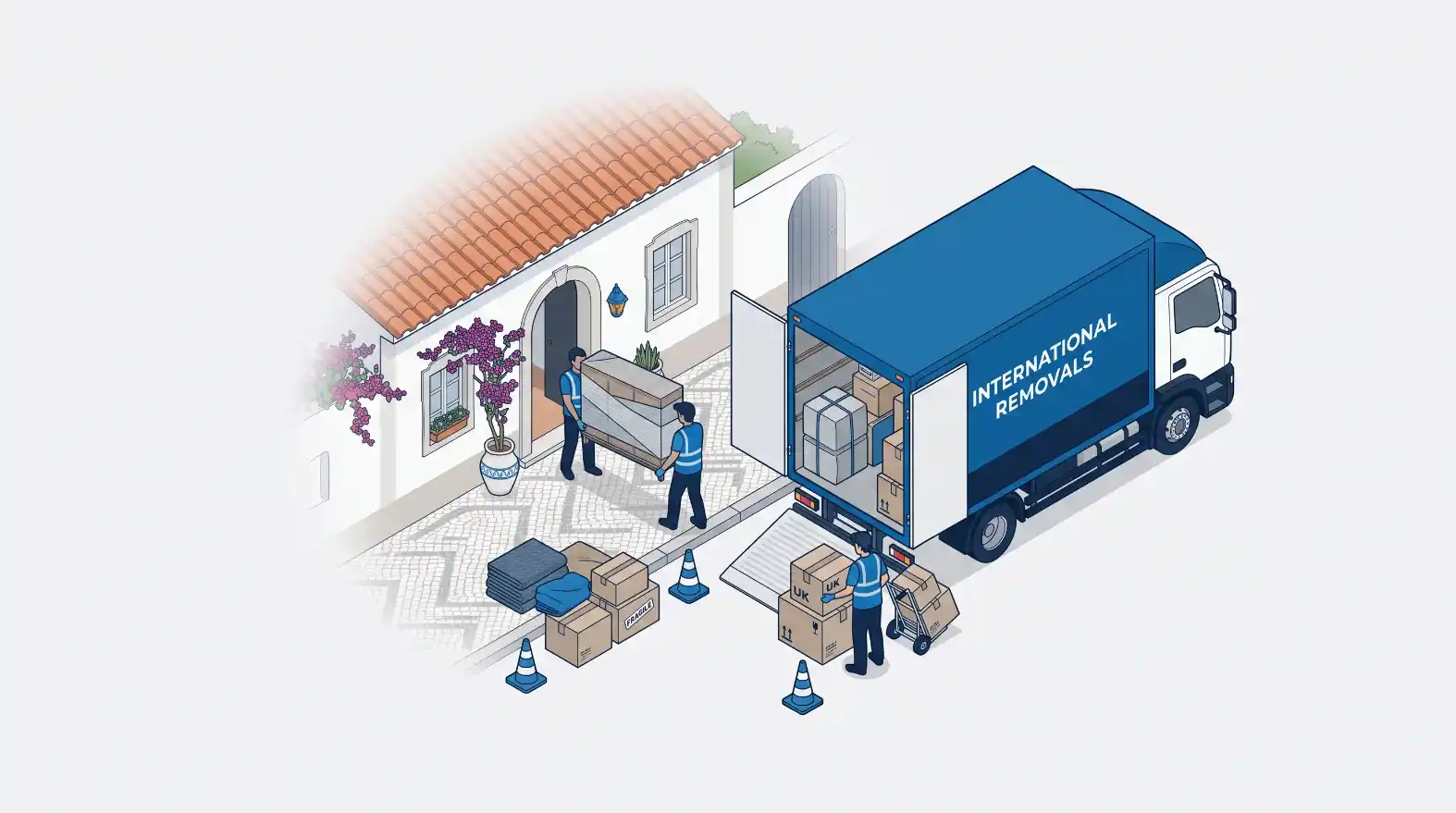
The decision that shapes everything else on this route is whether your consignment travels as a part load on the monthly route or in a dedicated vehicle, and that follows from your volume and from how fixed your dates are. The decision that shapes whether it arrives without a problem is the inventory, and that is worth starting today rather than in the week before loading.
EUROBR has run London removals since 2013 and operates a fixed monthly road route between the UK, Portugal and Spain, with dedicated vehicles and part loads, full or partial packing with materials, furniture dismantling and reassembly, and handling of the customs documentation at both ends. The team is English and Portuguese speaking, with the head office in Croydon and a second office in Portugal, which is the practical reason a query at the Portuguese end does not become a week’s delay. Transit runs from several days to around two weeks as of 2026, and clearance timing depends on the authorities rather than on the carrier, so the team gives you a realistic window with your quote instead of a promise it cannot keep.
Planning a move to Portugal? EUROBR runs monthly departures and handles the customs paperwork end to end. Message on WhatsApp at +44 7878 921856, email [email protected], or request an international quote today.