

IT relocation in London is the controlled decommissioning, transport and recommissioning of a business’s technology infrastructure, from workstations and monitors to switches, racks and servers, carried out so that systems come back up in the same working configuration at the new address.
It differs from a general removal in three ways: the shutdown follows a dependency order rather than a room order, every cable and port is logged before anything is unplugged, and the equipment carries legal duties over personal data that a sofa does not. The work is normally scheduled overnight or across a weekend so staff return to working desks. The measure of success is not that nothing was broken; it is that the network came back up, was tested, and nobody spent Monday morning looking for a cable.
IT relocation in London fails in a specific and avoidable way: the hardware arrives intact and the business still cannot work on Monday. Servers travel well when they are packed properly. What does not travel is the undocumented knowledge in the old comms room, the patching that nobody mapped, the static IP that was configured three years ago by someone who has left. This guide sets out how a professional IT move is planned and executed, the three phases that matter, what a full service includes, what drives the cost, and the data protection and waste duties that follow your old equipment out of the building. It is written for the person who will be held responsible if the phones do not work.
Why standard removal companies are not enough for IT relocation in London
A general removals crew is trained to move objects safely. An IT relocation crew is trained to move a system and put it back the way it was, which is a different discipline with a different failure mode.
The distinction matters because the risk in an IT move is not mainly physical. Hardware is replaceable and insurable. Configuration, connectivity and data are not, and a business that loses two days of trading because the network cannot be rebuilt has suffered a far larger loss than a dropped monitor would have caused. London adds density to the problem: with 538,000 registered businesses in the capital as of March 2025 according to the ONS, most offices sit in managed buildings where comms rooms are shared, risers are controlled and out-of-hours access is booked weeks ahead.
The risks of moving servers, racks and sensitive hardware in-house
Asking the internal IT team to move the infrastructure themselves concentrates several risks on the people least able to absorb them.
- Physical risk to loaded racks. A populated 42U rack is top-heavy and can weigh several hundred kilograms. The Manual Handling Operations Regulations 1992 require an employer to avoid hazardous manual handling where reasonably practicable, assess the risk where it cannot be avoided, and reduce it as far as possible. Handling, lifting or carrying accounted for 17% of the non-fatal injuries employers reported under RIDDOR in Great Britain in 2024/25, from 59,219 reported employee injuries in total.
- Shock and vibration damage. Spinning disks, rack rails and connector seats are vulnerable in transit in ways that are invisible on arrival and surface days later.
- No insurance cover. A hired van carries no Goods in Transit insurance for your equipment, and a rack of servers can exceed the value of everything else in the load combined.
- The team is unavailable for the restart. The people who should be validating the network at the new site spend the weekend carrying boxes, and arrive at the critical phase already exhausted.
Protecting corporate data and preventing avoidable downtime
Data protection duties travel with the equipment, and they apply during the move as much as at disposal.
Every device leaving the old building that holds personal data is a potential breach if it is lost. The controls are practical rather than exotic: a documented inventory of what left and what arrived, sealed and labelled transport, a chain of custody with named handovers, and equipment never left unattended in a vehicle overnight. The ICO’s expectations for records management make the same point at the disposal end, requiring documented secure disposal methods, secure storage with restricted access for equipment awaiting destruction, logs of what is held and where, third-party contracts that include security measures and a right to audit, and a named person checking destruction certificates against what was sent. Those expectations sit under articles 5 and 32 of the UK GDPR.
Downtime is the second half of the same problem. The way to prevent it is not speed on the day, it is the pre-move audit that makes the restart deterministic.
The core phases of a successful IT relocation strategy
A professional IT move has three phases, and the first one carries most of the value. Skipping it is what turns a weekend into a week.
1. Pre-move audit: mapping assets, cables and network dependencies
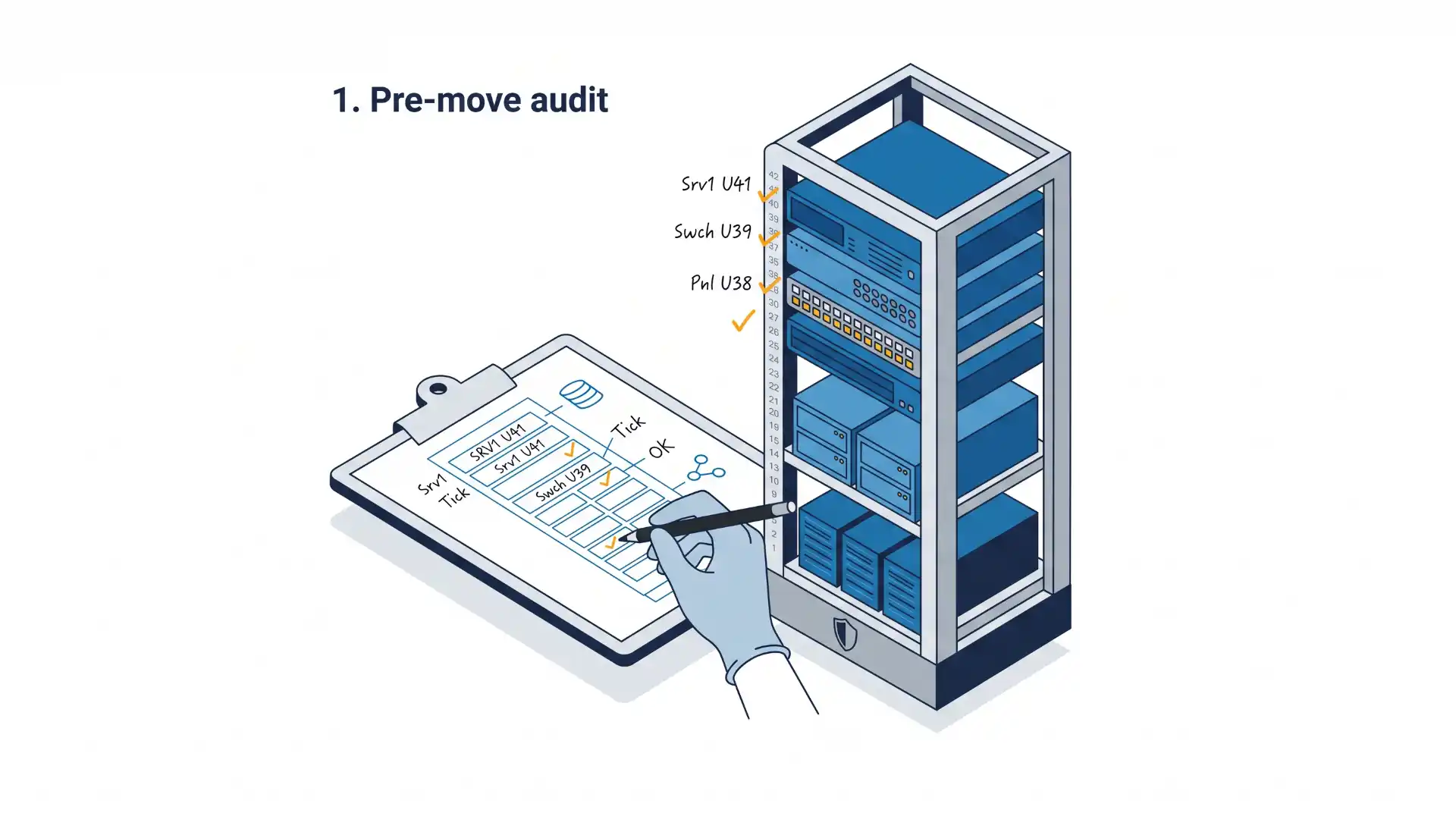
The audit produces the document the whole move runs on. It records every device with its asset tag or serial number, its current location and its destination, and it maps the things that are not written down anywhere else.
Five items belong in the audit and are routinely missing:
- Port and patch mapping. Which switch port serves which desk, and which patch panel position serves which port, recorded before anything is unplugged and photographed as well as written.
- Cable labelling. Both ends of every cable, so reconnection reproduces the original configuration rather than approximating it.
- Rack elevations. What sits in which U position, with rail types and power distribution noted.
- Dependency order. What must shut down before what, and what must come back up before what, including anything that depends on a service hosted elsewhere.
- Fixed configuration. Static addresses, licence keys tied to hardware, dongles, and anything bound to a MAC address or a physical port.
EUROBR’s office and IT relocation service includes crate hire, labelling and inventory management, with items labelled by destination, desk and department, and cabling logged for a clean reconnection.
2. Disconnection, protective packing and secure transport
The shutdown follows the dependency order established in the audit, not the floor plan. Equipment is powered down cleanly, cables are removed and bagged with the device or the rack position they belong to, and each item is packed for the specific risk it carries.
| Equipment | Handling in transit | The specific risk |
| Servers and rack-mounted kit | Removed from the rack where the rack is not moved loaded, packed upright, cushioned against shock | Drive and rail damage from vibration, not from impact |
| Populated racks moved intact | Strapped and moved on a dedicated route with lift and floor loading checked | Weight and a high centre of gravity, which makes the rack tip rather than slide |
| Switches, routers and comms | Packed with their patch leads bagged and labelled to the port map | Reconnection error rather than physical damage |
| Workstations and laptops | Crated by desk and department, screens packed separately | Screen damage and losing the association between machine and user |
| Monitors and screens | Face to face with protection between, never loose | Cracked panels, and screens are often excluded from standard insurance |
| UPS units and batteries | Declared in advance, handled as a specific category | Weight, and transport restrictions on some battery types |
Transport itself is the shortest phase and the easiest to get right. The load is secured rather than stacked, the vehicle does not stand unattended with equipment in it, and the inventory is checked at both ends.
3. Reconnection, testing and network validation at the new site
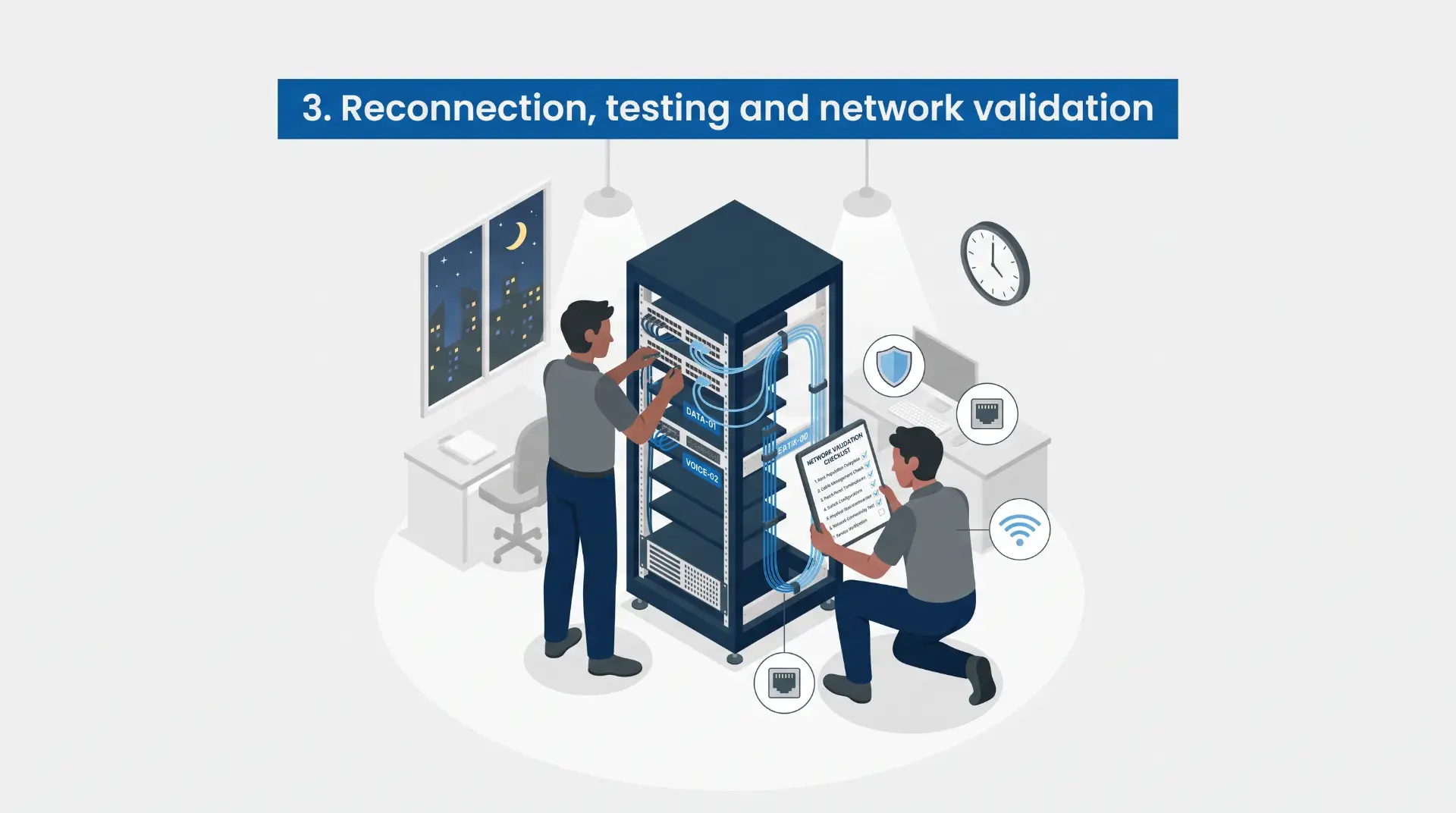
Reconnection rebuilds the mapped configuration. Racks are populated to the recorded elevation, patching is restored to the port map, and power is brought up in the dependency order rather than all at once.
Testing is where the move is actually finished, and it should be planned as a checklist with a named owner:
- Core switching and routing up, with uplinks confirmed
- Internet connectivity and any site-to-site links established
- Server and service startup in dependency order, with logs checked
- A sample of workstations logging in from real desks, not from the comms room
- Printing, telephony and conferencing tested from the floor
- Wireless coverage checked in the areas people actually sit
- A written snag list handed to the client before the crew stands down
The final step is a presence on site on the first working morning. Small problems appear when a hundred people log in at once, and they are far cheaper to fix with someone already in the building.
What services are included in professional IT equipment relocation?
A full IT relocation service covers the audit, the physical work and the restart, coordinated with the wider office move rather than run separately.
Server room and comms room migration
This is the specialist core of the work: decommissioning in a controlled sequence, handling servers, network and communications hardware, logging cabling for a clean reconnection, and recommissioning at the new site. Where a comms room is shared or sits in a controlled riser, the building’s own rules govern access, so the coordinator arranges permissions alongside the goods lift and loading bay booking.
Secure handling of confidential material
Equipment and paper records that hold personal data need a documented chain of custody rather than a general load. Secure handling of confidential documents is part of the commercial scope, with items inventoried and labelled by destination.
Disposal of legacy hardware and WEEE duties
Old equipment that is not moving has to leave the building by a lawful route, and the duty sits with the business rather than with the carrier. EUROBR is a licensed waste carrier registered with the Environment Agency and includes removal and licensed disposal of old furniture in its commercial service. The service page does not state that electrical equipment is handled under WEEE, so that must be confirmed at quote stage rather than assumed, and the legal position is set out in full below.
Temporary storage and staging
Where the two lease dates do not meet, equipment needs somewhere secure to wait. Short-term storage between moving dates appears on the house and flat removals service but is not published as a commercial IT offer, so confirm availability, duration, security and insurance during storage before relying on it.
What drives the cost of an IT relocation in London?
IT relocation is quoted per project after a survey, because the price follows the configuration rather than the headcount. No UK public authority publishes benchmark rates for IT moves, so any figure quoted online without a named source should be treated with caution.
Volume, rack configuration and lifting requirements
- Device count and type. Workstations are largely linear; racks, servers and comms are not.
- Whether racks move loaded or are stripped. Moving a populated rack is faster on the day and heavier in every other respect, including lift weight limits and floor loading.
- Comms room complexity. The number of patch panels, switch ports and distinct dependencies determines audit time, which is the largest single labour item.
- Access at both ends. Goods lift dimensions and weight limit, riser access, loading bay height restriction, and the distance from vehicle to lift.
- Timing. Overnight and weekend working carries a premium that is normally repaid many times over in avoided downtime.
- Testing scope. Whether the crew hands back at “powered on” or at “tested and validated” changes the labour materially, and it should be explicit in the written scope.
- Disposal. Legacy equipment leaving the site is regulated work and priced separately.
Three London charges are fixed and verifiable, and a compliant quote itemises them.
| Charge in 2026 | Amount | Applies to |
| ULEZ | £12.50 a day | All London boroughs, 24 hours a day, every day except 25 December |
| Congestion Charge | £18 a day paid in advance or on the day, £21 if paid within three days after | Central zone, 07:00 to 18:00 Monday to Friday and 12:00 to 18:00 at weekends and on bank holidays |
| Parking bay suspension or dispensation | Set by each borough, typically tens of pounds per bay per day plus an administration fee | Controlled parking streets, with three to fifteen working days’ notice depending on the council |
Goods in Transit insurance and why the limit matters more here
Insurance deserves more scrutiny in an IT move than in any other kind of removal, because the value density is extreme. A single rack can be worth more than the entire contents of a fifty-desk office.
Goods in Transit insurance covers goods while they are carried in the vehicle, and CMR is the separate regime for international road transport, explained on the CMR regulations page. EUROBR carries both on commercial work. Two questions decide whether the cover fits your move. What is the limit per load, as a figure rather than the phrase “fully insured”? And which categories are excluded, since screens and specialist equipment are commonly outside standard cover unless declared and priced separately?
There is a third question specific to IT: physical cover is not business interruption cover. If the concern is the cost of downtime rather than the cost of hardware, that sits with the company’s own commercial policy and should be checked before the move rather than after.
Access, buildings and the constraints that actually decide the schedule
The technical plan is usually sound. What breaks an IT move is the building, and every constraint is knowable in advance.
Confirm five things in writing at both addresses, several weeks ahead.
- Goods lift dimensions, weight limit and permitted hours. Internal depth matters as much as door width for a rack, and the weight limit governs whether a rack can move loaded.
- Comms room and riser access, including who holds the keys out of hours and how long approval takes.
- Loading bay height restriction, which routinely excludes larger vehicles from a service yard and changes the number of trips.
- Parking bay suspension where there is no bay, applied for through the borough with its own notice period. The parking suspension guidance and the blog article on parking suspension for moving in London set out the borough differences.
- Security clearance and insurance documentation for the crew, which many managed buildings require before admitting anyone.
In 12 years moving London households and offices, the EUROBR team finds the single biggest cause of moving-day delay is access that was not arranged in advance. In commercial work that means the goods lift and the riser far more often than the road.
Your legal duties over data and old equipment
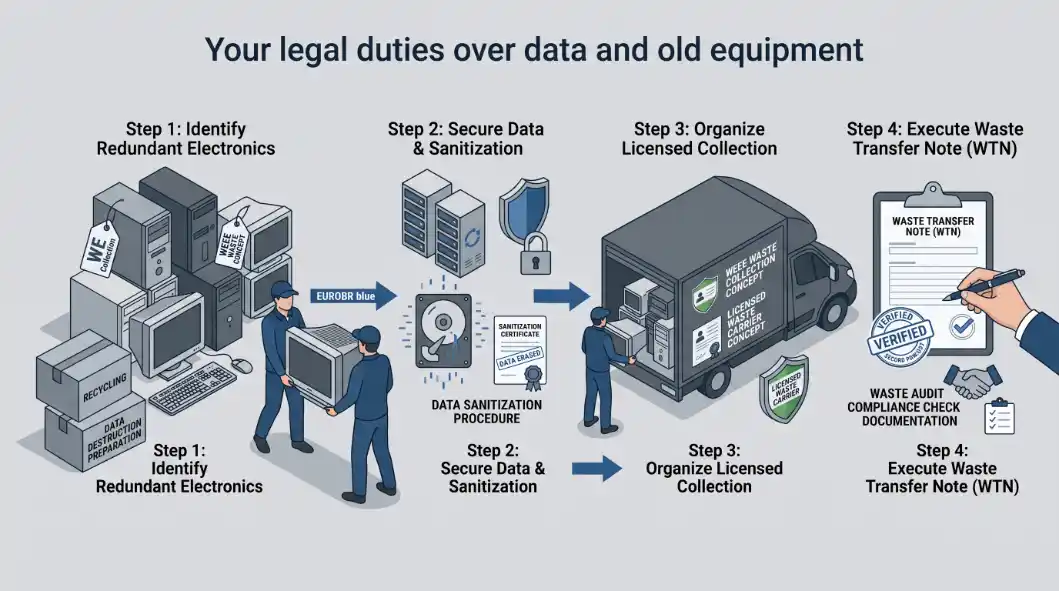
Three separate legal regimes apply when IT equipment leaves a building, and all three place the duty on the business rather than on the mover.
Business waste duty of care. GOV.UK requires a company to prevent, reuse, recycle or recover waste in that order, to sort and store it safely, to check that its waste carrier is registered, and to complete a waste transfer note for every load leaving the premises. Both parties keep a copy for two years and must produce it if the council or the Environment Agency asks. Upper tier waste carrier registration in England costs £191.02 for a new registration and £130.25 to renew every three years, and operating without one carries an unlimited fine.
WEEE. Electrical and electronic equipment becomes WEEE when the holder discards it, intends to discard it or is required to discard it. Equipment passed on for genuine reuse can stay outside the waste regime, but only if all six Environment Agency conditions are met: the previous holder’s actions must show an intention that the whole item is reused; the item must need no more than minor repair; that must be established before it leaves the premises; there must be evidence the repair will happen; there must be a real market for reuse; and it must not be transported or treated as though it were waste. Where equipment is prepared for reuse, records must be kept for each individual item showing the visual, safety and functionality checks carried out.
Data protection. The ICO expects documented secure disposal methods such as device wiping, degaussing or hardware shredding, secure storage with restricted access for equipment awaiting destruction, logs of location and content, third-party contracts including security measures and a right to audit, and a named member of staff checking destruction certificates against what was sent. Failing on these can engage articles 5 and 32 of the UK GDPR.
The practical rule for a move is that no device leaves the building without three things recorded: what it is, where it is going, and who signed for it.
How to check an IT relocation supplier before you sign
Business-to-business contracts do not carry the statutory consumer protections that domestic ones do, which makes the written scope and the evidence more important, not less. Six checks are worth insisting on.
- An on-site survey at both addresses, including the comms room, the goods lift and the loading bay. A quote given over the phone for an IT move is a guess.
- A written method statement covering the shutdown sequence, cable logging method, load order, reconnection plan and the testing checklist.
- A definition of “done”. Powered on, or tested and validated? This single line prevents most disputes.
- Goods in Transit and CMR limits in figures, plus the list of excluded categories in writing.
- Waste carrier registration if legacy equipment is being cleared. Search the company name on the Environment Agency’s public register of waste carriers. Ask separately and explicitly whether electrical equipment is handled directly or subcontracted, and who issues the evidence.
- A named coordinator and an escalation route. Firms in the British Association of Removers work to an Approved Code of Practice overseen by Chartered Trading Standards, which requires acknowledgement of a complaint within three working days and resolution within eight weeks, with unresolved disputes referred to the Furniture and Home Improvement Ombudsman.
Frequently asked questions
How far in advance should an IT relocation in London be planned?
Three months is the practical minimum for an office of 20 to 100 people, and longer where a comms room or a populated rack is involved. The constraint is rarely the supplier’s diary. Connectivity at the new site usually has the longest lead time of anything in the project, frequently longer than the removals booking, so circuits are ordered first and the moving weekend is chosen around the confirmed installation date. Goods lift diaries in managed London buildings fill weeks ahead and often restrict the hours a move may use them, and riser or comms room access needs its own approval with its own timescale. Parking bay suspensions need between three and fifteen working days’ notice depending on the borough. The pre-move audit itself takes days rather than hours in any environment with a real comms room, and it has to be finished before the shutdown sequence can be written. Working backwards from the lease dates is the reliable method, and the moving checklist sets out the same countdown for the administrative tasks.
Can an IT relocation be done overnight or over a weekend?
Yes, and for most London businesses it is the standard approach rather than an upgrade, because the premium for out-of-hours working is small next to the cost of a lost trading day. A typical sequence runs shutdown and packing on Friday evening after users have logged off, transport and unloading on Saturday, rack population and patching on Saturday evening, service startup and testing on Sunday, and normal working on Monday. Three approvals make it possible and all need arranging weeks ahead: written permission for out-of-hours access from both building managements, a booked goods lift at each end with the permitted hours confirmed, and security clearance for the crew where the building requires it. Some managed buildings prohibit moves outside set hours entirely, which is why the building rules are checked before the weekend is chosen. It is also worth agreeing that someone is on site on the first working morning, since problems surface when everyone logs in at once. Out-of-hours and weekend working is part of the scope described on the office and IT relocation service page.
Who is responsible for backing up data before a physical relocation?
The business is, and no removals or IT relocation supplier can take that responsibility on. A backup taken and verified before the shutdown is the only real protection against a hardware failure during transit, and verification matters more than the backup itself: a restore that has never been tested is an assumption, not a safeguard. The practical standard is a full backup completed before the shutdown window opens, with at least one copy held somewhere the move does not touch, whether that is a cloud service or media stored off site. It is worth confirming who holds encryption keys and recovery credentials, since the person who normally does may be occupied on the move weekend. Separately, every device leaving the building that holds personal data needs a documented chain of custody, because a lost laptop is a potential breach regardless of whether the data also exists elsewhere. The ICO’s records management expectations, covering documented disposal methods, secure interim storage and audit rights over third parties, set the standard the business is measured against, and the chain of custody sits inside the wider inventory described on the office and IT relocation service page.
What does an IT relocation cost in London?
IT relocation is quoted per project after a survey, because the price follows the configuration rather than the headcount, and no UK public authority publishes benchmark rates for this work. The largest labour item is usually the pre-move audit, which scales with comms room complexity: the number of patch panels, switch ports and distinct service dependencies drives it far more than the number of desks. Other significant factors are whether racks move loaded or are stripped first, access at both ends including goods lift weight limits and loading bay height restrictions, whether the work runs out of hours, the volume of legacy equipment being cleared, and how far the testing scope extends. Three London charges are fixed and should appear as separate lines: the ULEZ at £12.50 a day across all boroughs, the Congestion Charge at £18 a day in the central zone paid in advance or on the day, and any council parking bay suspension. Domestic hourly structures, which work on a different basis entirely, are set out in the guide to how much a man with a van costs in London.
What happens to old servers, PCs and monitors that are not moving?
They become regulated waste the moment the business discards them or decides to, and three duties apply at once. Under the business waste duty of care, the company must prevent, reuse, recycle or recover in that order, check its carrier is registered, and complete a waste transfer note for every load leaving the premises, with both parties keeping a copy for two years. Under the WEEE rules, electrical equipment can only stay outside the waste regime if it is passed on for genuine reuse and all six Environment Agency conditions are met, including that it needs no more than minor repair, that this is established before it leaves the premises, that a real market for reuse exists and that it is not transported as though it were waste. Records of the visual, safety and functionality checks must be kept per item. Under data protection law, the ICO expects documented destruction methods, secure storage with restricted access while equipment awaits destruction, contracts with audit rights and destruction certificates checked against what was sent. Licensed disposal of redundant items is part of the office and IT relocation service scope.
Is IT equipment insured while it is being moved?
It is covered by the mover’s Goods in Transit insurance while it is being carried in the vehicle, but the limit is what decides whether that cover is meaningful for an IT load. Value density in IT relocation is extreme, and a single populated rack can be worth more than the entire contents of a fifty-desk office, so a per-load ceiling that is comfortable for furniture may be inadequate here. Ask for the figure in writing rather than accepting the phrase “fully insured”, and ask which categories are excluded, since screens and specialist equipment commonly sit outside standard cover unless declared and priced separately. There is a third point specific to technology: physical damage cover is not business interruption cover. If the real exposure is the cost of being unable to trade for two days rather than the cost of replacing a switch, that risk belongs to the company’s own commercial policy and should be reviewed before the move. For cross-border road transport a separate regime applies, explained on the CMR regulations page.
How is the network reconnected exactly as it was at the old site?
By recording it before anything is unplugged, not by reconstructing it afterwards. The pre-move audit maps which switch port serves which desk and which patch panel position serves which port, photographs the patching as well as documenting it, records rack elevations with rail types and power distribution, and captures anything with a fixed configuration such as static addresses, licence keys tied to hardware, dongles and settings bound to a MAC address or a physical port. Both ends of every cable are labelled before disconnection, and cables travel with the device or rack position they belong to rather than in a common box. Reconnection then rebuilds the recorded state: racks populated to the noted elevation, patching restored to the port map, and power brought up in the dependency order rather than all at once. Testing follows as a checklist with a named owner, ending with a written snag list handed over before the crew stands down. Cabling logged for a clean reconnection is part of the commercial scope described on the office and IT relocation service page.
Keeping the business running through your London IT move
The hardware is the easy part. What decides whether Monday works is the audit that was done before anything was unplugged, the access that was booked weeks earlier, and a written definition of what “finished” means that both sides agreed before the vehicle arrived.
EUROBR has been moving London businesses and households since 2013, carries Goods in Transit and CMR insurance, holds waste carrier registration with the Environment Agency and holds a 5.0 Google rating. Commercial work across Greater London and the M25 covers server, network and communications handling with cabling logged for reconnection, crate hire, labelling and inventory management, desk and partition dismantling and reassembly, secure handling of confidential documents, licensed disposal of old furniture, and out-of-hours and weekend moves with a dedicated coordinator and building access, security and parking arranged. The wider office move is covered in the companion guide to office removals in London, and packing services and materials and furniture assembly and delivery can be added to the same project.
Request a free, no-obligation IT relocation quote from EUROBR’s insured team. Message on WhatsApp at +44 7878 921856 or contact the office online with your device count, whether racks are moving loaded, both addresses and your target weekend, and the team will arrange a survey and give you an itemised price.