

Student removals in London are small, fast, van-based moves built around the academic calendar: halls to a shared house, a shared house to a new flat, or a room’s worth of boxes into storage for the summer.
A one-room student move in London is usually done in a single van in two to four hours, and the price is driven by van size, crew size, floor level, distance and access rather than by the number of boxes alone. As of 2026, a non-compliant van pays £12.50 a day for the Ultra Low Emission Zone and £18 a day for the central London Congestion Charge, so ask whether those charges sit inside your quote or on top of it. Book two to three weeks ahead for September and June, when every mover in London is busy.
Introduction
Student removals in London are their own category of move, and treating them like a scaled-down house removal is how people end up paying twice. The volume is small, but the constraints are unusual: fixed hall check-in and check-out windows, tight loading bays shared by dozens of arrivals on the same weekend, lifts with a booking sheet, staircases in Victorian conversions, and a budget that has already been stretched by rent. London also charges vans to enter parts of the city, which quietly adds to a price that looked simple over the phone. This guide covers what a student removal includes, what it costs in 2026, when to book, how to handle parking and access, and how to check the company turning up is insured and real.
What student removals in London actually cover
A student removal is a small-volume house move handled by a van and a crew, typically covering one room of belongings between a hall of residence, a shared house, a studio flat or a storage unit. It is closer to a man and van service than to a full household removal, but the good operators treat it with the same paperwork: an inventory, transit insurance, and a written price agreed before the van is loaded.
What makes a student move different from a standard removal
Three things separate a student move from a family house move, and each one changes the price and the plan.
- The calendar is fixed and shared. Halls publish arrival and departure windows, so thousands of students in the same borough move on the same two or three days. Availability, not volume, becomes the constraint.
- The access is worse than the volume suggests. A single room in a fourth-floor conversion with no lift takes longer to clear than a two-bedroom ground-floor flat. Crews price on carry distance and stairs, not on box count.
- The items are awkward rather than heavy. Bikes, desk chairs, mini fridges, monitors, musical instruments and a term’s worth of books arrive as loose, oddly shaped objects that need wrapping before they travel.
The consequence of ignoring this is predictable: a van booked on volume alone arrives too small, or a two-hour slot booked on optimism runs into the next student’s check-in window.
Which parts of London student moves usually involve
Student housing in London clusters around the campuses and the transport lines that feed them, and the practical problems change with the postcode. Central sites around Bloomsbury, Holborn and the South Bank sit inside or beside the Congestion Charge zone, which adds a daily charge to the van. South and west London student areas such as Wandsworth, Wimbledon and Kingston are mostly outside it but bring controlled parking zones and narrow residential streets instead. If you are moving into one of those boroughs, the borough guides for Wandsworth, Wimbledon and Kingston upon Thames set out the local parking rules in detail. The EUROBR crew covers Greater London and the whole area inside the M25, so a hall in Zone 1 and a house share in Zone 4 are the same job.
How big the student market in London really is
The scale explains why September and June are so difficult to book. There were 2,863,180 students at UK higher education providers in 2024/25, of whom about 685,570 came from outside the UK, according to Universities UK’s analysis of the HESA student record published in 2026. London holds the largest single concentration of those students in the country. When a significant share of them changes address inside a two-week window, van availability disappears before the prices move.
How much do student removals in London cost?
A student removal in London is priced on the van and the crew, not on the room. The two common structures are an hourly rate with a minimum booking, and a fixed price agreed after the company has seen a list or a video of what is moving. Neither is automatically cheaper; the fixed price protects you when access is bad, and the hourly rate protects you when the job is genuinely small and the route is clear.
What actually drives the price
The variables below are the ones that move a quote up or down, in rough order of impact.
| Price driver | Why it matters | What to tell the company |
| Van size and crew size | A larger van with two crew clears a fourth-floor room far faster than one person with a small van | Room size, number of boxes, largest single item |
| Floor level and lift access | Stairs multiply carry time; a booked lift removes most of it | Floor number, whether there is a lift, whether it can be booked |
| Carry distance to the van | Fifty metres from door to kerb adds up over sixty trips | Where the van can legally stop |
| Distance and route | Crossing central London in the charging hours costs money and time | Both full postcodes |
| Time of year and day | The September and June peaks and Friday afternoons are the busiest slots | Your date, and whether you can flex by a day |
| Packing and materials | Buying boxes late and packing badly is what causes overruns | Whether you want materials, part packing or full packing |
| Dismantling and reassembly | Bed frames and desks that will not fit through a door have to come apart | Any flat-pack furniture travelling with you |
For a sense of the wider market, average UK removal costs recorded in November 2025 by reallymoving and published by the HomeOwners Alliance started at around £432 for a one-bedroom property. A single student room is smaller than that, so it usually sits below the figure, but London access and London charges push it back up. EUROBR does not publish a flat student rate, because a room in a lift-served block and a room at the top of a Victorian terrace are not the same job. The London man and van cost guide explains how hourly and fixed pricing compare in practice.
Choosing the right van size
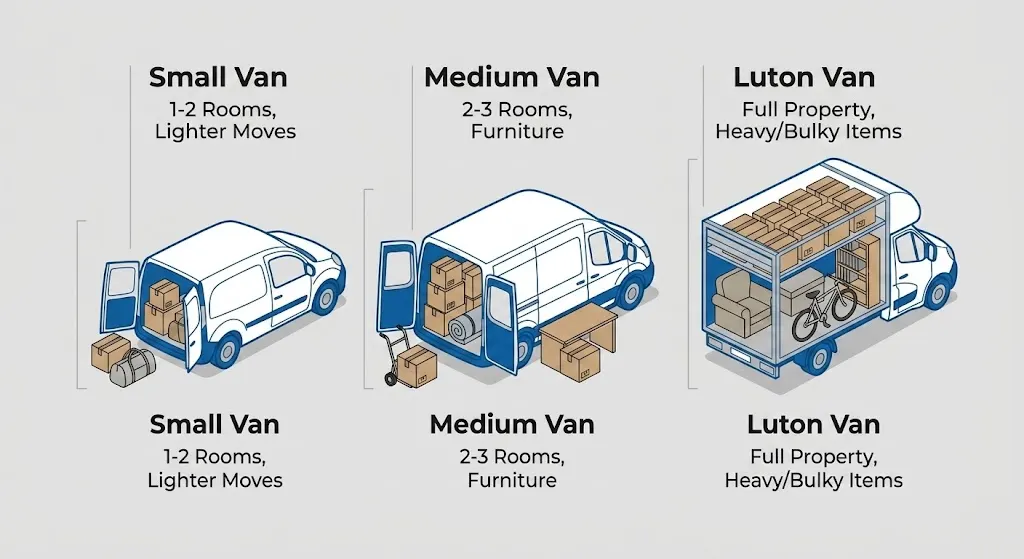
Booking a van that is too small is the single most expensive mistake in a student move, because the fix is a second trip charged at the same rate. Use the volume of the room, not the number of bags.
| Van type | Typical student load | Works for |
| Small van | Around 10 to 15 boxes, a suitcase, bedding, a monitor | A hall room with no furniture of your own |
| Medium or SWB Luton | A full room including a desk, chair, bike and small fridge | A studio or a room in a shared house with your own furniture |
| Large or LWB Luton | A room plus a double bed, wardrobe, sofa or several bikes | A house share where you own most of the contents |
If you are unsure, describe the largest three items and the total box count when you request the quote. The crew will size the van from that, and a packing box size guide helps you estimate the count before you have packed a thing.
Hidden charges to check before you book: ULEZ and the Congestion Charge
Two London road charges apply to removal vans, and whether they appear on your invoice depends entirely on how the company quotes. Ask directly.
- ULEZ, the Ultra Low Emission Zone, is a daily charge for vehicles that do not meet the zone’s emissions standards. It is £12.50 a day for vans up to 3.5 tonnes, it covers every London borough, and it runs 24 hours a day, every day except 25 December, according to Transport for London in 2026. A compliant van pays nothing, which is why the age of the fleet matters.
- The Congestion Charge applies only inside the central London zone. It is £18 a day when paid in advance or on the day of travel, and it operates 07:00 to 18:00 Monday to Friday and 12:00 to 18:00 at weekends and on bank holidays, per Transport for London in 2026.
A move from a Bloomsbury hall to a house in Zone 3 can therefore attract the Congestion Charge on one end and nothing on the other. In 12 years of moving London households, the EUROBR team finds the quotes that go wrong are almost never the ones that mention these charges up front; they are the ones that never mentioned them at all.
When should you book your student move?
Book two to three weeks ahead for an ordinary week, and four to six weeks ahead if your date falls in the September arrivals window or the June and July departures window. Those two periods absorb most of the student moves in London, and small vans sell out before large ones.
The three pinch points in the academic year
- Mid to late September. Arrivals weekends at halls across London are concentrated into a handful of days, and the loading bays outside large blocks are managed with time slots.
- Late June and July. Tenancies in the private student market commonly end together, so departures stack up alongside end of tenancy moves from the wider rental market.
- The January changeover. Smaller than the other two, but it collides with post-holiday staffing and with fewer vans on the road.
How far ahead to book, step by step
- Six weeks out: confirm your check-in or check-out window in writing with the hall or the letting agent, including the earliest hour you can access the building.
- Four weeks out: request quotes with both postcodes, floor levels, lift availability and a list of the largest items. Compare on what is included, not on the headline hourly rate.
- Three weeks out: book, and ask the company to arrange any parking suspension that the street needs, because most London councils want five to fifteen working days’ notice.
- Two weeks out: order boxes and materials. Late orders are why people pack in bin bags, and bin bags are why things break.
- One week out: book the lift if the building has a booking sheet, and confirm the arrival window with the crew.
- The day before: finish packing. Anything unpacked when the van arrives is charged in time.
The general moving checklist covers the admin that sits alongside this, from address changes to meter readings in a private tenancy.
Parking and access at halls and shared houses
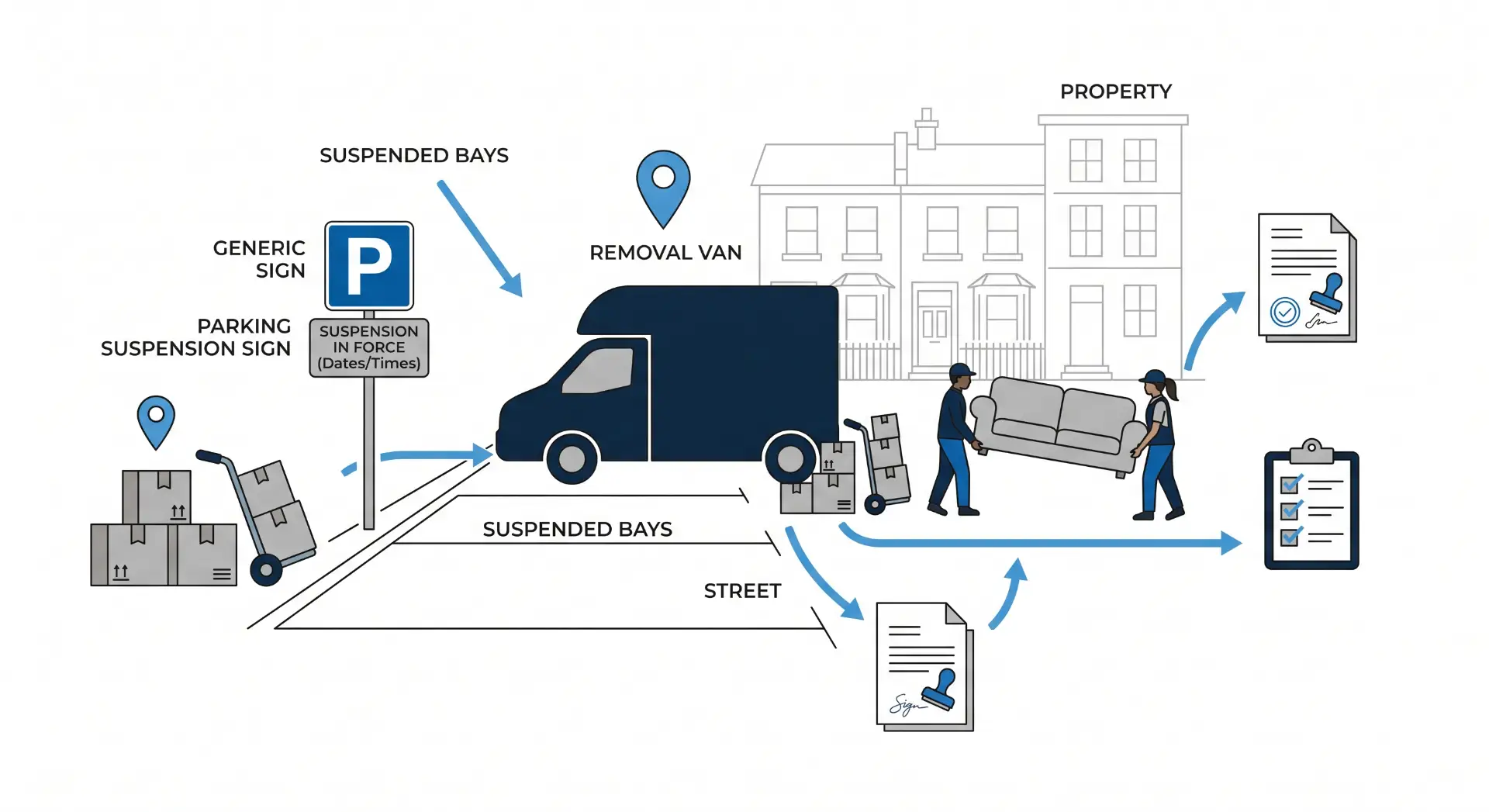
Access is the biggest single cause of delay on a London student move, and it is the part you can fix in advance for very little money. The question is always the same: where can a 3.5 tonne van legally stop, and how far is that from the door?
Loading bays, permits and parking suspensions
A parking suspension is a temporary reservation of controlled parking bays outside an address, arranged through the local council. It matters because on many London streets a removal van has nowhere legal to stop, and without one the crew carries your belongings a long distance or the driver risks a penalty charge notice. In practice most councils need five to fifteen working days’ notice and charge both an administration fee and a daily rate per bay, so it has to be booked well before the date. The parking suspension guide for moving in London sets out how the applications work borough by borough.
Purpose-built student blocks usually have their own loading bay with a time limit, often 30 to 60 minutes, managed by reception. That is generous for a small load and tight for a large one, so tell the crew the limit before they arrive. On red routes and yellow lines the rules are different again, and the Highway Code guidance on waiting and parking explains where loading is and is not permitted.
Lifts, stairs and narrow corridors
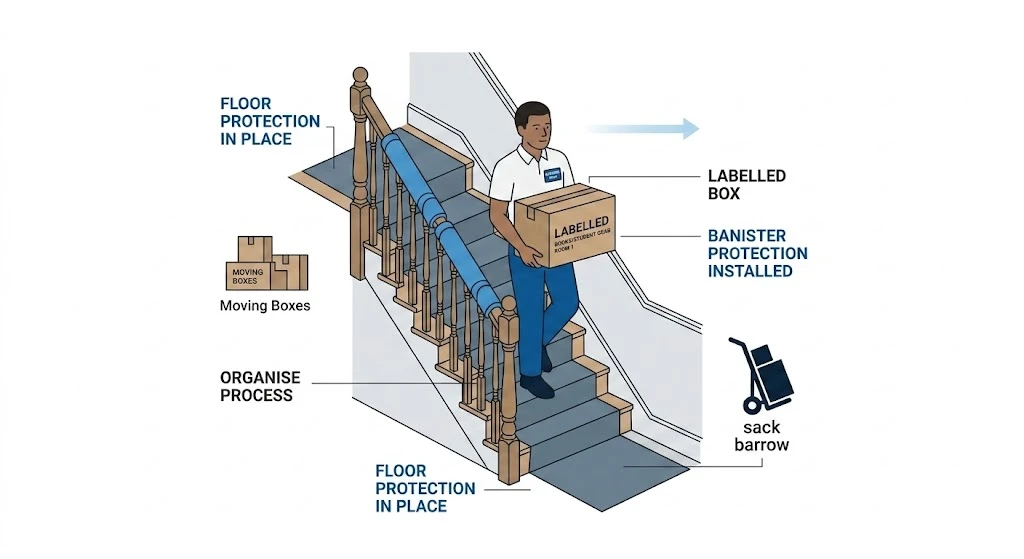
Ask the building three questions before moving day: can the lift be booked, does it need protective covers, and what is the out-of-hours access policy. Many managed blocks require the lift to be reserved and will not allow moves before or after set hours. If there is no lift, measure the tightest turn on the staircase and check your largest item against it, because a desk that came in flat-packed will very likely have to leave the same way. Furniture dismantling and reassembly exists precisely for that moment, and booking it in advance is far cheaper than discovering the problem with a loaded van outside.
Communal areas are the other exposure. Damage to a shared hallway, lift or carpet is usually charged back to the tenant who caused it, so a crew that brings floor protection and door guards is protecting your deposit as well as your belongings.
Packing for halls of residence and studio flats
Pack for a small space and a short carry: fewer, smaller, heavier-walled boxes beat a handful of enormous ones that nobody can lift up four flights. Aim to have everything sealed and labelled before the van arrives, because loading a packed room is quick and loading an unpacked one is not.
What to pack and what to leave behind
- Pack tightly by category, not by drawer. Books in small double-wall boxes, clothes in wardrobe boxes or vacuum bags, kitchen items wrapped individually in packing paper.
- Label on the side, not the top. Boxes get stacked, and a label on the lid is invisible in a loaded van.
- Keep a first-night bag with you. Bedding, charger, medication, documents, a towel and the keys. It should never go in the van.
- Photograph the back of your monitor and any cabling before you disconnect it. Reconnecting at midnight in a new room is not the moment to work it out.
- Be honest about what you will not use again. Moving a broken desk fan across London costs more than the fan.
EUROBR supplies boxes, wrapping and packing materials including small, medium, large, heavy-duty, wardrobe and specialist picture or television boxes, and offers full packing, part packing or materials only. Part packing, where the crew handles only the fragile and awkward items, is usually the sensible middle option for a student budget.
Prohibited items and waste
Removal firms will not carry certain items, and the list is longer than most people expect: petrol, gas canisters including camping gas, paint, aerosols in quantity, fireworks, and perishable food. Plants and open liquids are usually refused as well. Ask before you pack rather than on the day.
Waste is the other half of the problem. Clearing a room generally produces a pile of things nobody wants, and leaving it in a communal area is how tenants lose money from a deposit. Anyone carrying waste for a business must be registered with the Environment Agency, and you can check a company on the public register of waste carriers, brokers and dealers. EUROBR is a licensed waste carrier registered with the Environment Agency, which is the qualification that separates a legitimate operator from a van that fly-tips your old mattress on a side street and leaves your name on the paperwork.
Storage between tenancies
Short-term storage bridges the gap when your tenancy ends before the next one starts, which is the norm for students leaving in June and returning in September. EUROBR offers short-term storage between moving dates as part of its house and flat removals service, so a single collection can go into storage and come out to a new address without a second full move.
Three practical points decide whether storage is worth it. First, compare the storage cost against the cost of two separate moves, because a single collection into storage and one delivery out is often cheaper than moving twice. Second, inventory everything before it goes in, with photographs, so any dispute later has evidence behind it. Third, check what your own contents insurance covers while goods are stored, since transit cover and storage cover are not the same thing. For students going home overseas for the summer rather than staying in the UK, the international side of the business handles removals to Europe, Portugal and Brazil as a road or sea shipment instead.
How to check a student removals company is legitimate
Check three things before you pay a deposit: insurance, licensing and a written price. The student market attracts informal operators precisely because the jobs are small, the customers are young and the bookings are made quickly.
The checks that matter
- Goods in Transit insurance. This covers your belongings while they are in the van. Ask for the policy limit per load, not just a yes. EUROBR carries Goods in Transit and CMR cover, CMR being the international convention that governs liability for goods carried by road across borders, explained in full on the CMR regulations page.
- Public liability insurance. This covers damage to the building rather than to your things, which is what matters in a communal hallway.
- Environment Agency waste carrier registration, if anything is being taken away for disposal. Verify it on the public register rather than taking a screenshot on trust.
- A written, itemised quote that states whether ULEZ, the Congestion Charge, materials, dismantling and waiting time are included.
- A real trading address and a real review history. EUROBR has operated from Croydon since 2013 and holds a 5.0 Google rating.
If a job goes wrong, Citizens Advice sets out your rights when a service is not carried out properly, and the British Association of Removers publishes the trade standards the established firms work to. The common mistakes when moving house guide covers the rest of the traps.
Frequently asked questions about student removals in London
How much do student removals in London cost in 2026?
The cost of a student removal in London depends on van size, crew size, floor level, access and distance rather than on a fixed student rate. A single room moving a short distance with lift access at both ends sits at the low end of the market, while the same room on a fourth floor with no lift and a long carry to the van costs considerably more, because crews price on time and difficulty. For context, average UK removal costs recorded in November 2025 and published by the HomeOwners Alliance began at around £432 for a one-bedroom property, and a student room is usually smaller than that. Two London-specific charges can sit on top: the Ultra Low Emission Zone at £12.50 a day for non-compliant vans, and the central London Congestion Charge at £18 a day, both as of 2026. Materials, dismantling, waiting time and any parking suspension are the other variables. The reliable way to compare offers is to ask each company for an itemised written quote covering all of those items, as explained in the London man and van cost guide.
How far in advance should a student book a removal van in London?
Two to three weeks is enough for an ordinary week, and four to six weeks is realistic for the September arrivals period and the late June and July departures period, when student moves across London concentrate into a small number of days. Availability disappears before prices rise, and small vans usually sell out first because most student loads need one. The booking window is also constrained by the parking application: most London councils require five to fifteen working days’ notice for a parking bay suspension, and some charge more for short-notice requests, so the parking timetable often sets the earliest realistic date rather than the van. Halls and managed blocks add a third constraint, since many require a lift booking or a loading bay slot arranged with reception in advance. Booking early also leaves time to order materials, because late box orders are the usual reason a room is still unpacked when the van arrives. The moving checklist sets out a workable sequence.
What size van is needed for a student move?
Van size is decided by the volume of the room and the largest single item, not by the number of bags. A hall room with no furniture of your own, typically 10 to 15 boxes plus bedding, a suitcase and a monitor, fits a small van. A studio or a room in a shared house where you own a desk, a chair, a bike and a small fridge generally needs a medium van or a short-wheelbase Luton. A room that includes a double bed, a wardrobe, a sofa or several bikes needs a long-wheelbase Luton. Underestimating is expensive, because the remedy is a second trip charged at the same rate, and in peak season a second trip may not be available the same day. The practical method is to count boxes using a packing box size guide, then list the three largest items separately and give both figures to the company when requesting a quote.
Do students have to pay the ULEZ and Congestion Charge for a removal van?
Whether these charges reach the customer depends on the vehicle and the route, not on the customer’s status, and there is no student exemption. The Ultra Low Emission Zone charge is £12.50 a day for vans up to 3.5 tonnes that do not meet the zone’s emissions standards, applies across every London borough and runs 24 hours a day every day except 25 December, according to Transport for London in 2026. A van that meets the standards pays nothing, so a company operating a modern fleet does not pass on a charge it never incurred. The Congestion Charge is separate: £18 a day when paid in advance or on the day of travel, applying only within the central London zone between 07:00 and 18:00 on weekdays and 12:00 to 18:00 at weekends and bank holidays, also per Transport for London in 2026. A move from a central hall to an outer borough can therefore attract the Congestion Charge at one end only. Ask whether both are inside the quoted price, and see the parking and access information for the related street costs.
Can a removal company move a single item or just a few boxes?
Yes, and small jobs are a normal part of London van work rather than an exception. A single bed frame, a sofa collected from a marketplace seller, a bike, or fifteen boxes from a hall room are all viable bookings, though nearly every company applies a minimum charge covering a set number of hours or a fixed call-out, because the van and crew still have to travel. That minimum is the figure to compare between quotes for very small loads, since the hourly rate on its own is misleading. Combining jobs helps: collecting a desk on the way to the new address usually costs less than two separate bookings. Items that need dismantling to leave a room, or that will not fit a staircase assembled, should be flagged when booking so the crew brings tools and allows time. The man and van service page describes how small jobs are quoted and scheduled.
What can students not put in a removal van?
Removal companies refuse a defined list of items for safety and insurance reasons, and the list applies regardless of load size. Fuels and flammables are the main category: petrol, diesel in containers, camping gas and other gas canisters, paint, solvents, and aerosols in quantity. Fireworks and any explosive are refused outright. Perishable food, open liquids and, in most cases, live plants are also declined, because leaks and spoilage damage other customers’ goods and are not covered by transit insurance. Illegal items and firearms without proper documentation are obviously excluded. Anything of exceptional value, such as passports, cash, jewellery or original documents, should travel with you rather than in the van, since standard Goods in Transit cover is not designed for it. Waste is a separate matter: it can only be carried by a company registered with the Environment Agency, which can be verified on the public register of waste carriers, brokers and dealers before anything is handed over. The common mistakes when moving house guide lists the items people try to pack anyway.
Ready to book your London student move?
The student moves that go well are the ones booked early, sized honestly and packed before the van arrives. Everything else on moving day is logistics, and logistics is what a professional crew is for.
EUROBR has been moving London households and students since 2013, works across Greater London and the whole area inside the M25, and is fully insured for Goods in Transit and CMR as well as being a licensed waste carrier registered with the Environment Agency. The team is English and Portuguese speaking, which matters to a large share of London’s international student population. Tell the crew your two postcodes, your floor levels, your date and your three largest items, and you will get an itemised price rather than an estimate that grows on the day.
Get a free, no-obligation quote from EUROBR’s insured team, message on WhatsApp at +44 7878 921856, or request a price online.